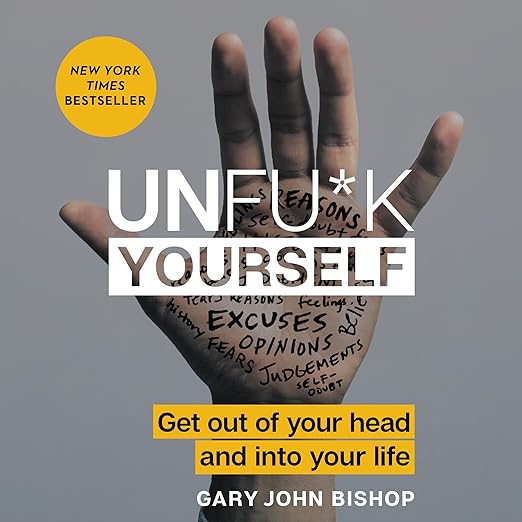
Gary John Bishop's prose style in Unfu*k Yourself operates the way good coaching does: it refuses to let you stay comfortable in your story. This audiobook, narrated by Bishop himself in just over three hours, is built around seven assertions that function less as affirmations and more as behavioral contracts, statements about what you are willing to do, wired to do, and committed to doing regardless of whether the conditions are ideal. Bishop, who built this framework through years of transformational coaching and seminars, brings a voice to the recording that makes the difference between a book that sits on a shelf and one that actually lands.
Seven Behavioral Contracts Instead of Affirmations
The structure here is deceptively simple. Seven chapters, seven assertions: I am willing. I am wired to win. I got this. I embrace the uncertainty. I am not my thoughts; I am what I do. I am relentless. I expect nothing and accept everything. Each assertion gets a chapter of unpacking, where Bishop identifies the particular flavor of self-sabotage the assertion is designed to cut through. The method is less analytical than prescriptive, and that is both its strength and its limit. Bishop is not interested in helping you understand why you behave the way you do. He is interested in getting you to behave differently starting now.
Reviewer A. Techmeier, who met Bishop at a seminar in 2012, described him as a person willing to say whatever needs to be said so that people own their power and take on life. That character comes through on the recording. Bishop does not soften difficult truths about self-deception or motivational inertia. When he addresses the reader's tendency to wait for perfect circumstances, his Scottish directness makes the argument land harder than it would in a more polished delivery. The book's New York Times bestseller status and the strong reviews it has accumulated reflect a readership that was ready for this particular kind of confrontation.
Bishop's Scottish Directness Suits Three Hours
Self-narration is not always an asset in self-help, but here it is essential. Bishop's voice carries the accent and cadence of a man who has had these exact conversations with real people in real rooms, and that quality cannot be replicated by even a skilled professional narrator. Reviewer Amazon Customer noted that the material feels achievable and real, and credited the audiobook with prompting immediate action after the first few listens. That is the specific promise of the format: a voice in your ear that does not allow the convenient retreat into theoretical understanding that reading sometimes permits.
The three-hour and twenty-four-minute runtime also matters. This is not a book that benefits from being stretched across weeks. Bishop's seven assertions are designed to accumulate, and the full arc from the opening provocation to the final acceptance of uncertainty lands differently in two or three sessions than it does when the arguments lose their momentum across fragmented listening. Reviewer Daniel noted that he immediately moved on to Bishop's next book, which suggests the format builds toward action in exactly the way it intends to.
The assertion I am not my thoughts; I am what I do is worth dwelling on as a piece of audio content specifically. Bishop delivers it as an axiom rather than an argument, and in the context of a book that is all about the gap between internal narrative and external behavior, hearing that principle stated out loud by the person who built a coaching practice around it carries weight that a sentence on a page does not automatically generate. The audio format makes the behavioral contract feel less abstract, more like a direct instruction from someone in the same room.
Brevity Skips the Philosophical Tradition Behind It
The book's brevity is a feature, but it also means the framework is light on nuance. Bishop's argument that you are not your thoughts, you are what you do is one of the more useful reframes in the book and sits within a substantial philosophical tradition. But he does not engage that tradition; he asserts the position and moves on. Listeners who want the intellectual context for these ideas, the cognitive behavioral research, the stoic philosophy, the Buddhist psychology that underwrites them, will need to go elsewhere. This is a book that operates at the level of lived experience and practical instruction, not theoretical analysis.
The confrontational tone is also not for everyone. Bishop names specific patterns of self-deception with a bluntness that some listeners find liberating and others find alienating. If you already have a sophisticated relationship with your own psychology and find aggressive coaching counterproductive, the book may feel like it is solving a problem you have already moved past. It is most powerful for listeners who are stuck in a recognizable way and need permission, and a shove, to start moving.
For People Who Know What to Do
This audiobook is well-suited for people who have consumed enough self-help to know what they need to do and keep finding reasons not to do it. The seven-assertion structure gives you a concrete vocabulary for identifying the specific form of resistance that is operating in any given situation. It is also a strong choice for listeners who respond better to directness than to compassion, or who have found softer approaches leave them feeling understood but unchanged.
Skip it if you are looking for research-backed behavioral science or sustained philosophical argument. Skip it also if you need a longer, more nuanced treatment of the same territory. Bishop's book earns its effect through compression and momentum rather than depth, and that is a legitimate and often useful approach, but only if you engage with it on those terms.
- Voice: Gary John Bishop narrates his own work, and his Scottish accent lends an unexpected authority to a book that depends entirely on the credibility of its voice. The delivery is direct, urgent, and unsentimental.
- Big ideas: self-imposed limitation, action over identity, relentless forward motion
- Atmosphere: Blunt and energetic, with no patience for excuses
- Worth it?: Bishop's seven assertions offer a structured framework for people who are done diagnosing the problem and ready to move, but only the self-narration makes the book feel like it could actually work.
Good to Know
Does Gary John Bishop's self-narration add enough to the audiobook to justify choosing it over the print edition?
Yes, substantially. Bishop's Scottish accent and direct coaching voice give the seven assertions a presence that print cannot replicate. Several reviewers specifically described the audiobook as the format that prompted immediate action in ways the text alone might not.
Is this audiobook suitable for repeated listening, or is it a one-time experience?
The seven-assertion structure makes it well-suited for return visits, particularly when facing a specific form of resistance. Many self-help listeners use Bishop's format as a reset mechanism, returning to particular chapters when they notice familiar patterns of avoidance.
At just over three hours, does the Unfu*k Yourself audiobook cover enough ground to be useful, or does the brevity feel like a limitation?
The brevity is deliberate and appropriate to the method. Bishop's approach relies on momentum and compression; a longer book would dilute the effect. Listeners looking for a more sustained treatment of the same ideas may want to follow up with Bishop's other titles in the series.