Quick Take
- Narration: Brett Barry reads with an unhurried warmth that suits Brennan’s meditative prose, never pushy, always present.
- Themes: Wild food systems, environmental philosophy, slow living
- Mood: Reflective and earthy, like a long walk through an overgrown orchard
- Verdict: If you care about where your food comes from and have any interest in cider culture, this one earns its length.
I came to Uncultivated on a rainy October afternoon, the kind where staying indoors feels less like a choice and more like the weather making the decision for you. I had a glass of farmhouse cider on the table and no particular plan for the next three hours. By the time I surfaced, I had listened to nearly half the book and that cider tasted different, richer somehow, more complicated. That is the effect Andy Brennan produces: he recontextualizes ordinary things until they carry weight you did not know they had.
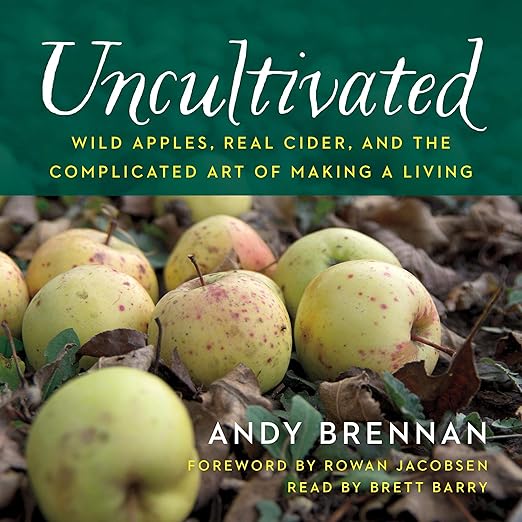
Brennan is the founder of Aaron Burr Cidery in upstate New York, and his subject is the wild apple, those pippin trees that once covered the American agricultural landscape and have since nearly vanished, casualties of conventional farming’s preference for uniformity and control. But this is not really a book about apples. It is a book about the costs of always intervening, always optimizing, always choosing predictability over complexity. Brennan uses the apple as a vehicle to argue something much larger about our relationship to the natural world.
Our Take on Uncultivated
Brennan writes in what one reviewer aptly called candid and at times philosophical prose. That description is accurate and also slightly undersells it. He is not academic or preachy. The writing is accessible and often funny, he describes himself as essentially a glorified canner and dishwasher, which is the kind of self-deprecating honesty that immediately signals you are in trustworthy hands. He is a rigorous observer and an honest narrator of his own failures as much as his discoveries.
The comparison drawn by one listener to Wendell Berry is earned. There is the same respect for tradition, the same suspicion of industrial solutions, the same belief that the local and the particular matter more than the scalable and the efficient. But Brennan has his own voice, rooted specifically in the apple and in the experience of building a small, ecologically grounded business from scratch.
Why Listen to Uncultivated
The audiobook format works exceptionally well here. Brett Barry’s narration has a settled, conversational quality that mirrors the book’s rhythm. This is not a text that rewards rushing. Barry reads like someone who has actually thought about the sentences before speaking them, and there is a pleasurable deliberateness in the pacing that feels appropriate for a book arguing against the relentless drive toward efficiency.
The material Brennan covers spans art history, geologic history, American agricultural policy, and personal memoir, but never feels scattered. The spine of the book is always his relationship with wild trees, his decades of working with naturalized apples that nobody planted and nobody tends, and what those trees have taught him about patience, diversity, and humility. It is a genuinely unusual piece of writing: part how-to, part manifesto, part love letter to a nearly extinct agricultural tradition.
What to Watch For in Uncultivated
Listeners who come expecting a straightforward cider-making guide will need to recalibrate quickly. The practical information is present, but it is woven into a broader argument about what real cider is, where it comes from, and why the commercially made product bearing the same name is essentially a different substance. Brennan is precise about this distinction without being insufferable about it, which is a difficult balance to maintain.
There are moments where the philosophical tangents grow quite long, and listeners with a more pragmatic orientation may find themselves impatient for Brennan to return to the orchard. That said, those tangents tend to land eventually. He circles back. The patience required of the reader is, in a sense, the book’s argument made experiential.
Who Should Listen to Uncultivated
This is for readers who already love food writing with real intellectual ambition, people who have read Michael Pollan and want something even more personal and specific. It is for anyone with an apple tree in their backyard, anyone curious about fermenting traditions, or anyone who finds themselves tired of the conventional agricultural model and wants a fully articulated alternative vision. Skip it if you need neat chapter structures and clear takeaways. This book asks you to wander with it.
Frequently Asked Questions
Do I need prior knowledge of cider-making to appreciate Uncultivated?
Not at all. Brennan assumes no technical background. The book is more philosophical memoir than how-to guide, and it works best if you approach it as a meditation on nature and food culture rather than an instruction manual.
Is the narration by Brett Barry a good match for Brennan’s writing style?
Yes. Barry reads with a calm, unhurried delivery that matches the book’s pace perfectly. He treats the reflective passages with the same care as the practical ones, which matters given how much of the book operates in that meditative register.
Is this book critical of the conventional cider industry, and does it feel polemical?
It is definitely critical, but Brennan avoids the self-righteous tone that sinks many sustainability-themed books. He is honest about his own struggles building a viable business from wild apples, which keeps the argument grounded and credible.
A PDF companion is mentioned, does it add meaningful content for audio listeners?
The PDF contains supplementary materials and illustrations that support some of the descriptions in the text. It is worth downloading if you have an Audible account, though the audio stands completely on its own without it.