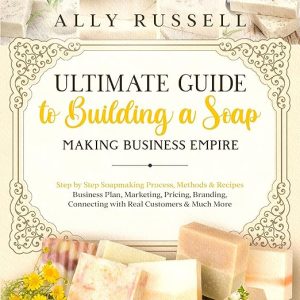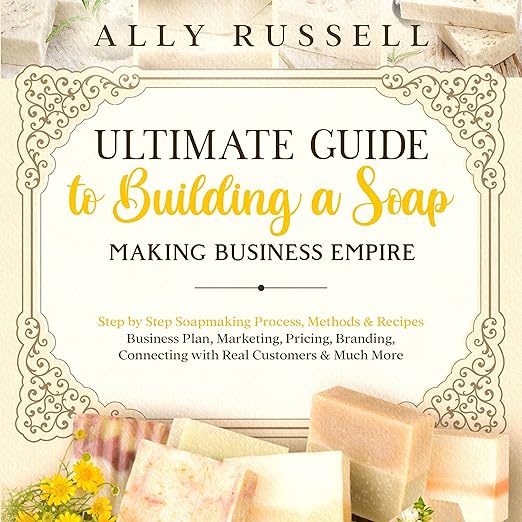
Ally Russell opens her audiobook with a question she is genuinely qualified to answer: do you love creating things with your hands, and have you wondered whether that love could pay its own way? The setup is disarmingly direct, and Ultimate Guide to Building a Soap Making Business Empire earns that directness across every chapter that follows. Russell is a practicing soap maker who has navigated the messy early stages, the learning curve of lye safety, the frustration of batches that seized, and the steeper challenge of figuring out how to actually sell what she made. Her book is structured around that dual experience. She does not separate the craft from the commerce, and that decision makes the audiobook more useful than most guides in this niche, which tend to choose one or the other.
The audiobook runs just over four hours and nineteen minutes, which is proportionate for a book of this practical ambition. Narrator Celia Rivera handles Russell's conversational register with care, keeping the instructional passages clear without stripping out the warmth that multiple reviewers noted about the source text. One reviewer described Russell's writing as having a "friendly tone" that makes even the nitty-gritty feel approachable. That quality translates well to audio, and Rivera sustains it across both the technical first half and the more business-oriented second half, which require different registers from a narrator committed to carrying the listener through both.
Four Soap-Making Methods Before the Business Half
The book divides cleanly into two parts: technique and business. Part one covers everything from setting up a safe workspace to understanding the chemistry of oils, from reaching trace in cold-process soap to troubleshooting a batch that seized unexpectedly. Russell walks through four distinct soap-making methods, explaining the benefits of each rather than declaring one superior, which is a more honest approach than most entry-level guides manage. She includes a detailed discussion of oils categorized by their specific properties: moisturizing, lather, conditioning, and hardness. That framework is genuinely useful for listeners who want to develop their own recipes rather than follow someone else's indefinitely, and it is the kind of underlying knowledge that separates long-term soap makers from those who plateau quickly.
Part two is where the book separates itself from the craft-only guides that fill this niche. Russell covers branding, marketing through Facebook, Instagram, and Google ads, pricing strategy, startup cost projection, LLC formation, and how to take payments both online and in person. For creative people who find the business side intimidating, which Russell openly acknowledges is common among makers, this section provides a grounded, step-by-step path through concepts that can otherwise feel overwhelming. The coverage is not encyclopedic, but it is coherent and sequenced logically: you understand the full picture of what running this kind of business requires before you are asked to implement any piece of it.
Rivera's Pacing Carries the Four-Method Walkthrough
The strongest case for this audiobook over the print version comes from how well the instructional structure translates to audio. Soap making is a process-oriented craft, and the four-method walkthrough Russell provides benefits from being paced by a narrator rather than skimmed by a reader who may rush the details that matter most. Rivera reads at a measured pace that lets the procedural elements land, and the chapter breaks give listeners natural stopping points during active listening sessions. One reviewer noted the presence of photographs in the print edition that are naturally absent in audio, but Russell writes her process descriptions with enough specificity that the visual gap is largely bridged by language alone.
The entrepreneurial half of the book also benefits from being heard rather than read. Hearing Russell explain the logic behind setting attainable goals, building a returning customer base, and adapting when strategies stop working feels less like reading a business textbook and more like sitting across a table from someone who has already made the mistakes she is describing. That is the register she is aiming for throughout, and it lands consistently. Reviewer Maria Ines Carias noted that Russell "educates us from the historical background of soap making in different civilizations" before moving into technique, which gives the craft its full context rather than presenting it as a purely practical skill disconnected from its history.
Cold Process Gets the Deepest Treatment Here
Listeners who come in as complete beginners should know that the four soap-making methods are introduced with varying depth. Cold process receives the most thorough treatment; other methods receive less detailed instruction. If your goal is mastery of a specific technique beyond cold process, you may want supplementary resources. The business section, while broad and practical, is also necessarily general. Russell covers the landscape of platforms and strategies available to a small handmade business, but the specifics of digital advertising change quickly, and some of the tactical guidance around particular social platforms will require updating as those environments continue to shift.
The 4.6 rating from seventy reviewers is consistent: this is a book that delivers on what it promises rather than overreaching. One reviewer called it "a very complete and detailed book," and another described it as covering "every aspect of soap making" while remaining accessible to beginners. The expectations it sets are realistic. It is not a deep-dive into the chemistry of saponification, nor is it a comprehensive digital marketing course. It is a practical orientation to both halves of the soap-making business, and it succeeds at that specific, well-defined aim.
Best for Hobbyists Ready to Monetize Their Craft
This audiobook is well suited to hobbyist soap makers who want to understand whether and how to monetize their craft, to beginners who want process guidance and business context together from the start, and to entrepreneurs considering handmade goods who want one resource that covers both sides. People with years of experience in both soap making and digital marketing will likely find it too introductory on both fronts. Those who require detailed photographic references for technique should consider the print edition alongside the audio. For anyone starting from scratch with genuine curiosity about the craft and its commercial potential, this is a coherent, encouraging, and well-structured place to begin.
In Brief
- Voice: Celia Rivera delivers Ally Russell's friendly, instructional voice cleanly, keeping the two-part structure easy to follow across nearly four and a half hours.
- Big ideas: Handmade craftsmanship, entrepreneurship from scratch, creative side-hustle scaling
- Atmosphere: Practical and encouraging, like a knowledgeable friend pulling back the curtain
- Worth it?: Soap makers at any level who want both the craft and the commerce covered in one place will find this audiobook genuinely useful.