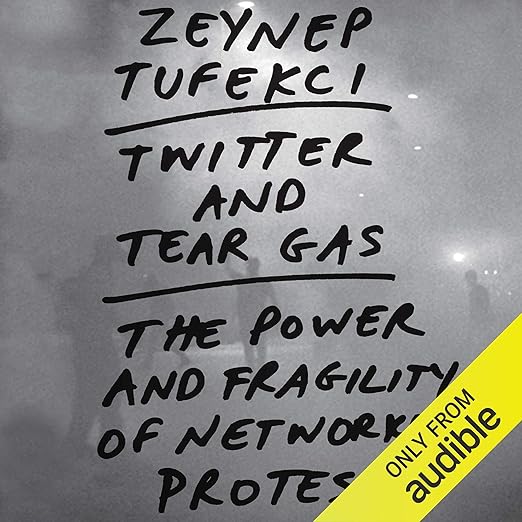
Zeynep Tufekci's Twitter and Tear Gas asks a question that sounds simple but has resisted easy answers since at least 2011: why do movements that form quickly online, mobilizing tens of thousands of people across continents overnight, so often fail to translate that mass participation into durable political change? The audiobook, narrated by Carly Robins and running thirteen hours and fifty-five minutes, is one of the most rigorous treatments of that question available, and it benefits from Tufekci's unusual combination of personal participation in the movements she studies and academic training in social science.
The book's central argument is counterintuitive. Tufekci does not argue that social media is simply bad for movements or that Twitter-fuelled organizing is inherently shallow. Instead, she argues that the ease of digital mobilization creates a specific problem of capacity: movements that once required years of painstaking organization to bring a million people into the street had, through that organizing process, developed the tactical, strategic, and leadership capacities needed to sustain their efforts. Movements that can mobilize the same number of people in days through social media often lack those internal capacities because they never had to build them. The result is what Tufekci calls a "tactical freeze," where movements achieve spectacular initial moments and then struggle to adapt, negotiate, or escalate when their initial demands are not met.
This argument is illustrated through examples that span the Zapatista uprisings in Mexico, the Arab Spring, the Occupy movement's refusal to use bullhorns in New York, the role of remote Twitter users in organizing medical supplies during the Egyptian uprising, and the specific dynamic of Istanbul's Gezi Park protests where, in a detail that gives the book its title, tear gas was paradoxically empowering for demonstrators rather than simply repressive. Tufekci was present for many of these events, and the on-the-ground interviews she conducted give the academic argument a texture that pure desk research cannot provide.
Robins Restores the Spoken Character of Interviews
Carly Robins handles the audiobook's demanding balance between journalistic storytelling and academic argument with consistent skill. The book moves frequently between theory and on-the-ground account, between the experience of individual protesters and the structural analysis of what their collective action achieved or failed to achieve, and Robins navigates those transitions without allowing either register to overwhelm the other. At nearly fourteen hours, the audiobook is substantial, and Robins's clear, measured delivery makes the long runtime manageable without sacrificing the analytical density that is the book's primary value.
A reviewer who came to the book through Tufekci's New York Times writing described her work as "sharp and insightful" and found the book a direct extension of that quality. The audiobook format suits the argument well for a particular reason: Tufekci's methodology is partly ethnographic, built on interviews and observation, and hearing those accounts spoken aloud restores something of their original spoken character. The passages describing the atmosphere inside Gezi Park, the logistics of Tahrir Square during the Arab Spring, and the specific organizational debates inside the Occupy movement have a different presence in audio than they do on a page.
Narrative and Disruptive Capacity Outpace the Electoral Kind
The book's analysis of what Tufekci calls "signaling" is where the argument becomes most theoretically precise and most practically applicable. She distinguishes between three types of capacity signals that movements broadcast through their actions: narrative capacity (the ability to frame events), disruptive capacity (the ability to impose costs), and electoral or institutional capacity (the ability to threaten or deliver political consequences). Understanding that framework unlocks the rest of the book's analysis, because Tufekci is arguing that digital tools dramatically amplify the first two while doing much less for the third, and that this imbalance explains the paradox of movements that are enormous in scale but limited in impact.
Pay also close attention to the sections on counter-movement tactics and surveillance. Tufekci was writing before the full extent of state-sponsored disinformation operations became publicly known, but the structural analysis she provides of how authorities learn to read and respond to digitally networked movements anticipated many subsequent developments. The book is not dated despite being published in 2017; if anything, events since its publication have validated its core arguments with depressing regularity.
The Occupy movement's decision not to use bullhorns, which Tufekci discusses in detail, is one of the audiobook's most memorable and analytically rich examples. What could be read as organizational stubbornness or romantic horizontalism is reframed by Tufekci as a signal of a particular kind of internal culture that, while admirable on its own terms, created real coordination problems when the movement needed to respond quickly to changing circumstances. Listen for how this example connects to her broader argument about the costs of leaderlessness as a structural feature rather than a tactical choice.
308 Reviews Back a 4.5 for Serious Listeners
This is a book for serious listeners interested in political sociology, technology and power, and the mechanics of collective action. The 4.5 rating with 308 reviews reflects an audience that came for substantive analysis and found it. Casual interest in social media or protest culture is probably not enough to sustain engagement across fourteen hours of dense argument; this audiobook rewards listeners who are willing to follow a sustained academic case through multiple empirical examples. Fans of Evgeny Morozov's The Net Delusion, Clay Shirky's Here Comes Everybody, or Sasha Issenberg's work on political organization will find Tufekci's framework the most rigorous and empirically grounded treatment of the overlapping territory. Activists and organizers who want to understand the structural limitations of their digital tools will find this essential listening.
In Brief
- Performance: Carly Robins reads Zeynep Tufekci's academic-adjacent prose with clarity and appropriate gravity, handling the movement between anecdote and analysis without losing the argument's thread.
- What it covers: Networked protest vs. hierarchical organizing, the paradox of social media's speed vs. movement durability, surveillance and counter-tactics
- Feel: Rigorously analytical with flashes of on-the-ground urgency
- Our call: Twitter and Tear Gas remains one of the most serious and well-grounded analyses of how digital technology reshapes collective action, and Robins delivers the dense argument with patient precision.
Does the audiobook require prior knowledge of the Arab Spring, Occupy, or other specific movements?
Tufekci provides sufficient context for each movement she discusses that prior detailed knowledge is not required. However, listeners with some background in the events she covers will find the analysis more immediately applicable and will catch the significance of specific on-the-ground details she includes.
How does the audiobook handle the balance between academic theory and firsthand reporting?
Carly Robins manages the transition between the two modes clearly, and Tufekci herself writes with the goal of making academic concepts accessible through narrative rather than requiring readers to follow dense theoretical exposition. The audiobook is demanding but not inaccessible to non-academic listeners.