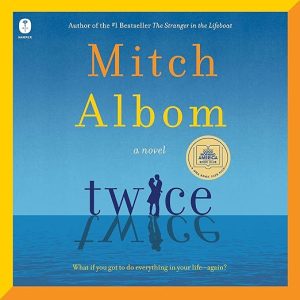
A publisher's blurb that sells you the audiobook from inside the book description is unusual enough to notice, and this one does it twice. Partway through its second paragraph the copy pauses to call the novel charmingly narrated by Mitch himself. Then, having arrived at its final sentence, it abandons the pitch for the story altogether and asks what better way to experience this story than through the delightful audiobook, narrated by Mitch himself. The same phrase, both times. When the marketing is that eager to tell you the author is reading, the reading is part of what is being sold.
What Mitch Albom Delivers
Alfie Logan is eight years old when he discovers he can undo any moment and live it again. The catch, as the description puts it, is that he must accept the consequences of his second try, for better or worse. So he grows up correcting mistakes, escaping adolescent embarrassments, and taking foolishly dangerous risks purely to learn what coming close to death feels like before tapping back to safety. The mechanism is clean, the temptation is obvious, and the opening third appears to be about a boy working out that he has been handed an unfair advantage over everybody else.
The second rule is what turns a premise into a novel. Once Alfie undoes a love, that person can never fall in love with him again, and by the time he learns this he is already deep in a life with Gianna, the woman he believes is the one. The frame around all of it is an interview room. An ailing Alfie has been arrested for allegedly cheating and winning millions at a casino roulette wheel, and his story surfaces as an interrogation, which is a shrewd structure for a man who has spent decades editing his own account of events.
What Mitch Albom Gets Right
Christie Martin's entry contains the sort of coincidence a publicist would pay for. The prologue opens on the storm of the year and Market Street in the city of Philadelphia, and that reader happened to be sitting in the Philly suburbs with wind and rain outside while going through it. That is weather rather than criticism, but it does confirm something useful about the opening: the book begins with a storm and a named street before any metaphysical premise, which suggests Albom grounds the fantastical rule in a real place before he ever explains how it works.
Self-narration is doing more work here than it usually does. Albom is described in his own jacket copy as America's favorite storyteller, and a storyteller reading aloud is a far less strange proposition than a novelist doing it. The book is also structurally an act of telling: a man explaining his life to a detective who keeps asking for more of it. Handing that to the author means the frame narrator and the actual narrator are one voice, which is either an elegant piece of casting or a redundancy, depending on your appetite for being told a story by its inventor.
Six hours and twenty-four minutes puts this among the shorter literary novels on the shelf, and the shape suits the material. A premise this tidy needs no four hundred pages to establish, and the interrogation frame supplies a natural clock. What gets lost is room. A rule forbidding any second chance at a love already squandered carries decades of consequence inside it, and six hours means those decades arrive compressed, in summary at least as often as in scene. Whether that reads as economy or as haste is the fair question to bring along with you.
Where Mitch Albom Loses Some Ground
Genre fields on this listing work against the book they describe. It sits under literature and fiction and simultaneously under science fiction and fantasy, with tags reading Genre Fiction and Science Fiction, which will deliver it to people expecting speculative machinery and no love story whatsoever. Pamela Shrewsbury's review offers a far better set in its opening line, filing the novel as literary fiction, magical realism, and romance. Three words of unpaid categorization work there do more for a prospective listener than the two official tags manage between them.
Eight votes produced a 4.5, and five of those eight left something written behind. Those five grade the book five, four, five, five, and five, which comes to twenty-four points. An eight-vote average of 4.5 fixes the total at thirty-six. The three people who voted without writing are therefore carrying exactly twelve points between them, an even four stars apiece. That is a quietly interesting distribution: the silent third of the pool is not hostile at all, merely unenthusiastic, which is the whole reason the badge reads 4.5 instead of something nearer five.
Oddities in the column deserve a scan before you lean on any of it. One entry arrives pasted in from somewhere else, complete with decorative symbols and a row of star glyphs sitting above its text. Another spells the author's surname Album rather than Albom. Two of the five bodies stop mid-sentence, one of them breaking off three letters into the word that would have completed a school anecdote. And the two longest entries disagree about the central rule: one says the power works only once, the other insists in capitals that it works only twice, which is what the title says too.
Who Should Pick Up Twice
Albom's regular readers know exactly what they are getting here, and the column confirms it without being asked. One entry praises him for refusing to sugar coat life and for making you think a story will end one way before it ends another. A second calls the books subtly spiritual with a twist at the end. A third simply reports that this is typical of the author, well written, a great read. That is a readership describing a reliable product, and reliability is the point: if the earlier novels worked on you, this one is assembled from identical materials.
Look elsewhere for the science fiction those tags promise, because the undo mechanism is a moral device, and no character in the book treats it as a system. Look elsewhere too if you want ambiguity, since the description announces in advance that the story will make you think, weep, and overflow with love, which is a publisher naming the emotional destination before the trip starts. And if the author's speaking voice is not one you enjoy spending time inside, this is the wrong edition, because the marketing has bolted that voice to the product on purpose. Six hours and twenty-four minutes is a short evening, and this one has been built to be finished inside one.
- Narration: Mitch Albom reads his own novel, and the jacket copy names that fact twice, once as a selling point and once as a closing argument
- Themes: Second chances and their price, a love that cannot be undone twice, confession under interrogation
- Mood: Warm and steadily sentimental, with a detective's clock ticking underneath
- Verdict: A reliable Albom novel at single-sitting length, badly served by that science fiction tag.
A Few Questions About Twice
Is the science fiction tag accurate for this audiobook?
Not really. The undo mechanism functions morally, never mechanically, and no scientific apparatus surrounds it anywhere. Pamela Shrewsbury files the book far more usefully as literary fiction, magical realism, and romance. Come for the love story and the interview room, not for speculative machinery.
Does hearing Albom read his own audiobook matter for this story?
More than usual, because the novel is itself an act of telling. Alfie explains his life to a detective across the entire frame, so putting the author in the reader's chair makes the storyteller inside the book and the storyteller performing it a single voice. The jacket copy flags that arrangement twice over.