
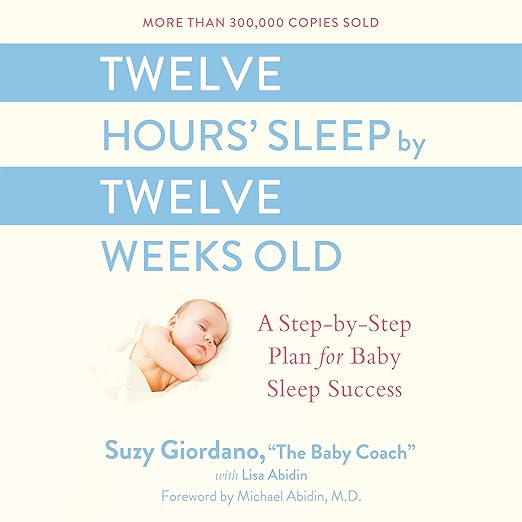
Suzy Giordano's approach to infant sleep training carries a specific promise that reviewers keep testing and reporting back on: twelve hours of sleep at night and three hours during the day, achievable with any healthy baby by twelve weeks. The Washington Post called her a baby sleep guru and an underground legend in the Washington area for this method, which she has tested with singletons, twins, triplets, babies with special needs, and colicky babies. This audiobook, narrated by Nia Roe at 2 hours and 48 minutes, is the distillation of Giordano's Limited-Crying Solution, and at that runtime, it's genuinely accessible to the audience it serves, which is parents who are too tired to read a comprehensive parenting tome but desperate enough to act on clear guidance immediately.
Naming the Middle Ground Between Two Extremes
The craft of Giordano's approach is worth examining before the method itself. The Limited-Crying Solution is the key piece of nomenclature: not a no-cry method, not a full cry-it-out method, but a specifically bounded framework for how much crying is appropriate in the process of teaching an infant to sleep independently. That distinction matters enormously for parents who've tried both extremes without success. The no-cry camp often fails because it produces unsustainable parental exhaustion without results; the full cry-it-out approach produces results but is genuinely distressing for many parents and babies. The middle position, which requires consistency and structure but doesn't demand either total silence or indefinite hands-off letting-cry, is the one that often works in households where the extremes haven't. Giordano's genius is naming that middle position clearly and giving it a structured system.
Reviewer Ash's account of using the method with two children and now gifting it to every friend who has a baby captures the word-of-mouth quality that has sustained this book's reputation across years. Reviewer Deer Tickhead's summary, do it for a few weeks by the book and it pays off for months and months, points to the central discipline the method requires, which is fidelity to the process rather than improvisation based on how a particular night goes. Giordano is explicit about this requirement, and the audiobook format reinforces it: Roe's narration conveys the system's logic clearly enough that parents can return to specific sections during implementation rather than needing to re-read the entire book to remember what comes next.
Under Three Hours, Tested on Twins and Triplets
The 2-hour-48-minute runtime is a genuine feature here rather than a limitation. Sleep-deprived parents don't have time for comprehensive parenting tomes that take months to complete, and Giordano respects that constraint. The audiobook can be completed in a single nap window or across a few fragmented shorter sessions, which makes it practically accessible in a way that longer parenting books often aren't. Nia Roe's narration is paced for comprehension rather than speed, which matters for material that parents may need to act on immediately after hearing it rather than holding it in working memory for days before implementation.
The scope of the tested population distinguishes this from more narrowly tested sleep approaches. Giordano has applied the system not only to singleton healthy newborns but to twins, triplets, special-needs infants, and colicky babies, the categories where standard sleep-training advice most often fails and parents most need alternative approaches. Reviewer Jessica's first-time parent account of immediate recommendation and gradual results through consistent implementation is a fair representation of what the method asks: not instant transformation, but measurable progress through disciplined application of a clear and reproducible system. That's a reasonable expectation to arrive with.
Where the Method Doesn't Cover Every Household
The audiobook's brevity means it presents the methodology without extensive qualification or a comprehensive discussion of edge cases beyond the ones Giordano explicitly addresses. Parents whose situations fall outside the described parameters, infants with specific medical complications that affect feeding, parents in shared sleeping arrangements that prevent the method's structural requirements, or households where feeding schedules are constrained by external work factors, may find the guidance less directly applicable to their specific circumstances. The book presents the method with the confidence of extensive tested application, which is appropriate given the documented track record, but it also moves past alternatives quickly and doesn't engage deeply with competing approaches.
The product notes indicate that a PDF companion is available in the Audible library alongside the audio, which is worth knowing before purchase. Some of the practical tools that support the Limited-Crying Solution, feeding schedules, sleep logs, tracking frameworks, are better engaged with visually than aurally. Parents who plan to implement the method directly and completely should access the PDF companion alongside the audiobook rather than relying solely on the audio to carry all of the method's practical infrastructure.
Committing to the Method Is the Real Ask
This audiobook is for expectant parents who want to arrive at the newborn period with a sleep framework already understood and ready to implement, and for parents in the early weeks who are looking for a structured and tested solution to the sleep-deprivation problem. The short runtime, clear methodology, consistent positive results across multiple reviewer accounts spanning multiple children, and Roe's warm and authoritative narration make it worth completing before deciding whether the system fits the household and the parenting philosophy.
Parents who've already established a sleep approach that is working have no reason to change course. Parents who prefer attachment-parenting frameworks that preclude structured sleep training should know this book is explicitly in the training tradition and doesn't engage seriously with alternatives. But for families willing to commit to the method's structure and consistency requirements, Giordano's track record as reported by parents who've used it across multiple children is as strong an endorsement as exists in this genre.
Questions Listeners Ask
Is this audiobook useful before the baby arrives, or is it only helpful once sleep problems have already developed?
Giordano addresses expectant parents as well as those already in the newborn period. The system works best when started with intention and structure from the beginning rather than as a correction to an established problem, so listening before birth and arriving prepared to implement from the start is described as the most effective approach.
Does the Twelve Hours' Sleep audiobook method work for twins or babies with special needs?
Giordano specifically states the method has been tested with singletons, twins, triplets, babies with special needs, and colicky babies without a reported failure. That breadth of application is one of the strongest differentiators from most sleep-training approaches, which are typically tested and documented only with healthy singletons.
How does Nia Roe's narration hold up for exhausted new parents who may be listening in fragmented sessions?
Roe's delivery is calm, clear, and paced for comprehension rather than speed. The 2-hour-48-minute runtime can be completed in one sitting or across several shorter sessions, and the narration is easy to return to after interruptions without losing the thread of the method's logic.
Is there a PDF companion included with this audiobook, and is it necessary to access it?
Yes, a PDF companion is available in the Audible library alongside the audio. For parents who want to use the feeding schedules, sleep tracking logs, and implementation frameworks that support the Limited-Crying Solution in practice, accessing the PDF is strongly recommended alongside the audiobook rather than relying on audio alone.







