Quick Take
- Read by: Paul Michael Garcia stands in for a first-person memoirist across twelve hours, a casting choice one reviewer openly wishes had gone the other way.
- At its heart: Addiction and relapse, family fracture, the unreliable self-account, recovery without guarantees.
- Vibe: Raw, restless, uncomfortable by design.
- Short version: The essential companion to Beautiful Boy in audio form, if you can spend twelve hours inside a self-justifying head.
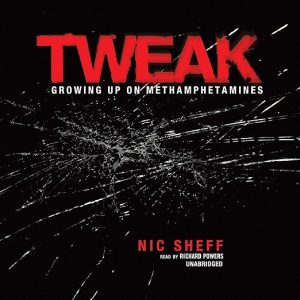
Blackstone Audio released Tweak on audio in February 2008, 12 hours and 17 minutes of it, with Paul Michael Garcia reading. Nic Sheff was drunk for the first time at age eleven. Pot, cocaine, ecstasy, crystal meth and heroin followed, and through all of it he believed he could stop and put his life together whenever he decided to, until a violent relapse one summer in California settled the argument. That is the book. What makes this audiobook a more complicated purchase than the average recovery memoir is not the content, which is every bit as raw as advertised, but a question one listener puts directly in the review column: who ought to be reading it aloud.
First, the Big Picture
Nic spares no detail, which is the promise the description makes and the promise the book keeps. The writing tracks the mental and physical depths of addiction from inside, and the person doing the telling is at odds with his past, with his family, with his substances and with himself, often within the same paragraph. That is the memoir's method. It does not organize the chaos into lessons after the fact; it reproduces the reasoning as it happened, including the reasoning that was obviously wrong at the time. Readers who want a memoirist to have already arrived somewhere calm will find that method exhausting, and readers who distrust tidy hindsight will find it the only honest way to tell this particular story.
Two of the five responses treat the book as half of a pair. JournalStone, at five stars, describes finishing Beautiful Boy and moving straight to Tweak in order to close the chapter, and notes that Tweak takes a slice of the same time period and tells it from the perspective of the addict rather than the father. The response signed Somebody's Nurse makes the same case, valuing the depth about what was really going on with Nic during the stretches when his family was left wondering and worrying. Read together, the two accounts cover the same months from opposite sides of a locked door.
The dissent is worth as much as the praise. Anne H, filing from France at three stars, found the book interesting and easy to read but could not summon sympathy: Nic is whiny and selfish and pompous at times, in that response's words, and other addiction memoirs did more. A Piece of Cake by Cupcake Brown, Candy by Luke Davies and the older well-known book about Christiane F. all get named as preferred alternatives. That is a legitimate reaction to a first-person account whose narrator is not asking to be liked.
First-person memoir is the natural home of this format. A voice speaking directly into your ear collapses the distance the printed page keeps, and for a book built on the inside of someone's decision-making, that collapse is the point rather than a side effect. Twelve hours is a long time to spend in a head like this one, but the length is doing work: the repetitions, the promises, the recalculations all land harder in real time than they would in a skimmed chapter.
Garcia's job is unusually difficult and easy to underrate. The register has to be self-justifying and self-lacerating at once, without the reader stepping outside it to comment. Push too hard on the wreckage and the book turns into a cautionary performance; underplay it and the relapse loses its weight. Blackstone Audio credits a single reader for the whole span, so no change of voice marks the difference between Nic in control and Nic gone, which throws that distinction entirely onto phrasing and pace.
One listener raises the casting question head-on. Natalie Hable, at four stars, removed a star for a single reason: the belief that all audiobooks should be read by the author whenever possible, to be more authentic and genuine. That is a real position, and it bites harder on memoir than on any other genre. It is also, notably, an argument about principle rather than about Garcia's execution, since nothing in that response faults the reading itself.
Weak Spots in Tweak
Category filing on this page will mislead somebody. Tweak sits in the teen and young adult category, tagged Biographies, and while the book is genuinely read by teenagers and taught in that context, the content includes needle use, crystal meth, sex work and violent relapse, described without softening. Parents scanning a young adult shelf deserve to know that before pressing play in a shared car. The category is defensible as an audience but not as a content rating.
The response titled Whiny narrator is a trap on an audio page. Read the body and the complaint is about Nic himself, the person narrating his own life, not about the reader hired to voice him. Anyone scanning headlines for performance feedback will draw the wrong conclusion in about two seconds. Worth noting too that the visible responses were filed from the United States, Germany and France between 2010 and 2026, and several are truncated in mid-sentence where the display cuts them off, so the column is a pooled and partial record rather than a clean audience for this edition.
Finally, be clear about the limits of the promise made here. It ends at the road to recovery without specifying how far along that road the book stops, and nothing in the audio listing mentions an author's note, an afterword or any supplementary material recorded for this release. What you get is the memoir proper, at its original length, without the retrospective framing a later edition might have added.
Is This One for You?
Readers who have finished Beautiful Boy and want the other half of that story should take this, along with listeners who work in recovery or education and need the interior account rather than the clinical one, and to adult readers of memoir who can sit with a narrator they may not like. Families dealing with an addicted teenager will find much of this familiar, which is precisely why some of them should wait until the crisis has cooled before taking this on.
Avoid it if you need a redemption arc delivered on schedule, if graphic drug use is a hard limit, or if you specifically want author-read memoir, because this is not one. Sheff wrote it from inside the wreckage rather than from a safe distance, and twelve hours of that is a commitment worth making with your eyes open rather than on a recommendation.