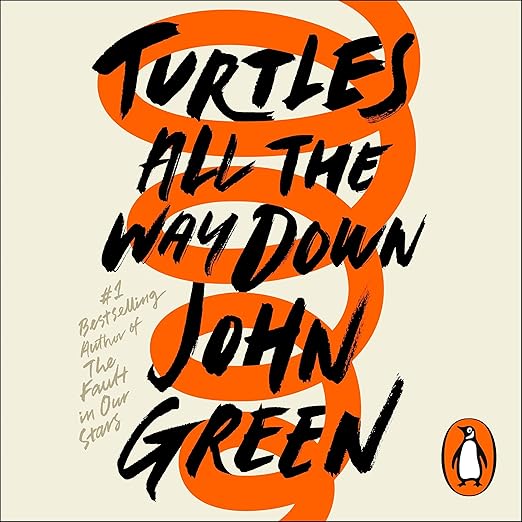
I listened to Turtles All the Way Down on a long bus ride through the countryside, the kind of journey where you run out of things to look at and start paying close attention to whatever is in your ears. Within the first twenty minutes I had stopped watching the window entirely. The book's opening sections, in which Aza Holmes narrates her own thought processes with a clinical and often darkly funny awareness of how her OCD operates, have a quality I have rarely encountered in YA fiction: they feel physiologically accurate.
John Green has spoken in multiple interviews about the autobiographical roots of Aza's mental illness, specifically the way OCD manifests not as a quirky organizational habit but as a recursive trap, a thought that pulls you back before you can escape it. The spiral is the structural motif of the novel, and Green earns it. Where some of his earlier work, Looking for Alaska, The Fault in Our Stars, has faced reasonable criticism for a certain sameness of voice across different protagonists, Aza is distinct. Her interiority is harder to inhabit, more exhausting, and also more specific.
The plot, involving a missing fugitive billionaire named Russell Pickett and a hundred-thousand-dollar reward that Aza's best friend Daisy wants badly, is essentially a MacGuffin. What it provides is a reason for Aza to get close to Davis Pickett, Russell's son, and to explore a relationship that develops with the tentative, emotionally complicated quality that tends to characterize Green's romantic pairings. Daisy, Aza's bold and relentlessly enterprising friend, is one of Green's better supporting characters, someone who gets to be genuinely flawed and challenging without becoming a villain. The friendship between the two is what anchors the book during its slower stretches.
One reviewer described the novel as being as much about the loss of a parent and about how great wealth alters one's life as it is about OCD. That reading holds up. Davis's situation, rich, effectively orphaned, living in a house too large for any ordinary feeling, creates a productive contrast with Aza's experience of being trapped in the small repetitive loops of her own mind. Both characters are in different kinds of cages.
What John Green Gets Right
Kate Rudd is a thoughtful choice for this material. She has narrated Green's work before, including The Fault in Our Stars, and she understands the rhythm of his prose: the combination of adolescent humor and philosophical density that can tip into self-indulgence with the wrong delivery. Rudd keeps Aza grounded. The interior monologue sequences, where Aza's thoughts circle back on themselves, are handled without melodrama, which is exactly right. They feel like thinking, not like performance. At seven hours and eleven minutes, this is also one of the more compact listens in Green's catalog, which suits the novel's compressed emotional architecture.
Where John Green Loses Some Ground
If you have read multiple Green novels, the structural similarities are real. The witty best friend, the romantic interest with a complicating backstory, the meditation on mortality and meaning: these elements are familiar from his earlier work, and at least one long-time reader in the reviews notes the pattern. What is genuinely new here is the specificity and unflinching honesty of the OCD depiction. Several readers with personal experience of the disorder describe feeling seen in ways that other fictional portrayals of mental illness rarely achieve. That quality is what distinguishes this book from the broader catalog.
Who Should Pick Up Turtles All the Way Down
Listeners who have personal experience with OCD or anxiety disorders will likely find Aza's interior voice one of the more accurate and compassionate fictional treatments available. YA readers who want a story that takes the emotional lives of teenagers seriously will find plenty here. Those who have read extensively in Green's catalog and felt a sense of repetition with earlier titles should know this one is different enough in its focus and emotional register to merit the attention. Very young listeners or those looking for a straightforward mystery or adventure will find the introspective pace challenging.
Before You Press Play
- Read by: Kate Rudd captures Aza's interior voice with a natural, unforced quality that makes the OCD thought spirals feel immediate rather than performed.
- At its heart: obsessive-compulsive disorder, friendship under pressure, grief and wealth
- Vibe: Tender and claustrophobic, funny in the Green way until the walls close in
- Short version: Green's most autobiographically honest work, and the one where his gifts for character and interiority feel most purposefully deployed.
Does Kate Rudd's narration handle the interior thought-spiral sequences well?
Yes. Rudd narrates the recursive OCD sequences with a naturalistic quality that keeps them feeling like thought rather than performance. Her previous experience narrating Green's work shows in how comfortably she inhabits his prose rhythm.
How central is the mystery plot about the missing billionaire?
The Pickett mystery is primarily a structural device that sets the story in motion and gives Aza and Daisy a shared project. The emotional core of the novel is Aza's inner life, her friendship with Daisy, and her relationship with Davis.
Is Turtles All the Way Down part of a series?
No. It is a standalone novel. The characters and setting are entirely self-contained.