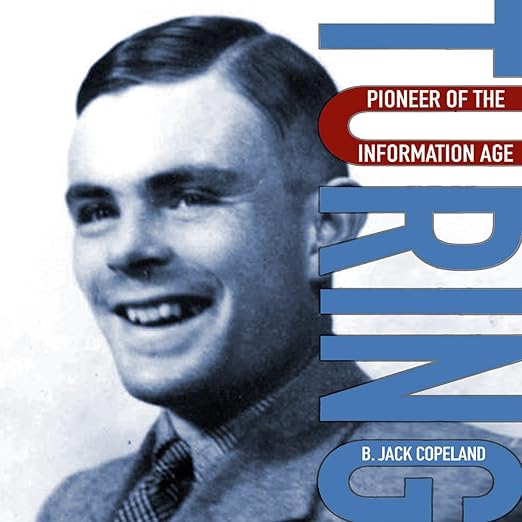
The timing of my encounter with this audiobook was slightly absurd. I listened to most of it on a flight back from a conference on machine learning, somewhere over the Atlantic, while the inflight entertainment system offered me a Hollywood film about the very same subject. I chose the Copeland. It was the right call. B. Jack Copeland's biography of Alan Turing is a more complicated portrait than any film has managed, in part because Copeland refuses to organize Turing's life around its tragedy, the 1952 prosecution for gross indecency and the death in 1954 that most likely-origin accounts describe as suicide. The death is there, examined carefully. But it is not the frame around everything else.
The book's full title in print is Turing: Pioneer of the Information Age, which is an adequate if uninspiring description of Copeland's project. What he is doing, in practical terms, is restoring priority. The secrecy that surrounded Bletchley Park's operations for decades after the Second World War meant that Turing's contributions to code-breaking, and more specifically to the intellectual architecture of modern computing, were either classified, mis-attributed, or simply unknown to the historians who shaped the early record. Copeland had access to materials that earlier biographers did not. The result is a book that occasionally feels like a correction to the record as much as a biography, which is both its strength and occasionally its limitation.
Where This One Lands
Copeland does something genuinely difficult here: he explains the Turing machine, the Church-Turing thesis, and the conceptual foundations of artificial intelligence in ways that are followable by a reader with no computer science background, without condescending to readers who do have that background. The trick is that he contextualizes the technical ideas historically rather than explaining them in the abstract. You understand what the Turing machine was for because you understand what mathematical problem it was designed to address, and you understand that problem because Copeland has placed it in the debates of 1930s logic and foundations of mathematics that Turing was working within.
The Bletchley material is the book's most historically significant section and also its most compellingly told. One reviewer who described themselves as a computer scientist said the book revealed contributions they had not known about, including Turing's work on artificial life and electronic music. That reviewer's surprise reflects how effectively Copeland has broadened the picture beyond the Enigma story that most readers bring to the subject. Turing's work on morphogenesis, the mathematical study of biological pattern formation, is genuinely surprising in this context, and Copeland presents it not as a curiosity but as a coherent extension of the same thinking that produced the universal computing machine.
Why Turing Works as an Audiobook
Copeland addresses the circumstances of Turing's death carefully and at length. The standard account is suicide by cyanide-laced apple. Copeland argues the evidence for this conclusion is far thinner than popular accounts suggest, and presents the possibility of accidental poisoning from his home chemistry experiments as at least equally plausible. One reviewer found this revisionism persuasive. I find it genuinely uncertain, as Copeland probably intends.
What matters in the context of this biography is that Copeland refuses to let the death function as an organizing tragedy that retrospectively colors everything before it. Turing's life was complicated, painful in specific ways, and extraordinarily productive in others. Collapsing it into a martyrdom narrative, as the Imitation Game film largely did, loses the texture of a person who was by multiple accounts also often playful, eccentric, and deeply happy in his mathematical work. Copeland holds both things.
What Gives Us Pause
At nine hours and ten minutes, this is a substantial audiobook, and Griffith's narration is what keeps it from feeling slow in its denser sections. His read is intelligent rather than performative: he does not try to inject drama into the technical passages or emotion into the biographical ones, which might sound like a criticism but is actually the correct approach for a subject whose life already contains both in abundance. The book's early chapters, which deal most heavily with the foundations of mathematical logic, are the most demanding on a first listen. Pushing through them pays dividends when the Bletchley material arrives.
The production from Audible Studios is clean. There are no supplementary materials or chapter markers worth noting, but the book's internal structure is organized clearly enough that listeners who need to step away and return can do so without losing the thread.
The Right Listener for Turing
If you want the broad cultural biography of Turing, including his sexuality, his persecution, and the broader tragedy of a man destroyed by the society he helped save, there are more emotionally engaged accounts. Andrew Hodges' Alan Turing: The Enigma is the standard reference for that approach, and remains worth reading.
Copeland's book is the better choice if you want to understand what Turing actually did technically, what his specific intellectual contributions were, and how those contributions relate to the computing and artificial intelligence landscape of the present day. That is a rarer thing than a good biography, and Copeland has achieved it here with clarity and genuine scholarly integrity.
One detail from the reviews that stayed with me: a computer scientist said the book revealed aspects of Turing's work they had not previously known, including his contributions to sequential analysis in statistics. That a specialist found genuinely new material here is a testament to how effectively Copeland used his access to previously classified records. The corrections in this book are real corrections, not narrative convenience, and the listening experience is richer for knowing that.
Questions Listeners Ask
Does this audiobook require a background in mathematics or computer science to follow?
No. Copeland is a philosopher of computing who has spent his career making Turing's work accessible to general audiences. The technical material is contextualized historically, so you understand the problems before you encounter the solutions, making it followable without specialist knowledge.
Does Copeland cover Turing's work beyond Bletchley and the Turing machine?
Yes, and this is one of the book's strengths. Copeland covers Turing's work on artificial life, morphogenesis, electronic music, and sequential analysis in statistics, areas that most popular accounts ignore entirely. Reviewers with computer science backgrounds described finding material here they had not previously known.