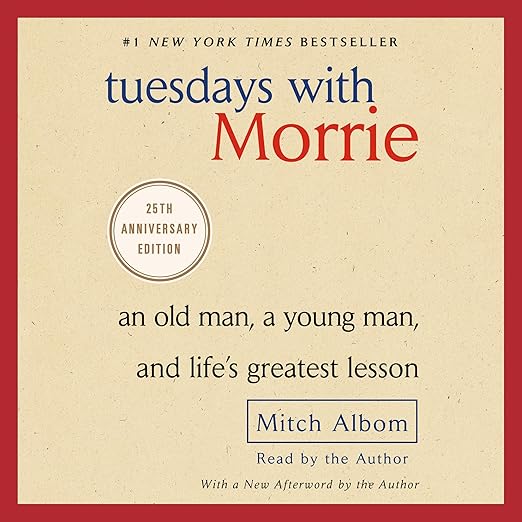
I first read Tuesdays with Morrie in my early twenties for a class on contemporary memoir, and I returned to the audiobook version some years later, on a Sunday afternoon when a family member was ill. The experience of listening to Mitch Albom read his own words about Morrie Schwartz while sitting in a hospital waiting room is the kind of encounter with a book that you do not plan but that stays with you. That is what a certain kind of memoir does: it waits for the right moment in your life and then arrives exactly where you are.
The 25th anniversary edition includes a new afterword by Albom that adds context about how the book has affected the people who read it and about where Albom is now in relation to his former professor's lessons. That addition matters. Twenty-five years of living with a book's impact is itself a story worth telling, and Albom tells it with the same directness and lack of pretension that characterizes the original text. The book has changed enough lives in the intervening decades that the afterword has genuine material to work with.
Fourteen Tuesdays, Each Built Around a Theme
Tuesdays with Morrie is organized around the fourteen Tuesdays that Albom spent with his former sociology professor Morrie Schwartz after reconnecting with him as Morrie entered the final stage of ALS. Each Tuesday functions as a chapter organized around a theme: the world, self-pity, regrets, death, family, emotions, the fear of aging, money, love, marriage, culture, forgiveness, a perfect day. That structure is not accidental. Morrie was a teacher his entire life, and he shaped his final months as a final class. Albom understood that the organizational principle that had defined their relationship should define the memoir as well.
What the structure enables is intimacy without sentimentality. Each Tuesday's theme gives both Morrie and Albom something to think against rather than simply a space to feel. The conversations that result are genuine rather than performed. Morrie disagrees with Albom, pushes back on his assumptions about work and success, and offers counsel that is occasionally inconvenient rather than simply reassuring. The line that appears on the cover, that once you learn how to die, you learn how to live, sounds like a platitude extracted from context, but within the actual conversations it emerges from something harder-won and more specific than any aphorism can capture.
Albom Reads With Grief and Gratitude Together
The question of who should narrate a memoir is almost always answered correctly by the author, and the Tuesdays with Morrie audiobook makes the case definitively. Albom's voice carries what a reviewer describes as both grief and gratitude simultaneously, and that emotional dual register is precisely what the book requires. He is not performing sadness about losing Morrie; he is remembering him while still carrying the specific quality of loss that does not resolve cleanly with time.
The reading is unhurried. At under four hours, the audiobook is brief for its subject matter, but Albom does not rush through the material as if conscious of the runtime. He reads the way the book was written: with attention to each week's weight. The Tuesday framework means that every chapter carries a sense of temporal pressure, the awareness that there are fewer Tuesdays left, and Albom's reading preserves that compression without dramatizing it unnecessarily. The emotional impact accumulates through understatement rather than through emphasis.
Twenty-Five Years Later, an Afterword Adds Perspective
For readers who encountered Tuesdays with Morrie years or decades ago, the 25th anniversary edition offers something the original could not: the perspective of a writer who has lived with his own book's impact across a quarter century. Albom's new afterword addresses the extraordinary volume of correspondence the book generated, the specific ways it has been used in hospice settings and school curricula, and his own evolving relationship to Morrie's lessons as he has aged and experienced loss of his own since the book's original publication.
Reviewers who return to the book after years away consistently describe finding new meaning in material that felt different when they first encountered it. A reviewer who notes the book grows with you, that what touched them years ago feels even more meaningful now, is describing the particular quality of books that are about universal experiences: mortality, love, the question of how to use the time we have. Those experiences accumulate additional resonance rather than fading with familiarity.
This is not a book that will change anything about the logistics of your life. It is a book that is likely to change something about the quality of your attention to it. For listeners who have never encountered Morrie Schwartz and Mitch Albom before, the three hours and fifty-one minutes it takes to complete is among the most efficiently deployed time you can spend with an audiobook. Bring something to dry your eyes for the final Tuesdays. Not because the book is manipulative, but because the emotion it generates is the honest kind that arrives when someone has taken a real thing seriously.
Specificity Over Symbolism Makes the Lessons Stick
Books about mortality are everywhere. Books that actually change how their readers think about mortality are rare. Tuesdays with Morrie has stayed in print because it does the second thing rather than the first, and it does it through specificity rather than through general wisdom. Morrie Schwartz is not a symbol of the good death; he is a specific man with a specific way of engaging with the world, and his particularity is what makes the lessons transferable rather than merely inspirational.
Albom understood this, and his memoir preserves it. The book is not about what we should all think about dying. It is about what one extraordinary teacher thought about it, week by week, as it arrived. That distinction is everything. A reviewer who describes it as one of the best books ever written is expressing something that many readers share, not because the prose is technically dazzling, but because the book makes mortality feel survivable as a subject of contemplation.
Common Questions
Is the 25th anniversary edition significantly different from earlier editions of Tuesdays with Morrie?
The core text is unchanged. The addition is a new afterword by Albom covering the book's 25-year impact and his current relationship to Morrie's lessons. For longtime readers, that afterword adds meaningful dimension. For new listeners, the original material is complete on its own.
At under four hours, is the audiobook too brief to feel substantial?
Multiple reviewers describe the brevity as appropriate rather than insufficient. The book is intentionally spare and direct, and Albom's unhurried reading makes the runtime feel full. The Tuesday structure gives each chapter a specific weight that compensates for the overall short length.
Is Tuesdays with Morrie a religiously specific book, or does it work across different belief frameworks?
It is not religiously specific. Morrie Schwartz had a broad spiritual sensibility but the conversations are not doctrinally tied to any particular tradition. The book's central concerns about mortality, love, and meaning are accessible to readers regardless of religious background.
Mitch Albom reads the audiobook himself, is his narration professional quality?
Yes. Albom reads with the natural authority of someone recounting experiences from his own life, and the emotional register he maintains throughout is genuine rather than performed. Several reviewers note that hearing his voice adds something to the text that reading silently does not provide.