
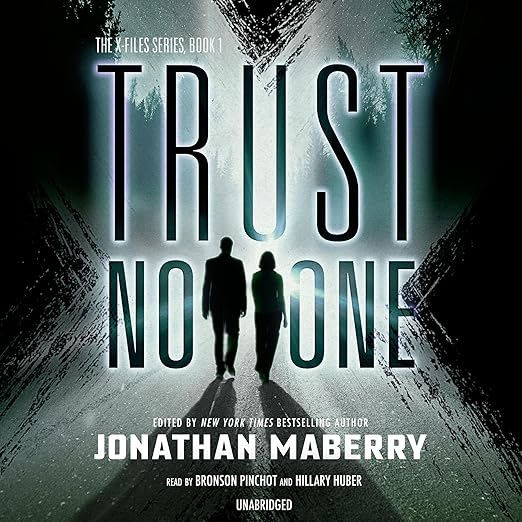
I watched The X-Files during its original run and came back to it years later with the increased appreciation that distance tends to provide. The show, at its best, was not really about aliens or monsters, it was about the particular American anxiety of institutions that lie, of truths too large and too threatening for official acknowledgment. Jonathan Maberry's edited anthology Trust No One inherits that DNA, and arriving at fifteen stories totaling more than fifteen hours of listening, it is a substantial commitment to a beloved fictional universe.
Maberry assembled a notable roster: Kevin J. Anderson, who has written X-Files novels before; Tim Lebbon; Max Allan Collins; Heather Graham; Brian Keene; Peter Clines; and a dozen more. The collection has IDW Publishing and series creator Chris Carter's authorization, which matters for fans who care about canonical standing. This is not fan fiction. It is an officially sanctioned extension of the universe, and it carries the weight of that authorization into its ambitions.
First, the Big Picture
Anthologies live and die by their range, and this one has both significant highs and some genuine lows. The most enthusiastic reviewer here described many stories as feeling like "they could be episodes from the show", which is precisely the right benchmark for this kind of tie-in fiction. The best stories in the collection do capture the specific texture of the X-Files episode formula: the cold open oddity, the investigative dialogue that dances between Scully's skepticism and Mulder's certainty, the monster or conspiracy that is never quite fully explained. Anderson, cited specifically by multiple reviewers, is particularly fluent in this mode.
The criticism that the collection is "hit or miss" with some stories feeling "amateurish" is fair and worth taking seriously. When you commission fifteen writers to work in someone else's universe, the results will be uneven. Several stories in this collection feel like writers who understand the surface elements, the aliens, the shadowy government, the monster classifications, without fully grasping what the show's best episodes were actually doing emotionally. The result is stories that resemble X-Files episodes in outline but not in atmosphere.
Bronson Pinchot's narration is the production's most significant asset and the strongest argument for the audio format. Pinchot is a character actor with substantial range, and he brings genuine vocal differentiation to fifteen stories that each require their own atmosphere. His Mulder and Scully voice work is not an impersonation of David Duchovny and Gillian Anderson, it is a character interpretation, which is both necessary and smart. He commits to the genre's paranoia and the show's specific brand of mordant humor in ways that make even the weaker stories more engaging than they would be on the page.
The stories are set across different points in the show's timeline, which creates useful variety. We see Mulder before Scully joined the X-Files in at least one story; others place them during the main run, and some extend into their relationship as a couple. For long-term fans, this kind of temporal range is pleasurable, it allows the collection to work with the characters at different stages of emotional development rather than being locked into a single window.
Before You Commit to Trust No One
The inconsistency of quality across fifteen stories is the main challenge, and there is no index in the listening experience that tells you which stories are the stronger ones before you arrive at them. One reviewer noted "several grammatical and spelling errors throughout the stories," which suggests the production quality of the source text was not uniformly high and that some of those issues may occasionally surface in the narration's relationship to the text. These are minor issues but worth knowing about in a professionally produced anthology of this scope.
At over fifteen hours, this is also a commitment that some listeners may find better suited to reading than to listening. The episodic structure means you can put the audiobook down between stories without losing narrative thread, which makes it more practical as casual companion listening than as an immersive experience.
Is This One for You?
The audience here is committed X-Files fans who want more of the universe and are comfortable with the quality variance that anthology fiction inherently produces. Pinchot's narration makes this audiobook specifically worth listening to rather than reading, his performance is the added value the audio format provides. Casual viewers of the show or listeners who know Mulder and Scully only by reputation will find less to hold them across fifteen hours of stories that assume a familiar relationship with the characters and their world.
Is Bronson Pinchot's narration an impersonation of the TV cast?
No. Pinchot creates his own interpretations of Mulder and Scully rather than attempting to replicate Duchovny and Anderson's specific vocal performances. His approach is character-based rather than imitative, which is the appropriate choice for a fifteen-hour audiobook and works better than an impersonation would across such an extended runtime.
Which stories in the anthology do reviewers most recommend?
Kevin J. Anderson's contribution receives specific praise from multiple reviewers for capturing the show's voice most accurately. However, reviewers generally describe enjoying the collection as a whole rather than identifying standout individual stories, which suggests the highs are distributed fairly broadly across the anthology rather than concentrated in a few exceptional entries.







