Quick Take
- Narration: Gary Tiedemann delivers the trivia with a dry, faintly incredulous tone that suits the material, not performative, not flat, just competently bemused.
- Themes: Historical absurdity, obscure facts as social currency, the gap between textbook history and actual events
- Mood: Casual and episodic, built for short sessions rather than sustained listening
- Verdict: A trivia collection that works best in 20-minute chunks rather than end-to-end, the individual facts are genuinely surprising, but the format offers no connective tissue across three hours.
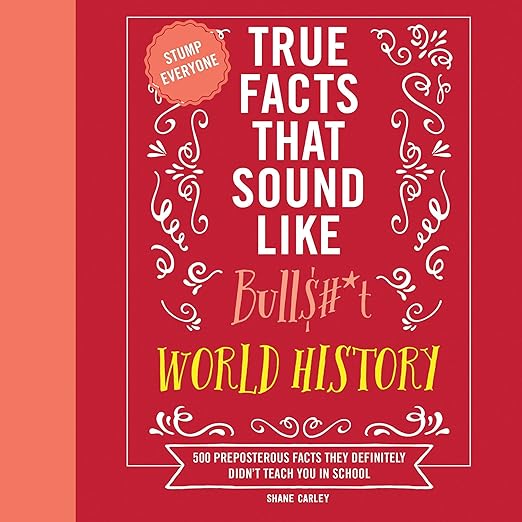
I was on a train somewhere in the middle of France, between Macon and the outskirts of Paris, when I started this one. I had forty minutes of battery left on my phone and nothing I wanted to concentrate on. True Facts That Sound Like Bull$#*t: World History was sitting in my queue precisely because it required nothing from me except ears. By the time we pulled into Gare de Lyon, I had learned that Pope Gregory IV declared war on cats, that Abraham Lincoln is in the Wrestling Hall of Fame, and that the Netherlands and the Isles of Scilly conducted a war lasting 335 years with zero casualties. None of this made me a better reader or a more serious person. All of it made those forty minutes considerably more enjoyable than staring at countryside in November.
Shane Carley’s True Facts series operates on a simple premise: aggregate historical facts that are so specific, so counterintuitive, or so plainly strange that they provoke a reflexive disbelief before the verification instinct kicks in. The World History installment draws from across time periods and geographies, with a curatorial eye for maximum surprise. There are 500 entries across three hours, which works out to roughly 21 seconds per fact when you account for Gary Tiedemann’s delivery pace. That pace is not a problem. Tiedemann reads without overselling the material: no exaggerated comedic beats, no drawn-out pauses for effect. He trusts the facts to do their own work, which is the correct call.
What Makes a Fact Land in Audio
The challenge with trivia audiobooks is that print readers can pause, re-read, and absorb at their own speed. In audio, each fact arrives and immediately makes room for the next one. This means the selection has to do more heavy lifting than in a print collection. Facts that require context to be funny, or that depend on the reader already knowing a related detail, do not survive the format as well as facts that are self-contained and immediately absurd. Carley largely understands this. The strongest entries here are the ones where the fact is the complete payload: the length of the no-casualty war, Lincoln’s wrestling credentials, the papal-feline conflict. These land cleanly and the disbelief response happens in real time. The weaker moments are facts that gesture toward something without quite landing the punchline, entries that would benefit from a footnote or a two-sentence elaboration but get the same 21-second treatment as everything else.
Session Listening and the Format Ceiling
Reviewer after reviewer describes this as a book they have given as a gift or used for trivia night preparation, and that framing is honest about what the format actually is. Three hours of back-to-back trivia has a cumulative effect that is less amusing than the first twenty minutes suggested it would be. There is no narrative, no escalation, no chapter structure. The facts are loosely organized by thematic area but the transitions are minimal. Listening straight through produces a kind of trivia saturation around the ninety-minute mark where the facts, however individually interesting, begin to blur into each other. The solution is obvious: this is a session-listening audiobook, not a finish-in-one-sitting one. Load it onto your phone, play it during commutes, dip in and out. That is how it was meant to be experienced, and in that mode it delivers exactly what the title promises.
Who Should Listen / Who Should Skip
The right listener is someone who wants ambient intellectual entertainment: trivia nights, long drives, background listening while doing something light with the hands. It rewards the format. Skip it if you need structure, narrative, or comedy that builds on itself. This is a collection, not an argument. The audio format is perfectly adequate but adds nothing over the print version except the convenience of not needing to hold a book.
Frequently Asked Questions
Are the 500 facts organized by time period or region, or is it a random order?
The collection is loosely thematic but not strictly chronological or geographical. It moves through various eras and locations with minimal transitional structure, expect variety rather than curriculum.
Is this part of a series, and does the world history installment stand on its own?
Yes, it is part of the Mind-Blowing True Facts series with volumes on other topics. The world history entry works as a standalone. The broad geographic and temporal range makes it more varied than a single-topic volume, which some listeners prefer.
Can a child listen to this alongside adults, or is the content adult-oriented?
The content is age-appropriate for older children and teens. Nothing here is graphic or inappropriate. The humor comes from historical absurdity rather than adult themes.
Does the audiobook include sources or context for the facts, or just the facts themselves?
Just the facts, delivered without citation or extended context. If you hear something you want to verify or explore further, you will need to do that research independently.