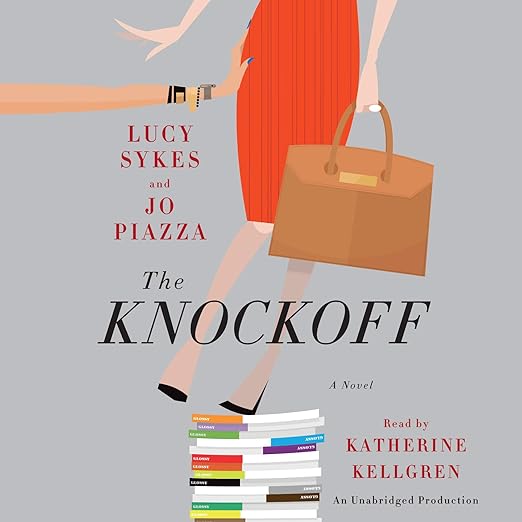
The Short Version
- Narrator: Katherine Kellgren is perfectly cast here, her voice carries both Imogen's old-world magazine authority and her fish-out-of-water bewilderment with precise comic timing.
- Subjects: Generational workplace conflict, fashion industry satire, digital disruption
- Tone: Fizzy, wry, and occasionally biting
- Bottom line: A fun satirical romp through the fashion world that works best as a comedy of manners rather than a serious tech critique, with Kellgren's narration elevating the material considerably.
I listened to The Knockoff on a long train journey and it was exactly the right book for that context, fizzy, propulsive, and smart enough to be amusing without demanding full concentration. Lucy Sykes has worked inside the fashion industry, and that insider fluency gives the novel a texture that pure outsiders can't manufacture. The name-drops feel earned rather than Googled, the power dynamics ring true, and the specific absurdity of turning a 768-page September issue into an app has the sting of something that probably happened in real rooms with real stakes.
Katherine Kellgren is one of the most technically accomplished narrators working in audio, and she brings considerable gifts to Imogen Tate. She catches Imogen's particular variety of disorientation, not stupid, not out-of-touch, but precisely calibrated to a world that has moved the goalposts without announcing it. When Imogen gets her iPhone stuck in Japanese for two days, Kellgren makes you feel both the comedy and the quiet humiliation of it.
What Lucy Sykes Delivers
The novel's central conflict, editor-in-chief versus her insurgent former assistant, is both timeless and sharply of its moment. Eve Morton, fresh from Harvard Business School, is less a character than a force of nature: hackathons all night, mandatory group dances to Beyonce, firing anyone over forty with algorithmic efficiency. The joke is that Eve's tyranny is framed as progress, and Sykes keeps that irony consistent throughout. This is not a novel that thinks the digital future is simply bad, it just thinks the people implementing it with missionary zeal are worth mocking.
The comparison to The Devil Wears Prada is inevitable and partially fair. Both books use a high-fashion magazine as their arena, both have a central power struggle between generations of women, and both trade in the specific pleasures of insider fashion gossip. But The Knockoff is funnier about technology than Prada was about fashion, and its protagonist is more sympathetic from the start, Imogen isn't an ambitious ingenue learning the ropes but a competent woman being slowly erased.
What Makes The Knockoff Worth Hearing
The audiobook is twelve hours long, which is about three hours longer than the material strictly requires, but Kellgren's energy never flags. She handles the ensemble cast of Glossy's office, the supply-closet-demoted managing editor, the texting underlings, Imogen's fashion-world contacts including Alexander Wang and Diane von Furstenberg, with clear differentiation. Listening feels like watching a slightly too long but consistently entertaining comedy of manners.
The fashion world details are precise and fun without requiring any prior interest in fashion. The tech satire is equally accessible, you don't need to know what Foursquare is to understand why Imogen's inability to distinguish it from Facebook is both funny and pointed. Sykes is writing about the anxiety of obsolescence, which is universal, dressed in very good clothes.
Things to Know Before Starting The Knockoff
One reviewer called it a knockoff of something you've read before, and that criticism has teeth. The novel's structure is familiar: outsider returns, finds everything changed, must adapt or be destroyed, finds inner resources she didn't know she had. Sykes doesn't fundamentally subvert that arc. If you are looking for structural invention, this isn't the book. If you are looking for execution within a familiar frame, it delivers.
Eve's villainy also tips occasionally into caricature. The more extreme her behavior becomes, the less interesting she is as an antagonist. The novel is sharpest when it treats the generational conflict as genuinely two-sided, when Imogen's nostalgic attachment to print is gently mocked alongside Eve's digital fanaticism. Those moments of balance are the best ones.
Who Should Pick Up The Knockoff
For listeners who enjoy workplace satire, fashion world fiction, and comedies of professional obsolescence. Also a strong pick for anyone who enjoyed The Devil Wears Prada and wants something funnier about the digital pivot. Skip it if you want your satire to have sharper structural teeth or your villains to be more nuanced, this is pleasures-of-genre fiction done well, not a reinvention.