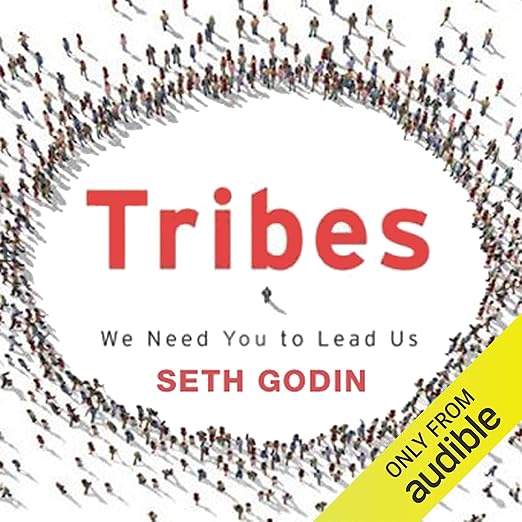
I listened to Tribes on a Sunday morning walk several weeks after I had finished Cialdini's Influence, and the contrast was instructive. Where Cialdini builds careful, evidence-based architecture over twenty hours, Godin constructs a manifesto in under four. Both approaches can be right. Tribes is not the book you go to for peer-reviewed research and systematic argument. It is the book you go to when you need someone to tell you, directly and without hedging, that the thing you keep putting off is already possible.
Godin narrates his own work, which matters. His voice has a specific quality, slightly hurried, confident, taking no prisoners, and it perfectly matches the book's format of short, punchy chapters that rarely extend beyond a few minutes. A different narrator reading the same text would almost certainly produce a flatter result.
How Tribes Holds Up
The central argument is compact: the Internet has eliminated the barriers of geography and cost that once made organizing groups of people possible only for large institutions. A tribe, any group connected by shared interest and a leader willing to guide them, can now form around almost anything. The question Godin presses is not whether you could lead one, but whether you will choose to.
The distinction between leadership and management is the book's most durable idea. Godin frames management as the preservation of status quo, ensuring that things continue as they have been, while leadership is the willingness to cause change and accept the friction that comes with it. Reviewer S. Gale describes this as the book's most powerful observation, and it has held up well. The specific examples Godin cites, Gary Vaynerchuk building a wine tribe, Joel Spolsky organizing software engineers, feel dated in their specifics but accurate in their structure.
The short runtime is a feature, not a concession. Godin made a deliberate choice to write a book short enough to read in a single sitting, and the audio version honors that intention. Reviewer Peter A. Mello compares the experience to Harvey Penick's Little Red Book, a slender volume of lessons dense enough to return to repeatedly. That comparison is apt. This is not a book that overwhelms you with information; it is a book that identifies a single, important thing and argues for it from multiple angles until you can no longer pretend the argument does not apply to you.
Godin's evangelical reviewer Gregory Cox captures something real about the book's effect: it makes you feel accountable for inaction. The word sheepwalker, Godin's term for someone who protects the status quo at the cost of their own agency, is designed to make you uncomfortable, and it works. Whether that discomfort translates into action is on you, not the book.
Weak Spots in Tribes
The book's weakness is the weakness of most business manifestos: it is better at identifying the problem than explaining how to solve it. The examples are largely drawn from a specific early-internet moment, 2008, when social platforms were new enough that first movers had dramatic advantages. The structural argument about tribes and leadership is durable, but specific tactical advice around building online communities has been overtaken by a decade and a half of platform evolution.
Listeners who come for a step-by-step guide to building an audience will find the book frustratingly abstract in places. Godin is not a how-to writer. He is a who-are-you writer, and the books that most disappoint his readers are often read by people hoping for the former and receiving the latter.
Who Should Listen to Tribes
This works best for listeners who are already doing something, running a business, managing a team, building a community, and have stalled because they are afraid of the friction that comes with actual leadership decisions. The book functions as a pointed reminder more than an instruction manual.
Those who have already read Godin's Purple Cow or Linchpin will find the territory familiar; Tribes is worth adding for the specific argument about community and leadership rather than as a standalone introduction to his thinking.
- Narration: Seth Godin narrates his own work, and his stripped-down, direct delivery suits the book's manifesto energy, short chapters, punchy sentences, no wasted space.
- Themes: Leadership versus management, the internet as organizing infrastructure, the cost of conformity
- Mood: Urgent and conversational, occasionally repetitive but consistently motivating
- Verdict: At under four hours this is a focused provocation about why leadership is now possible for anyone, worth the time even if some arguments have aged less gracefully than others.
Common Questions
Does Seth Godin narrating his own book change the experience significantly?
Yes. Godin's delivery is integral to the book's manifesto quality, direct, unhurried in the sense of never wasting words, and with the particular rhythm of someone who has given this speech before and knows exactly which sentences need space. A third-party narrator reading the same text would lose the conversational urgency that makes the book feel personal.
Is the book still relevant given that it was written in 2008 and references early social media?
The specific examples, early Twitter, first-generation YouTube creators, Joel Spolsky's Stack Overflow community, have dated somewhat. But the central argument about tribes as organizing structures and the distinction between management and leadership is more relevant now than in 2008, not less, because the barriers to forming online communities have continued to fall.
How does Tribes compare to Godin's other works, is it a good entry point?
It is one of the more accessible entry points because its argument is clear and concentrated. Listeners new to Godin will get a clean, complete version of his leadership thesis. Those who have read Purple Cow or Linchpin will find this reinforces and extends ideas from those books rather than introducing entirely new ones.
At under four hours, is this a complete book or an extended essay?
It is a complete book by design, Godin made a deliberate choice about scope. The brevity is intentional and argumentative: the book embodies its own thesis by being direct and moving rather than slow and comprehensive. There is no abridgement; what you hear is the full text.