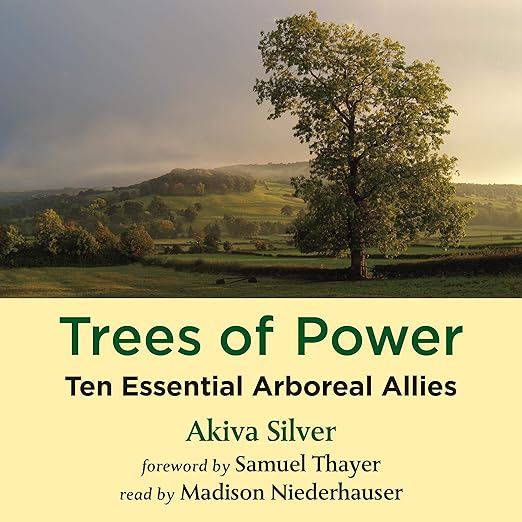
Quick Take
- Narration: Madison Niederhauser’s warm and engaged delivery suits Akiva Silver’s enthusiasm perfectly, making what could be dense horticultural content feel like a conversation with someone genuinely excited about trees.
- Themes: Human-tree partnership, soil-building through perennial systems, ecological restoration through species selection
- Mood: Quietly inspiring, the kind of listening that makes you want to go outside and dig something
- Verdict: A 4.9-star book that earns its rating through genuine expertise delivered with warmth, though listeners outside temperate North America should note the geographic specificity.
I was planning a backyard food forest project when I came across Trees of Power, and I listened to it over a weekend while mapping out a section of my garden that had been stubbornly underutilized. By Sunday evening I had reconsidered three of my species choices and ordered two things I hadn’t previously considered. That’s the practical test for a horticultural audiobook, and this one passes it.
Akiva Silver runs his own commercial nursery and writes from a position of working knowledge rather than synthesized research. The difference shows immediately. When he describes propagation techniques for chestnuts or explains why black locust has such unusual nitrogen-fixing properties, the detail comes from someone who has done these things repeatedly rather than compiled them from secondary sources. Reviewer Maggie Twigg captures this quality precisely: Silver knows these trees the way you know something you have put real time into, not theoretically but through the specific resistance and cooperation of actual living plants.
Our Take on Trees of Power
The book’s architecture is well considered. The first half covers foundational concepts: propagation methods including seed, grafting, layering, and cuttings; soil building principles; the ecological logic of woody perennials in agricultural systems. The second half profiles ten specific trees, each given a chapter with its own ecology, culture, and uses. This structure works both as an audio experience and as a reference, though the latter function is more effective in print. The trees covered are chestnut, apple, poplar, ash, mulberry, elderberry, hickory, hazelnut, black locust, and beech, all commonly found across temperate North America with considerable overlap into other temperate zones globally.
Reviewer Amber L. Bishop makes the key geographic note: Silver is writing from the Northeast United States, and his knowledge is deepest in that biome. He does acknowledge other climatic conditions, which reviewer Amber L. Bishop credits him for, but listeners in significantly different precipitation environments or growing zones will need to do translation work. Silver’s framework and ecological principles are broadly applicable; the specific species knowledge is most directly relevant to temperate North American conditions.
Why Listen to Trees of Power
Madison Niederhauser’s narration is a genuine asset. Horticultural content in audio format risks the flat delivery that makes dense informational books difficult to sustain. Niederhauser brings energy and warmth that mirrors Silver’s own voice in the text: someone who finds the material genuinely interesting rather than someone working through a reading assignment. Reviewer Ryan describes the book as “the gateway to seeing and loving trees in ways you never imagined,” which is the kind of response that happens when both the writing and the narration communicate genuine enthusiasm rather than just information.
The philosophical dimension that reviewer Jon E. Korneliussen mentions, the blend of history, philosophy, and practical tips, gives the book staying power beyond its immediate utility. Silver isn’t just cataloguing tree species. He’s making an argument about the relationship between human communities and the perennial plants they depend on, and about the particular responsibilities that come with tree stewardship across generational timescales. A tree you plant today will likely outlive you. Silver treats that fact as the foundation of an ethic rather than a footnote.
What to Watch For in Trees of Power
Reviewer JD Savage notes that the first half of the book assumes some prior growing knowledge, which is worth flagging for listeners who are completely new to gardening. The concepts are explained but not at an introductory level. Complete beginners may want to pair this with a more foundational permaculture or homesteading text before working through the horticultural specifics Silver covers. Listeners with even moderate growing experience will find the concepts accessible.
The audio format has one genuine limitation for this book: the visual diagrams and illustrations that appear in the print edition aren’t available to audio listeners, which matters most for the propagation technique sections. If you plan to actually implement Silver’s grafting or layering instructions, the print or ebook edition alongside the audio would be the most functional combination.
Who Should Listen to Trees of Power
This is for the permaculture practitioner, the homesteader adding perennial food systems, the environmentalist who wants to do something tangible rather than theoretical, and anyone who has felt what Silver describes as a deep kinship with trees and wants practical vocabulary to match that feeling. The audience Silver addresses in his own synopsis is genuinely wide, and the book delivers across that range.
Listeners who want a comprehensive reference covering hundreds of species will find the focus on ten trees limiting. Silver’s depth on those ten is exceptional, but if breadth is the primary requirement, this is a companion rather than a complete library.
Frequently Asked Questions
Does Trees of Power cover propagation techniques in enough detail to actually use them, or just introduce the concepts?
In enough detail to use them, though the audio format means you’ll want the print edition alongside for the visual diagrams covering grafting and layering. Silver runs a commercial nursery and writes from practical working experience, so the instructions are specific rather than conceptual.
Is this book useful for listeners outside North America, particularly in different temperate climates?
The ecological principles and partnership philosophy are broadly applicable. The specific species knowledge is deepest for the temperate Northeast US, and Silver’s climate context is that region. Listeners in the UK, northern Europe, or similar temperate zones will find significant overlap. Those in significantly different precipitation or temperature conditions will need to adapt.
How does Trees of Power relate to other permaculture audiobooks like Gaia’s Garden or Toby Hemenway’s work?
Silver is narrower in focus but deeper on his ten species than broad permaculture surveys. He’s less concerned with whole-system design than with the specific ecology and culture of key trees. The books are complementary rather than overlapping, and reading Silver alongside a broader permaculture framework is a common approach.
Is Madison Niederhauser’s narration suitable for listeners who find horticultural content dry in audio form?
Yes. Multiple reviewers specifically describe Silver’s writing as engaging rather than dry, and Niederhauser’s delivery matches that warmth. The combination makes technical tree content more accessible in audio than you might expect from the subject matter alone.