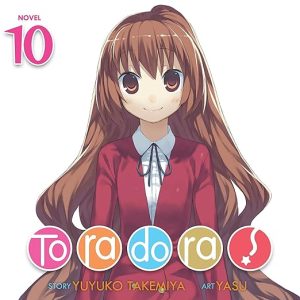
Ryuuji and Taiga's story concludes in Toradora! (Light Novel), Vol. 10 with the particular weight of a narrative that has spent nine prior volumes earning this moment. Yuyuko Takemiya's light novel conclusion, narrated in audiobook form by Courtney Shaw, resolves the series' central romantic arc through what might be the most logistically complicated and emotionally loaded teenage elopement plan in Japanese popular fiction: one that requires Minori, Ami, and Kitamura to answer definitively how much they love these two people and what they are willing to sacrifice for them. The audiobook runs just over five and a half hours, proportional to the emotional terrain it maps, and it represents the culmination of a story that began with an unlikely domestic arrangement between a boy who cooks and cleans and a girl who intimidates everyone who meets her.
For listeners arriving at this audiobook as the tenth entry in a completed series, the experience is fundamentally different from encountering a single standalone novel. The accumulated history of Ryuuji's patient domestic steadiness and Taiga's fierce, often violent self-protective aggression gives every scene in this volume a resonance that depends entirely on what came before. Takemiya is clearly writing for readers who carry that accumulated history - the dialogue is calibrated for people who remember how far these characters have traveled from their respective starting points, and the audiobook rewards that patience with scenes that land very differently when you have lived inside this cast of friends for the full series arc rather than arriving at their conclusion fresh. Shaw's narration reflects this cumulative quality: she is performing for an audience that already knows and loves these people.
Highlights
Courtney Shaw's narration understands the specific difference between the light novel's narrative voice and the anime adaptation's visual language, and she exploits that difference productively rather than simply providing audio access to the text. The best light novel audiobooks add texture that the source medium necessarily leaves implicit: interiority, physical detail, the specific quality of a held silence in an emotionally charged scene. Shaw gives Taiga's voice enough of the original character's combative energy and spiky defensiveness to be immediately recognizable to fans of the anime while simultaneously finding the vulnerability beneath that exterior that Takemiya's prose makes more visible than any animated performance can. Ryuuji's chapters are handled with the quiet, pragmatic warmth that defines the character across the full series.
Reviewers who have followed Toradora across all its media adaptations - the anime, the manga, and the light novels - consistently note that the print versions add details and emotional nuances that the anime compressed or translated into visual shorthand. This final volume is where those additions have the most cumulative impact, because the conclusion carries the weight of everything the series has built. The parents' interference subplot, which in the anime can feel like a plot mechanism the story needs to overcome before reaching its destination, has more psychological texture in Takemiya's novelization. The specific fears and misunderstandings that have hardened into parental opposition receive the space here that the anime could not afford to give them, and their eventual dissolution feels earned rather than narratively convenient.
The supporting cast's choices in the final arc constitute some of the audiobook's most affecting moments. Minori, Ami, and Kitamura each face a version of the question the series has always been circling about self-knowledge and honesty, and each response reflects their individual arc across the previous nine volumes. Shaw delivers these scenes with the kind of emotional specificity that comes from genuine understanding of the character relationships rather than competent reading of a script.
Before You Commit to Toradora! (Light Novel), Vol. 10
The elopement plan is deliberately impractical, and Takemiya leans into its absurdity with the same self-aware humor that has always coexisted with the series' emotional sincerity. Do not be put off when the logistics start to accumulate in ways that seem increasingly unlikely. The complexity of the plan reflects the complexity of the feelings behind it - these are teenagers trying to solve an adult problem with the tools available to them, and the gap between what they are trying to do and what they can actually accomplish is part of the point. Shaw navigates the tonal balance between the comedic elopement planning and the genuinely moving resolution with the same craft that has made the series work across ten volumes.
Listeners who watched the anime and feel they know this ending should understand that the light novel version provides a longer and more textured approach to the same destination. The audiobook ending is not a surprise if you know the series, but it lands differently - with more weight and more earned completeness - than the animated version's conclusion. One reviewer described being sad for it to end, which is exactly the right description for a finale that does its job fully without overstaying. The series' closing note is one of cautious forward momentum rather than triumphant resolution, which feels honest about what it is like to be seventeen and having just made the most important decision of your life so far.
Best Suited For
Fans of the Toradora anime who want more time with these characters and a fuller, more internally detailed version of the series ending will find this audiobook the most direct path to that experience. Readers who have been working through the light novel series in audiobook form will want this final volume as the natural completion of their investment in Shaw's narration and Takemiya's characters. New listeners should not start here under any circumstances; this audiobook depends entirely on the accumulated emotional investment of the preceding nine volumes and provides no orientation for those arriving without that context. If you have never encountered Toradora and are deciding whether the time investment is worthwhile, start with the anime - it is the fastest way to understand what the series is doing emotionally before you commit to the extended experience that the light novels provide.