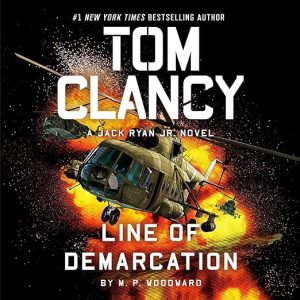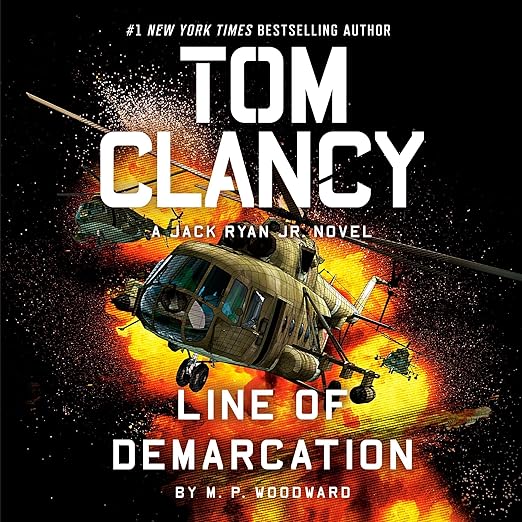
Jack Ryan Jr.'s thirteenth outing drops him into Guyana at one of the more volatile intersections of oil, empire, and covert violence the series has yet attempted, and this audiobook delivers that conflict with the controlled efficiency that has defined Woodward's contributions to the franchise. Scott Brick narrates, which is a genuinely meaningful piece of information for anyone who has spent time in the broader Clancy audio catalog. Brick has a long history with this material, and his measured cadence suits Woodward's prose well: clean declarative sentences, action that doesn't linger, geopolitics rendered legible without being dumbed down.
The setup in Tom Clancy Line of Demarcation is efficiently brutal. A US Coast Guard cutter goes down with all twenty-two hands in what should have been a routine mission to open a sea lane near a newly discovered oil field. Jack Ryan Jr. is already in Guyana on business for Hendley Associates, and what looked like a business deal becomes something considerably more dangerous as Russia's Wagner Group and Venezuelan narco-terrorists enter the picture. The question driving the plot, who sacrificed twenty-two people and why, is the kind of question the franchise handles well when it is at its best.
First, the Big Picture
What Woodward does particularly well, and what separates his installments from the more generic thriller assembly-line output that sometimes carries legacy brand names, is his attention to the geopolitical substrate beneath the action. The Guyanese oil field isn't decorative backdrop. It connects to real questions about resource extraction, South American political instability, and Wagner Group adventurism that feel lifted from the news cycle rather than invented for plot convenience. One reviewer called the novel absorbing and dynamic, crediting Woodward as a good writer, which is damning with faint praise but points at something true: the book is well-constructed without being flashy, and that relative modesty is actually a strength in a franchise that can suffer from overreach.
Brick's narration reinforces this. He doesn't perform the tension so much as sustain it. His Jack Ryan Jr. has a steady competence that never shades into unearned cockiness, and his villain voices carry menace without melodrama. At 11 hours and 55 minutes, the audiobook is a substantial commitment, but the pacing earns the runtime. Woodward doesn't waste chapters on setup that doesn't pay off, and Brick doesn't allow scenes to drag beyond their purpose.
The Best Parts of Tom Clancy Line of Demarcation
The audio version of this particular installment benefits from Brick's familiarity with the universe. He has narrated enough Clancy-adjacent material that his performance carries a kind of institutional memory, a sense that he understands not just the words but the genre's expectations. That experience shows in how he handles the technical military and intelligence vocabulary, which can become awkward when narrated by someone less fluent in the idiom.
For listeners coming from Woodward's previous Jack Ryan Jr. entries, this one sits comfortably in that lineage while expanding the geography and the stakes. The Guyana setting gives the franchise some fresh visual texture after installments set in more familiar cold-war geography, and the Wagner Group angle, a private military company with Kremlin adjacency, feels like a timely update to the series' traditional Russia-as-antagonist framework. Woodward has done his homework on the geopolitical situation, and that research shows in the specificity of the scenario rather than in the length of the expository passages.
A Few Reservations
Newcomers to the Jack Ryan Jr. series will find this installment accessible as a standalone thriller, though some context about Hendley Associates and Jack's backstory will be assumed rather than provided. The novel doesn't spend time recapping prior entries, which experienced series listeners will appreciate but newcomers may find slightly disorienting in the early chapters.
The subplot involving the shifting line of demarcation between friend and foe is where the book's title earns its meaning, and Woodward handles it with sufficient ambiguity that the resolution doesn't feel predetermined. One reviewer described the plot twists as interesting, which in the context of this genre is a real compliment; the franchise can sometimes telegraph its pivots well in advance. Woodward shows more restraint than that here.
The social media angle that one reviewer flagged as heavy-handed does appear, and for listeners who find that particular device worn out, it may grate slightly. It is not the load-bearing element of the plot, but it is present as a contemporary texture that the series is trying to integrate into its Cold War-derived DNA. Whether that integration feels natural or forced will vary by listener.
Should You Listen to Tom Clancy Line of Demarcation?
Series fans who have followed Woodward's contributions to the Jack Ryan Jr. franchise will want this one. Listeners who appreciate geopolitical thrillers with genuine research behind the scenes, not just names-on-a-map verisimilitude, will find Woodward's treatment of the Guyana oil field situation satisfying. Scott Brick fans need no further persuasion; he is at home with this material in a way that makes the full 12 hours feel controlled rather than exhausting.
Skip it if you are allergic to the Clancy franchise's particular blend of operational detail and patriotic scaffolding. Skip it if you want your thrillers to arrive at their conclusions faster than roughly 12 hours allows. But if you want a well-executed installment in a long-running series that shows genuine care for its geopolitical material, this audiobook does the work without calling attention to itself. Woodward's track record in the franchise is now long enough to constitute a body of work worth following, and this installment is a reliable entry in that catalog.
- Read by: Scott Brick brings exactly the right controlled tension to M.P. Woodward's prose, anchoring the geopolitical complexity with a steady, authoritative performance.
- At its heart: Intelligence operations, resource geopolitics, loyalty under pressure
- Vibe: Taut, propulsive, and geopolitically grounded
- Short version: Woodward continues to demonstrate that he genuinely understands what makes the Clancy universe tick, and Brick's narration keeps the pressure on from the opening scene.
Questions Listeners Ask
Is Scott Brick the narrator for this audiobook?
Yes. Scott Brick narrates the full audiobook, and his familiarity with the Clancy universe makes him a strong choice for the franchise's blend of technical vocabulary and geopolitical intrigue.
Is this audiobook based on real events or geopolitical situations?
The Guyanese oil discovery and Wagner Group involvement are drawn from real-world dynamics rather than invented whole cloth, which gives the thriller its sense of contemporary urgency.