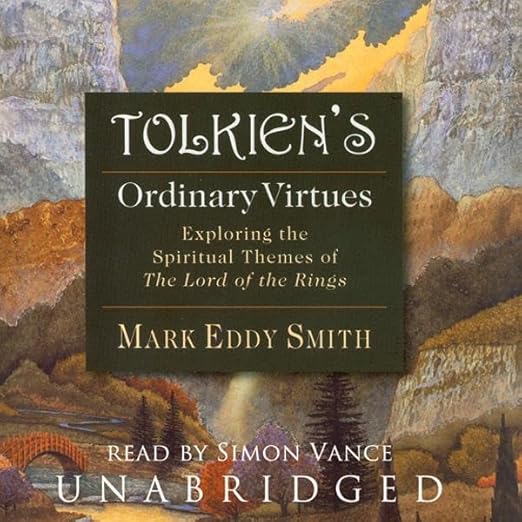
Brevity is the first surprise here: a book about The Lord of the Rings that takes under three hours to hear. Mark Eddy Smith is not attempting a companion volume, a concordance or a work of criticism. This audiobook works through a short list of virtues that Tolkien's characters practice almost without noticing, generosity, pity and hospitality among them, and asks what each one would cost a listener who decided to practice them as well. Simon Vance takes the reading credit and Blackstone released the recording in 2008, on a text short enough to hear twice in an afternoon.
Smith's argument is simple and consistently applied. The trilogy contains a working moral vocabulary, most of it unremarked by the characters who live it, and the book pulls that vocabulary out one word at a time. Generosity, pity and hospitality get their own treatment. So do the roots of destruction, which the description locates in pride and betrayal, and the ingredients of getting through, which it names as community and sacrifice. The organizing claim is that every reader, even the most simple, is called to a journey of some kind, and that Frodo's company is evidence you will be given the help you need on it.
Subtraction is the technique. A five-star from May 2013 describes it more sharply than the publisher copy does, saying the book peels away the difficult language, the songs and poems, the genealogies, the histories and the unfamiliar politics of Lord of the Rings in order to reach the virtues underneath. Whether that sounds like clarification or like vandalism will tell you a great deal about whether this book is for you. Everything that response lists as an obstacle is, for a certain kind of reader, the actual pleasure of Tolkien.
Notice who the description puts on its guest list: Bilbo, Gandalf, Tom Bombadil and Glorfindel. Two of those four never reached the screen, which is a quiet signal about the intended audience. This is a book for people who have read the novels rather than watched them, and it assumes you will recognize a name without a paragraph of introduction.
What Stands Out
Virtue talk becomes concrete when it is attached to characters, and that attachment is where the book earns its keep. A five-star from April 2015 puts it plainly, calling the explanation of each virtue and the way it shows up in a particular character genuinely illuminating. Abstract nouns of this kind slide off a listener; a specific hobbit refusing a specific thing does not, and building the argument on scenes rather than definitions is what keeps the moral instruction from turning into a lecture.
Simon Vance holds the reading, and the material asks something specific of whoever takes it on. A book of this kind is largely made of quotation, moving between Smith's own prose and passages lifted from a novel with a very different rhythm, and the reader has to make the transition audible without announcing it. Nothing on the record points to music, effects or a second voice, so the whole business of separating the two writers rests in the delivery itself.
Length is a genuine asset rather than a compromise. At under three hours the book fits inside one commitment, and its structure invites return visits, since the chapters are effectively separable essays that can be revisited one at a time without rereading the whole. Books written for reflection often bury that possibility under bulk. This one keeps it available, and the audio format makes a second pass unusually cheap.
Before You Commit to Tolkien's Ordinary Virtues
The publisher copy leaves out the frame. Nothing in the description mentions Christianity or scripture, and the record files the title under literary history and criticism, but a five-star from July 2014 describes the method exactly: quotations from the trilogy paired with quotations from scripture, tied together into a single argument. That is a devotional reading of Tolkien, which is a perfectly respectable tradition and not the same product as literary criticism, and a listener who came expecting the second will notice the difference within a chapter. That same entry recommends the audio edition specifically, saying the narrator adds a nuance the page does not.
Overreach is a genuine risk here, and the responses are honest about it. A four-star from June 2023, from someone who has read the trilogy many times, says a few of the correlations Smith proposes had to be forced, while adding that none of them break. That is the occupational hazard of thematic readings: a scheme built around a fixed list of virtues will eventually need a scene to illustrate the fifth one, and the scene that gets recruited is not always volunteering.
Quotation is the audio-specific difficulty. Print marks the boundary between Smith's sentences and Tolkien's with indentation and quotation marks, and a listener has none of that, so a passage from the novel can arrive with no visible seam and drift back out again the same way. Anyone who cares which words belong to whom will want the print edition open, and anyone who does not will find the two voices merging into a single sustained meditation, which is arguably the effect the book wants anyway.
Best Suited For
Readers who have finished the trilogy more than once and want to think about what it asks of them are the natural audience, especially anyone comfortable with a Christian reading of the text. A five-star from February 2025 describes finishing the book, taking notes on it and expecting to return to those notes over time, which is exactly the right relationship to have with something this short and this deliberately practical. Three hours is a small investment for a book meant to be revisited.
Tolkien completists after scholarship should go elsewhere. This is not source criticism, philology or a study of the legendarium, and the sections that treat the novels as a moral resource rather than as an invented world will frustrate a reader who came for the invention. Listeners with no patience for a devotional register should treat the scripture pairing as the method rather than as an occasional flourish, and choose accordingly.
At a Glance
- Read by: Simon Vance is credited alone, and the job here is boundary-keeping, since the text moves constantly between Smith's prose and long passages borrowed from the novels.
- At its heart: generosity and pity and hospitality, pride and betrayal as the roots of ruin, community and sacrifice, a Christian reading of Tolkien
- Vibe: Quiet and reflective, closer to a retreat talk than to literary study
- Short version: A short, warm devotional reading of Tolkien that works well on its own terms, provided nobody sold you literary criticism.
Is the audiobook organized by virtue or by the plot of the trilogy?
By theme, on the evidence of the description, which moves from qualities to the characters who embody them and then to what ruins people and what carries them. The book crosses the trilogy rather than walking through it, so anyone wanting a chapter-by-chapter companion is buying the wrong shape of book entirely.
How long is the audiobook, and who is credited with the reading?
Two hours and fifty-five minutes, read by Simon Vance, in a Blackstone recording issued in November 2008. No other voices are credited on the record, and no abridgment is indicated, so what you get is the complete text at a length most listeners will finish in one go.
Does the audiobook cover The Hobbit and the wider legendarium too?
Only glancingly. Bilbo appears among the named figures, but the description centers on The Lord of the Rings and on Frodo's company in particular. Nothing on the record suggests any treatment of the invented histories, languages or earlier ages that fill the surrounding books, so a reader after the wider mythology should look elsewhere.