The Short Version
- Read by: Esther Wane is a natural fit for Melanie Cellier's clean fairy-tale register, moving between Charlotte's warmer interiority and Gwen's more guarded perspective with clear vocal distinction.
- At its heart: Forced marriage and female agency in a fairy-tale world, friendship as foundation for love, found family across class lines
- Vibe: Warm, adventurous, and genuinely sweet without being saccharine
- Short version: A well-crafted fairy-tale duology in a single package, best suited to listeners who want clean romance, dual heroines, and a retelling that respects its source while reinventing the emotional architecture.
I have complicated feelings about fairy-tale retellings. The form has been so thoroughly worked over in the last fifteen years that the burden of proof has shifted: a retelling now needs to justify itself against the tradition it is entering, and the most common failure is to assume that swapping the perspective or the gender dynamics is sufficient. The source tale, East of the Sun and West of the Moon, is itself a less-visited corner of the fairy-tale canon, which gives Melanie Cellier more room to maneuver than a Cinderella or Sleeping Beauty retelling would allow.
I listened to this duology over a long Saturday, the kind of day where you want something that will hold your attention without demanding too much of it. The dual-heroine structure, Charlotte's story and Gwen's story running in parallel until they intersect, was the element that most surprised me. It transforms what might have been a single romance into something closer to a friendship narrative with romantic subplots embedded on both sides.
Our Take on To Ride the Wind and Steal the Sun
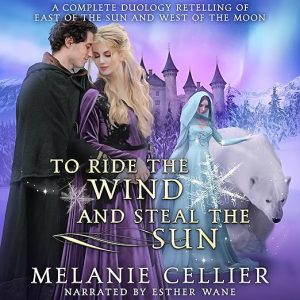
The setup is precise about its two parallel problems. Charlotte has been pushed into marriage with a stranger by sisters more interested in her beauty than her wellbeing, and what she is building with this stranger of a husband is a partnership she did not choose but is slowly learning to value. Gwen, a princess whose people live isolated in the mountains, discovers that her mother's scheming threatens the entire world, and she has lost the one friend who might have helped her stop it. The connection between these two stories takes time to reveal itself, and the pleasure of the second book is largely in watching how Cellier has constructed the seams between them.
Readers who have encountered Cellier's other fairy-tale retellings, she has a long catalogue in the Four Kingdoms universe, will find this duology consistent with her established approach: the source myth is honored structurally while the emotional relationships are thoroughly reinvented. One longtime reader calls the combination of Cellier and Wane my happy place, and that kind of reader loyalty after multiple books is meaningful. It suggests that this author delivers reliable quality rather than variable peaks.
Why Listen to To Ride the Wind and Steal the Sun
The packaging decision, combining both books into a single 17-hour listening experience, is the right call. Both reviewers who had read the books separately describe wanting to experience them together, and one notes that having all two books together really immerses you into the exciting world. The intersection of Charlotte's and Gwen's arcs is structurally the most satisfying element of the retelling, and that intersection has more impact when you move from book one to book two without interruption. Esther Wane's narration maintains vocal consistency across both heroines throughout, which the combined format requires and which she delivers.
What to Watch For in To Ride the Wind and Steal the Sun
This is explicitly clean romance, which the fanbase consistently mentions as a feature. Listeners who prefer more friction or more explicit content will find the romantic development restrained. The retelling also stays close to a fairy-tale moral universe where good and evil are not ambiguous: Gwen's mother is a genuine villain, Charlotte's sisters are genuinely selfish, and the resolutions are satisfying rather than complicated. If moral ambiguity is what you are after, look elsewhere. If you want the fairy-tale emotional structure executed with genuine craft, this delivers it.
Who Should Listen to To Ride the Wind and Steal the Sun
This is ideally suited to listeners who have enjoyed clean fantasy romance, who appreciate dual-perspective storytelling, and who want a fairy-tale retelling that has done genuine work on its source material rather than simply renaming the characters. It is also worth noting that several readers recommend it for sharing with younger listeners, given the content. Skip it if you need a single sustained protagonist or if the clean romance constraint frustrates you. But if those parameters suit your listening habits, this is a well-executed example of what the form can achieve.