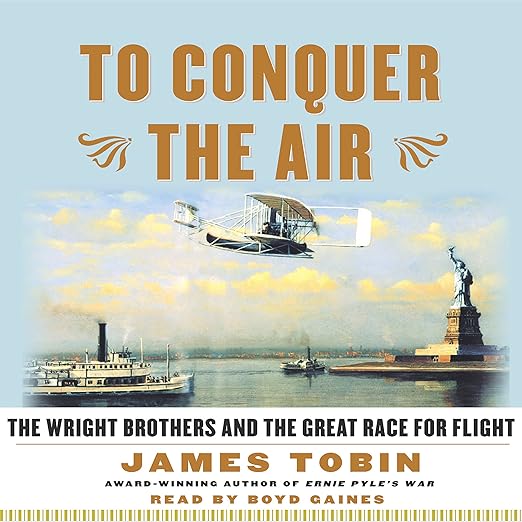
I came to To Conquer the Air having already read one account of the Wright Brothers' story, a short popular history that focused primarily on the Kitty Hawk moment and treated it as triumphant endpoint. What James Tobin does in this biography is considerably more ambitious and, in my estimation, considerably more honest about what the triumph at Kitty Hawk actually meant in context, which is to say less than the myth suggests and more than the cynics allow.
Tobin is a National Book Critics Circle Award winner for biography, and that training shows on every page. He approaches the race for powered flight not as a simple hero narrative but as a collision of personalities, methods, and philosophies. Wilbur Wright, Samuel Langley, Glenn Curtiss, Alexander Graham Bell: these are not stock figures here. They are specific human beings with specific blindnesses and specific gifts, and Tobin is genuinely interested in all of it, which is what distinguishes this from the many accounts that treat the Wrights as folk heroes and everyone else as supporting cast.
The Verdict, Briefly
The central argument of To Conquer the Air is methodological. Langley, armed with Smithsonian resources and a US War Department contract, approached flight as a problem of power. The Wrights approached it as a problem of balance. This distinction, which sounds simple in summary, ramifies across the entire book. Langley's backed-by-institutions approach produces spectacular public failures. The Wrights' bicycle-shop empiricism, working in obscurity with family support and rigorous iterative testing, produces a machine that actually flies.
Tobin never lets this become a simple story of the humble overcoming the establishment. He is careful about what the Wrights' success actually required, including a family, particularly their sister Katharine and their father Milton, that was unusually cohesive and intellectually serious. The autodidact narrative that sometimes attaches to the Wrights, two guys without high school diplomas who figured out what the experts could not, is more complicated than that. Their self-education was real, thorough, and methodical, in some respects more rigorous than Langley's institutional credentialing, and Tobin gives it the careful analysis it deserves rather than treating it as charming folklore.
What Makes To Conquer the Air Worth Hearing
One reviewer noted that To Conquer the Air gave them the other side of the Wright-Curtiss patent battle after reading a Curtiss-centered account, and Tobin's treatment of this period is one of the book's most interesting and least romanticized sections. The 1903 triumph at Kitty Hawk was, as Tobin writes, ill-reported and disbelieved. The Wrights spent years afterward trying to transform their delicate machine into a practical airplane while others worked to overtake them, and the story of those years is where Tobin's historian's accuracy and novelist's eye work best together.
The showdown over New York harbor between Wilbur Wright and Glenn Curtiss is rendered with the kind of dramatic specificity that marks the book at its best. Curtiss, the fastest motorcyclist in the world at the time, is not a villain in Tobin's telling but a genuine rival with his own claims on the history of flight. How Tobin balances sympathy across his subjects without collapsing into false equivalence is one of the book's quieter achievements, and it is what makes the book genuinely rereadable in a way that more partisan accounts of the same events are not.
Points to Consider
Boyd Gaines was an appropriate choice for this material. He narrates with authority and a storyteller's instinct for pacing, which matters considerably in a biography that needs to make aeronautical engineering accessible without condescending to the listener. The technical passages, descriptions of control surfaces, the specific mechanics of how the Wrights' machines solved the balance problem, come through clearly enough to follow without becoming so simplified that the engineering loses its interest.
One reviewer observed that Tobin sometimes goes off on tangents that stretch relevance, and I noticed this occasionally in the audio, where an extended section on a minor figure's motivations or a digression into period social texture would slow the narrative momentum. These tangents are not random: Tobin is building a sense of a world, not just a race. But listeners who prefer tighter biographical narrative may find a few of these stretches test their patience in audio format more than they might on the page, where you can skim more easily.
Who Should Listen to To Conquer the Air
The clearest thing To Conquer the Air leaves behind is a revised sense of what the Wrights actually were: not romantic dreamers who winged their way to glory, but scientists who identified the right problem, built systematic experiments to answer it, and refused to be deterred by the weight of authority and money stacked against them. Tobin's book does not sentimentalize that. It respects it in the way that only serious biographical treatment can.
At just over six hours, this is not an exhausting listen. It moves well for its subject and rewards listeners who bring some curiosity about the early aviation period rather than just the famous moment. For those interested in how innovation actually happens, as opposed to how it gets mythologized after the fact, it remains one of the sharper books in the genre and one of the most honest about the cost of being right before the world is ready to believe you.
In Brief
- Narration: Boyd Gaines brings a crisp, authoritative storytelling voice to Tobin's narrative, well-suited to the competing ambitions and rivalries the book tracks.
- Themes: Scientific discipline versus brute force, American innovation mythology, the obsession required for genuine discovery
- Mood: Measured and absorbing, with the quiet tension of a race whose outcome everyone already knows
- Verdict: One of the best audiobooks on the Wright Brothers and their era, balancing biography, history, and the specific drama of human flight with uncommon skill.