At a Glance
- Read by: Alyssa Blask Campbell narrates her own method with practiced, practical warmth, the voice of someone who has actually used these scripts in real meltdowns.
- At its heart: Collaborative Emotion Processing, toddler tantrums and self-regulation, caregiver emotional modeling
- Vibe: Encouraging and hands-on, built for immediate real-world application
- Short version: A genuinely useful, script forward audiobook for parents of young children currently navigating big emotions, not just another gentle parenting philosophy title.
Collaborative Emotion Processing, a Real-Moment Toolkit
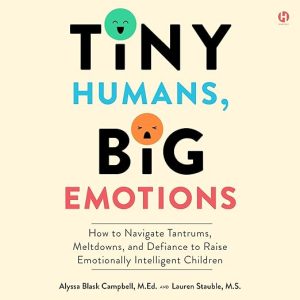
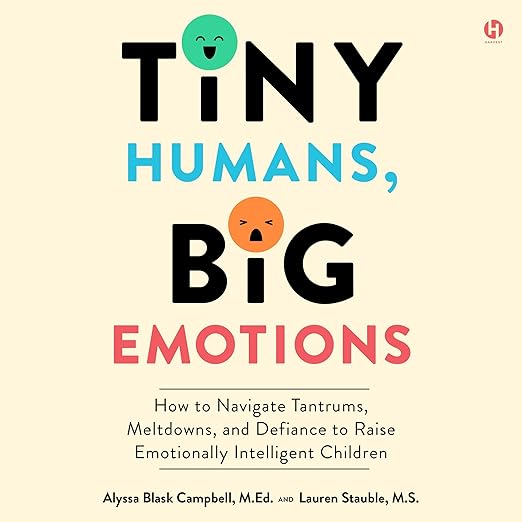
Collaborative Emotion Processing sounds like a phrase built for a conference slide, but Alyssa Blask Campbell spends this entire audiobook translating it into something a parent can actually use during an actual tantrum at an actual grocery store checkout line. Campbell narrates her own material, co-written with fellow early childhood expert Lauren Stauble, and the result is less a parenting philosophy book than a working manual for the exact moments most parenting books gesture past: the hitting, the meltdown that starts before bedtime and will not end, the sudden refusal to walk through a classroom door that opened easily yesterday.
The book's argument rests on a generational shift Campbell names directly: the old default of minimizing a child's feelings, don't cry, you're fine, don't make a scene, is giving way to an approach grounded in what researchers now understand about developing brains. Tiny Humans, Big Emotions positions itself squarely inside that shift, built around the Collaborative Emotion Processing method Campbell and Stauble developed together, and structured less as theory and more as a toolkit: specific scripts for school refusal and bedtime resistance, concrete guidance for when a child hits or bites, and techniques aimed at regulating a child's nervous system before a meltdown fully arrives.
The synopsis frames its own mission with a specific tagline: the future is emotionally intelligent. That framing matters because it positions Tiny Humans, Big Emotions as generational rather than merely a tips-and-tricks manual, arguing implicitly that today's approach to a toddler's tantrum shapes tomorrow's adult capacity for self-regulation. Campbell and Stauble back that ambition with named credentials, an M.Ed. and an M.S. respectively, giving the New York Times bestseller status here real institutional weight rather than pure platform popularity.
Self-Narrated Specificity, Down to the Scripts
Self-narration is close to essential for this kind of book, and Campbell's delivery bears that out. She sounds like someone explaining a method she has used in real rooms with real overwhelmed toddlers, not an actor reading a manuscript cold. The practical, encouraging register the material calls for, confident without being clinical, warm without slipping into saccharine reassurance, comes through because the person narrating is also the person who built the framework being described.
What separates this from the broader gentle parenting audiobook shelf is specificity. Rather than a general philosophy of validating feelings, Campbell and Stauble walk through named, distinct scenarios: what to actually do in the middle of a tantrum, which the book states directly is not what most parents assume; how to anticipate and interrupt a meltdown before it fully begins; and how to notice a caregiver's own habitual reactions, since the book frames emotional regulation as something adults model as much as something children learn.
The book's promise of specific scripts for moments like school refusal and bedtime resistance is worth calling out directly, since it signals a level of concrete usability that separates this from more abstract parenting philosophy. Rather than leaving caregivers to improvise language in the middle of a stressful standoff, Campbell and Stauble provide actual wording to reach for, the kind of detail that turns a listened-to audiobook into something a tired parent can recall and use in the moment rather than only in hindsight.
Co-Regulation Is the Method's Real Mechanism
Central to the book's method is the idea of co-regulation, the well-established developmental principle that a young child's nervous system is not yet equipped to self-soothe independently and instead borrows calm from a present, regulated adult. Campbell returns to this idea repeatedly across different scenarios, framing a caregiver's own composure during a meltdown not as a nice-to-have but as the actual mechanism the rest of the method depends on, which reorients a lot of the practical advice around the adult's internal state as much as the child's external behavior.
This positions Tiny Humans, Big Emotions somewhat differently from the broader gentle parenting shelf it might otherwise get grouped with. Where some titles in that space lean heavily on permissiveness or avoiding all conflict, Campbell and Stauble are explicit that boundaries remain necessary, the goal is processing emotions collaboratively rather than eliminating limits entirely, a nuance the synopsis itself gestures toward when it promises tools for tackling stressful situations rather than simply tolerating them.
Built as a Toolkit for Infancy Through Age Eight
This is explicitly a caregiver's guide, useful across infancy through roughly age eight per the synopsis's own framing, so parents of older kids or teenagers looking for adjacent strategies will find the age range narrower than a general emotional intelligence title might promise. The book is also built as a genuine toolkit rather than a single continuous narrative, which means some listeners will want to revisit specific chapters, the bedtime resistance material, the hitting and biting guidance, as situations come up rather than absorbing everything in one long sitting.
One reviewer's comment is worth flagging honestly: a five star rating attached to an admission of not having finished the book yet. That is not unusual for a practical parenting guide people start applying immediately, but it does mean some of the strongest praise on record reflects an early, promising impression rather than a completed assessment of the full method across all ten-plus hours.
Listeners coming from a more traditional, consequence-based parenting background should expect this book to challenge some deeply held assumptions rather than simply supplement them. The synopsis names the pattern directly: minimizing a child's emotions, the don't cry, you're fine approach many current parents were themselves raised with, is exactly what this method sets out to interrupt, which means getting real value from the audiobook requires genuine openness to reconsidering inherited parenting instincts rather than just picking up a few new phrases.
At just over ten hours, this sits comfortably in the same range as most substantial parenting guides, long enough to cover real depth across infancy through age eight without demanding the kind of extended commitment a much longer narrative nonfiction title would. Many caregivers report absorbing books like this in short fragments, a chapter during a nap window, another during a solo commute, and the toolkit structure here supports that fragmented listening pattern better than a book built around one continuous argument would.
Toddlers, Tantrums, and Twins Getting Real Help
Strongly recommended for parents and caregivers of toddlers and young children specifically, especially anyone currently in the thick of tantrums, separation anxiety, or aggressive outbursts and looking for scripts rather than general philosophy. One reviewer credited the book with tremendous help managing twins with big feelings, a specific, concrete outcome that speaks to the material's practical design.
Educators and childcare providers working with children in the same infancy-through-eight age range will also find real professional value here, since the Collaborative Emotion Processing method was developed by two early-childhood specialists with classroom as well as home-based experience in mind, not exclusively a parent-facing framework.
Skip it if you are looking for parenting guidance focused on teenagers or older children, since the core age range here runs from infancy to about eight, or if you strongly prefer a research heavy, citation dense approach over Campbell and Stauble's practitioner first, scripts and scenarios style.
Frequently Asked Questions
Does the author narrate this parenting audiobook herself?
Yes, Alyssa Blask Campbell narrates her own material, and that self-narration adds real credibility given the practical, scripts-based nature of the advice.
What age range does this audiobook's advice actually cover?
The guidance is aimed at caregivers of children from infancy through roughly age eight, so it will feel narrower for parents specifically seeking strategies for teenagers.