
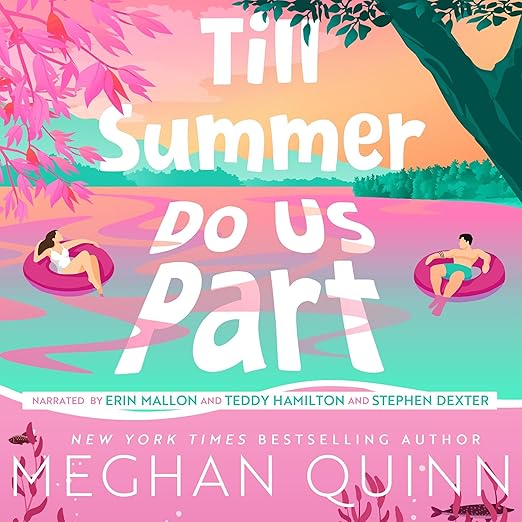
Scottie Price's predicament begins with a lie so specific and compounding that it achieves a particular comic logic: she invents a husband to fit in at a job where everyone else is married, gets immediately called out for not wearing a wedding ring, escalates by claiming an unhappy marriage, is offered mandatory couples counseling by her boss, drafts a fake husband from her best friend's improv-obsessed millionaire brother, and ends up at an eight-day summer marriage camp in a shared cabin with a man she has known for approximately forty-eight hours. Meghan Quinn's Till Summer Do Us Part is an audiobook that commits to that premise without apology, and that commitment is what makes it work.
Erin Mallon narrates with the light touch the material requires. Quinn's prose is genuinely funny in the way that the best romantic comedy writing operates: the situational complications are absurd, but the characters within them have consistent internal logic that keeps the comedy from tipping into pure farce. Scottie is not an idiot who makes these decisions out of laziness. She is a person who panics in a specific social direction, and once you understand that direction, every escalation lands with the inevitability that good comedy depends on. Mallon finds that internal logic and plays it straight, which is the right choice.
Wilder Wells and His Always-Say-Yes Rule
Wilder Wells is a better-constructed romantic lead than Quinn's premises usually demand. The improv background is functional rather than decorative: his rule about always saying yes gives the fake marriage arrangement its governing principle, and when it backfires during the counseling session, it is because improv logic and real emotion operate on different systems. The moment where he signs them up for summer camp without breaking character is the film's first act problem played correctly - the lie has to get bigger before it can collapse. Mallon's performance through the camp sequences captures the tonal shift from pure comedy to the slower, warmer territory Quinn moves into when Scottie and Wilder start to actually know each other.
Reviewer ChristiReadsALot cataloged the trope stack explicitly: fake marriage, best friend's brother, only one bed, adult summer camp for couples, forced proximity. That is a lot of romantic comedy infrastructure in one package. The reason it does not collapse under its own weight is that Quinn, whatever her faults as a realist novelist, is a disciplined practitioner of the long setup and the earned payoff. Reviewer FirstLight Reviews noted that the book "delivers" for readers "in the mood for a hilarious, heat-packed, fake marriage romance that doesn't skimp on emotional depth" - and that emotional depth is what distinguishes Quinn's better work from the merely competent.
Banter Needs a Narrator With Good Timing
The audiobook format suits romantic comedy in a specific way that literary fiction does not quite share: the banter scenes are better heard than read because Mallon can calibrate the comic timing in real time rather than leaving it to the reader's internal rhythm. Quinn is explicitly described by reviewer Cristina as "a master of comedic banter," and banter is an acoustic phenomenon. The back-and-forth between Scottie and Wilder during the marriage counseling sessions, during the camp activities, and in the cabin's unavoidably close quarters benefits from a narrator who understands that comedy is as much about pause as it is about line.
At eleven hours and fifty minutes, Till Summer Do Us Part runs longer than many romantic comedies of its register, but the length is honest about what Quinn is doing: building a full character study of two people who each have specific reasons for hiding behind their respective performances. Scottie's fake husband persona is a defense against the loneliness of being the only woman at a sausage-fest job. Wilder's yes-to-everything improv practice turns out to be its own form of avoidance. Quinn makes sure to earn the ending by showing you what they are each hiding before she lets them stop hiding it.
Unhinged Plots, But an Earned Payoff
Reviewer Cristina offered the most grounded caution available: Quinn "is a master of comedic banter, but her plots just get more unhinged with every book." The marriage camp premise requires more suspension of disbelief than most contemporary romances ask for, and listeners who need their fiction to track closely to plausible workplace and social dynamics will find the escalation curve steep. The improv-obsessed millionaire who happens to be available, the boss who responds to a lie about an unhappy marriage with mandatory couples counseling rather than, say, concern or discomfort - these require a particular reading contract that some listeners will not want to sign.
For listeners who do sign that contract, the heat level is present but the emotional payoff is genuinely worked for. Reviewer FirstLight Reviews noted the book does not "skimp on emotional depth," and the reviews suggest that the camp sequence, despite its improbability, is where Quinn does her most careful characterization work. Mallon's narration does not soften the absurdity but she does not play it for camp (in the mockery sense), which keeps the emotional transition in the second half from feeling jarring.
Escapism That Knows What It Is
Romcom listeners who have made peace with Quinn's escalating premise architecture and want a well-executed fake relationship audiobook with real emotional payoff will find this entry satisfying. Erin Mallon fans, who know her from her narrations across multiple contemporary romance series, will find her in comfortable territory here. First-time Quinn readers who want to know what the bestselling author's voice sounds like at its most characteristic should note that this represents her banter-heavy, comedy-forward mode rather than her more dramatic work. Readers seeking strict contemporary realism, or who require their protagonists to make decisions within the range of normal human judgment under pressure, should look elsewhere. This is escapism with self-awareness about what it is, and Mallon makes it an eleven-hour listen that passes faster than it should.







