
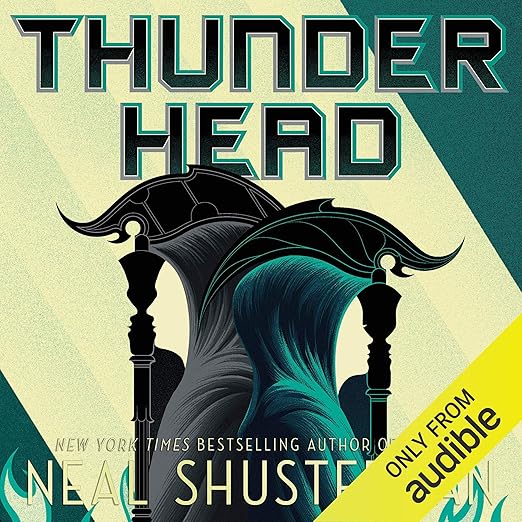
In Brief
- Performance: Greg Tremblay carries thirteen hours of a book that keeps cutting away from its two humans to the entity watching them.
- What it covers: Licensed killing as a profession, an institution attracting the wrong applicants, two friends who agree on the problem and not the method
- Feel: Procedural dread under an unexpectedly companionable surface
- Our call: The strongest kind of middle volume, provided you have read Scythe first, because the description gives that book away in three sentences.
Book two arrives with the first novel's ending already spent. Within three sentences the description for this audiobook has told you that Rowan is off grid and living as an urban legend, and that Citra is now Scythe Anastasia, which are not small things to hand a person who has not read Scythe. Thirteen hours and two minutes later I would still call it a fair exchange, because Thunderhead is the rare middle volume that widens its own subject instead of marking time until the finale. It simply requires you to have done the reading first, and the listing will not tell you so.
Total Visibility, One Rule It Won't Break
Rowan and Citra were partners and rivals in the first book. Here they are on opposite sides of a moral argument and, for long stretches, nowhere near each other. A four-star review from April 2020 sets out the shape of it in more detail than the publisher bothers to: Rowan has gone off-grid and become a dark folk hero, called Scythe Lucifer in that same write-up, burning corrupt scythes across the continent, while Citra works inside the institution as a junior scythe under Scythe Curie and challenges the new order from within it. Same diagnosis, two incompatible treatments. That is the engine, it is a good one, and it runs for most of the length without needing a villain to justify itself.
Shusterman's real subject, though, is the third party. The Thunderhead is described in the copy as something that observes the Scythedom and cannot interfere in its affairs, and the same paragraph adds, flatly, that it does not like what it sees. A watcher with total visibility and one prohibition it has agreed never to break is a genuinely good problem to build a novel around, and the book spends most of its length leaning on it. Every time the human plot tightens, the perspective pulls back to something that could fix all of this in an afternoon and has promised not to. The question the description closes on, whether the Thunderhead intervenes or simply watches a perfect world unravel, is not rhetorical decoration. It is the plot.
Tremblay Turns Killing into Family Listening
One of the five reviews is the only place on this listing where the book is described in actual use. A five-star from September 2025 recounts a household that played it in the car with the kids and then performed the good parts aloud when a parent came home from work, and calls the experience fun as a family. Greg Tremblay is the credited voice, and that domestic detail tells you something real about register: a book whose premise is professionalized killing plays as shared entertainment rather than as an ordeal, and thirteen hours absorbs interruption without losing the thread. Very little young-adult dystopia survives being paused by a parking maneuver.
The moral argument underneath the plot is more serious than a teen-fiction shelf implies, and it is what makes a middle book worth its length. Gleaning is a job with rules, an institution, and a career ladder, and any institution eventually attracts people who like the work for the wrong reasons. Citra's compassion and Rowan's fire are two answers to the same question about who should be permitted to hold that office, and the book pointedly declines to mark either one correct. The copy calls this a chilling sequel. What is actually chilling is how procedural the apparatus is, how reasonable everybody sounds while defending it, and how quickly the phrase new order stops sounding like a slogan and starts sounding like a personnel policy.
Page 122 Went Missing from a Different Book
Page 122, according to a five-star from Canada in May 2025, was missing from that reader's copy and replaced with an entry from the Thunderhead. Sit with that for a second. A misbound signature is a thing that happens to printed books and cannot happen to a recording, which means the review column under this audio listing contains at least one person grading a physical object. It is a small detail and a useful warning at once, because that same column is where the 4.7 you are reading comes from. Fifteen ratings averaging 4.7 means the pool has surrendered four or five stars in total across all of them, no more and no fewer, and nothing on the page tells you which edition any of those deductions were aimed at.
October 2018 produced the most detailed of the five, a five-star that reads like a chapter summary and takes care to note that a year has passed and that nothing blatant has changed as far as the reader knows. Read it and you notice something structural: it cannot describe this book without describing the previous one. Every review here that engages with the plot reaches backward to do it, without exception. Meanwhile the listing files Thunderhead under teen and young adult with a single tag for literature and fiction, which gives a browsing buyer no signal whatsoever that the premise is speculative, that the title character is not a person, or that this is the second half of an argument started in another book.
Systemic Dread Over a Single Villain
Anyone who finished Scythe and liked it should simply continue. This is the volume where the series stops being a contest between two apprentices and becomes an argument about institutions, and it closes on a note that makes a third book non-optional rather than merely tempting. Listeners who prefer their dystopias systemic rather than personal, where the dread sits in procedure and paperwork instead of in a single antagonist, will get thirteen hours of exactly that. It also travels well beyond its home market: the shortest review in the column, filed from Australia in late 2024, calls it a departure from that listener's ordinary reading and lands on the premise alone.
Pass on it if you have not read Scythe, and not because you would be lost. You would be spoiled, thoroughly, inside the first paragraph of the description, which is a strange thing for a publisher to do to its own back catalog. Pass also if you need a middle volume to resolve something, since this one widens the board and hands it back unfinished. And go in aware that the category fields give you nothing to work with: teen fiction plus a literature tag, for a novel about who gets licensed to kill and what the watching thing above them decides to do about it. Nothing on this page separates the ratings by edition, which is worth a moment's thought before you lean on a 4.7.
Questions Listeners Ask
Do I need to finish Scythe before starting this audiobook?
Yes, and urgently. The description hands over where the first book leaves both of its leads inside its opening lines, so coming in cold costs you that novel's ending for nothing in return. Thunderhead also assumes you know why one of them is in hiding and what the other has been apprenticed to.
Does this audiobook stand on its own, or does it end on a cliffhanger?
It closes one argument and opens a larger one. The threads Rowan and Citra carry do reach a resolution of sorts, but the final movement changes the terms the whole series has been operating under and points squarely at a third volume. Expect a genuine ending and an unavoidable next purchase.
How graphic is the killing in Thunderhead for a younger listener?
Violence is the subject rather than a garnish, since the copy is candid that scythes glean and that Rowan is burning the corrupt ones. What the book does with it stays procedural more than visceral, arguing about who is licensed and under what rules. No content advisory appears anywhere on the listing.







