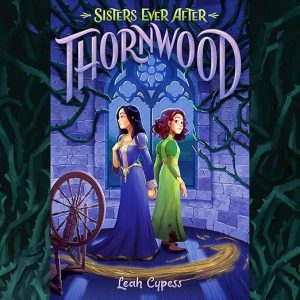
Quick Take
- Narrator: Jessica Almasy carries a first-person comic heroine for the full runtime, and the response column has left the performance entirely undescribed
- Subjects: Sibling rivalry, fairy tale retelling, a curse and its aftermath, finding your own destiny
- Tone: Wry, brisk, faintly eerie
- Bottom line: The funniest way to spend six hours inside Sleeping Beauty, with a menace underneath that the packaging never advertises.
Briony is the younger sister nobody in the fairy tale bothered to name, and Thornwood hands her the whole audiobook. Five hours and forty-one minutes of Sleeping Beauty told from the wrong end of the family, by a girl who has spent her life being measured against a sibling everyone agrees is the beautiful one. The premise works as a joke and a grievance simultaneously, and Leah Cypess plays both without letting either win.
Our Take on Thornwood
You know the story, the copy says, and then promises the part you do not. That is a confident way to sell a retelling, and the confidence is earned by the structure: the famous curse arrives on schedule, the castle sleeps its hundred years, and the book only really begins once everybody wakes up into a kingdom that has moved on without them. Briony is the one who has to work out what actually happened. Nobody wants to hear it from her, which is the point.
Shopping for grandchildren in 2021, a grandfather put the tonal question best: unlike many fairy tale retellings, this one is not sickly sweet. That reader particularly liked the heroine summarizing her sister's many virtues with the phrase blah, blah, blah. Comic deflation of exactly that kind is the book's default setting, and it is what keeps an underdog premise from curdling into self-pity.
Something colder runs underneath, though. The thing the sisters wake into is described as the murderous Thornwood, and murderous is not a word children's copy uses casually. A hedge of thorns that grew for a century and now wants something is closer to folk horror than to a princess story, and the book gets a real engine out of that shift.
Credibility is the actual subject. Who is going to listen to her, the copy asks, and the plot turns entirely on a girl nobody has ever taken seriously being the only person who grasps the danger. Middle-grade readers recognize that predicament instantly, because it is the ordinary condition of being eleven. Dressing it in a hundred-year curse does not disguise the situation so much as sharpen it.
Why Listen to Thornwood
Recognition beyond the target age is worth knowing about. A four-star from 2022 identifies the book as a nominee for the Andre Norton Nebula Award and, while noting that it is marketed to middle-graders, argues it can be enjoyed by anyone open to a fairy tale retold by a highly likable young heroine with challenging hair. That last phrase is doing a lot, and it explains why adults keep turning up in this column.
First-person comedy is also the material audio serves best. A voice that undercuts, sulks, exaggerates and then quietly gets on with saving everyone needs timing, and timing is what a page cannot supply. Jessica Almasy has to hold that register across nearly six hours while keeping Rosalin sympathetic rather than a punchline, since the sisterhood only pays off if the beautiful one turns out to be a person.
Length is right, too. Five hours and forty-one minutes divides neatly into a week of bedtimes or a couple of afternoons, short enough that a nine-year-old will not lose the thread and long enough to feel like a real book rather than a chapter sampler.
Listening Library handling the production counts for something in a category where self-published retellings are everywhere. A house working at that volume tends to get the unglamorous parts right: consistent levels, clean chapter breaks, casting chosen rather than improvised. None of it appears on the page as a promise, but the imprint is a reasonable proxy for a floor.
What to Watch For in Thornwood
Not one response on this record describes the recording. A 2024 entry comes closest, and it is about reading the book aloud instead: a parent working through it nightly with a ten-year-old daughter, dreading the arrangement at first and ending up as invested in the ending as the child was. Useful evidence about the material, and none at all about the performance, which is the single thing a parent choosing between formats most wants to know.
Age guidance is missing as well. The record shelves it as children's listening, adds tags for adventure, fairy tales and humor, and stops there. The column supplies the number the listing will not, placing it in the middle-grade bracket, and the read-aloud account names a child of ten. Somewhere around eight to twelve is the honest band, with the thorns and the deaths of the hundred-year gap pushing the lower end.
The award nomination surfaces only in the column, never on the page. No badge, no citation, no series companion appears in the record's own fields, even though the copy announces this as the first book of Sisters Ever After and the sequence has clearly continued. A listener who finishes and wants the next one has to go hunting.
Who Should Listen to Thornwood
If you are choosing something for a child who has outgrown picture-book fairy tales but is not ready for teenage fantasy, this sits exactly in that gap. A 2021 response from an aunt who bought three additional copies as gifts calls it wholesome and empowering while also being funny and fast-paced, and gift-buying at that volume is the most reliable recommendation any children's book gets.
Younger sisters specifically will take something from it that nobody else quite will. So will adults who like the fairy tale retelling as a form and are tired of the reverent version. What the book is not is a bedtime soother; the thorns are genuinely menacing and the stakes involve people not waking up.
Reluctant readers deserve a mention too. Short chapters, a voice that sounds like an actual child rather than an adult impersonating one, and a plot that starts moving well before the first hour is out make this a strong candidate for anybody who has stalled halfway through longer fantasy.
Skip the hunt for depth, because that is not on offer and never claimed. What Thornwood delivers in under six hours is a sharp, funny, slightly eerie retelling that respects its readers enough to give them a heroine with grievances, and a villain the packaging keeps remarkably quiet about.
Common Questions
What age is the Thornwood audiobook right for?
Roughly eight to twelve. The record gives no age band at all, shelving the title as children's listening with adventure, fairy tale and humor tags. Length, vocabulary and comic register all point at a middle-grade audience, and Listening Library, the imprint behind it, works largely in that space.
Is the Thornwood audiobook scary?
In places, yes. A thorn hedge that has been growing for a century, and that the copy calls murderous, functions as a genuine menace rather than as scenery, and Briony has to save her family and friends from it. Nothing is graphic, but sensitive younger listeners may want company for it.
Does it continue in later books?
The copy announces it as the first book in the Sisters Ever After series, though this record lists no companion titles and its series field carries only the number one. Anyone finishing and wanting the next installment will need to search for it rather than find it linked here.