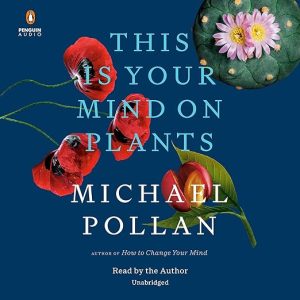
Opium, caffeine and mescaline are the three plants at the center of this audiobook, and the question holding them together is deceptively simple. Why is making tea from the leaves of a tea plant unremarkable, while making tea from the seed head of an opium poppy is a federal crime? Michael Pollan spends just over seven and a half hours refusing to let that question stay rhetorical, and he reads the whole thing himself, which turns out to matter more here than on most self-narrated titles.
Caffeine, the Odd One Out, Proves the Point
Pollan's subject has been drifting for years and one assessment names the drift precisely: the writing has moved from food culture into natural drug culture, and this book is a look at three further substances of interest. That same reader calls it somewhat of an extension piece to the earlier work on consciousness, which is fair, and then makes the sharpest observation on the page by noting that one of the three is a bit of an odd man out. Caffeine does not belong with opium and mescaline in any obvious way, and the book knows it. That mismatch is the argument, not a flaw in the selection. Put a legal stimulant most of the planet uses daily beside two substances that carry prison sentences, and the differences stop looking like facts about chemistry and start looking like facts about us. A book that had picked three illegal plants would have proved nothing at all.
Caffeine is the section people remember, and it works because the participation runs backward. For the other two plants Pollan consumes and reports. For caffeine he stops, which means the chapter is a withdrawal narrative written by someone deliberately removing the most normalized drug in the world from a working writer's day. The structure of the book depends on that inversion. Legality, ritual and social permission turn out to be the variables, not pharmacology, and the tea-versus-poppy question at the front of the description is answered by the time the caffeine section ends.
Pollan's Self-Narration Makes It Feel Confidential
Journalism that puts the writer inside the experiment always risks becoming a stunt, and the defense against that is the reporting around it. This book carries history, science and law alongside the first-person material, and the balance holds because it keeps stepping back outside the personal to look at the cultures that have grown up around each plant. The result is closer to an anthropology of permission than to a drug memoir. What counts as a drug turns out to be a question about custom, and custom is best examined by somebody who has tested its boundaries personally. The risk in that method is well known: the writer becomes the story. What keeps it honest here is that the experiments are unglamorous. Brewing a tea, going without coffee, writing down what happened. Nobody would call any of it an adventure, and the ordinariness is precisely what makes the legal contrast bite.
Michael Pollan reads it, and one four-star assessment explains why that choice pays off without meaning to. That reader describes the book as reading like a conversation, a struggle with himself along the way, which made the information feel almost confidential. A confidential register is exactly what self-narration produces. Written words performed by a hired reader are a performance of intimacy; written words spoken by the person who lived them are the thing itself, and in a book whose most interesting passages are about the author's own head, the difference is not decorative.
Mescaline Relies More on Secondhand Sources
Mescaline is where the book gets complicated and where a listener should slow down. An assessment that catalogs the book's sources names Pollan alongside two other people, traditional practitioners and researchers, and two of those names never appear in the publisher's copy. No fault attaches to that. It does show how much of the material arrives secondhand in this final section, because the legal and cultural position of mescaline makes direct participation a very different proposition from the one the opium chapter describes.
Twenty-five years is the age of the essay this book is partly built on, and the description says so openly. That is honest and it also sets an expectation. A quarter-century-old piece of reporting on opium sits inside a book published in 2021, so parts of the legal and cultural landscape described are not the current one. Nothing on the listing flags which parts. The recording arrived from Penguin Audio in July 2021 and nothing in the fields suggests any updating since, so treat the opium material as a period document with a long tail rather than as a survey of where things stand now. That is worth stating plainly because listeners tend to date a book by when they hear it, and audio strips away the visual cues, the dated jacket copy and the typography, that tell a reader in a bookshop how old a piece of reporting really is.
Coffee Drinkers Get Converted Most Reliably
Coffee drinkers are the audience this converts most reliably, which is a strange thing to write about a book two thirds concerned with controlled substances. The caffeine chapter is the one that reorganizes an ordinary morning, and almost everyone listening has an ordinary morning to reorganize. A short assessment sums up the appeal in a line, calling the style accessible and informative and the author a good writer of scientific material, and that is the promise being kept: no jargon, no lecture, no assumption of prior reading. The book is also genuinely funny in places, which is not obvious from a description that leads on federal crimes and altered consciousness.
Listeners who came for a psychedelics book will find only one of the three sections pointed that way, and even that one is more legal history than trip report. Anyone hoping for practical guidance should look elsewhere entirely, because the book is a work of inquiry rather than instruction and gives no protocol for anything. And if the idea of a writer making tea from an opium poppy and then telling you about it strikes you as reckless rather than interesting, that reaction is the book's actual subject, so you would spend seven hours arguing with it.
- Narration: Pollan reads his own reporting, which lets the passages about his own mind arrive from the person whose mind it was rather than through a hired performance of intimacy.
- Themes: Opium, caffeine and mescaline, the arbitrariness of drug law, ritual and social permission, participatory journalism
- Mood: Curious and companionable, sharpest when it turns on the reader's own habits
- Verdict: The caffeine section alone justifies the listen, and self-narration makes the first-person material land the way it should.
Does Michael Pollan read the This Is Your Mind on Plants audiobook himself?
Yes. The narrator field carries his name and no second performer is credited, so every minute of it comes from the author. For a book built around personal experiments with three substances, that removes any distance between the person reporting and the person reading it aloud.
How long does the recording run, and when did it come out?
7 hours and 37 minutes, released by Penguin Audio on July 6, 2021. The listing carries no series information whatsoever, so nothing is presupposed going in and nothing is promised as a follow-up afterward. One credit line, one voice, and no companion document mentioned in any field.
Which of the three plants gets the most time in the audiobook?
The description gives no page or chapter breakdown, and the running time is not divided in any field on the listing. What it does state is that the caffeine section involves the author trying not to consume it, which makes that portion structurally different from the other two.