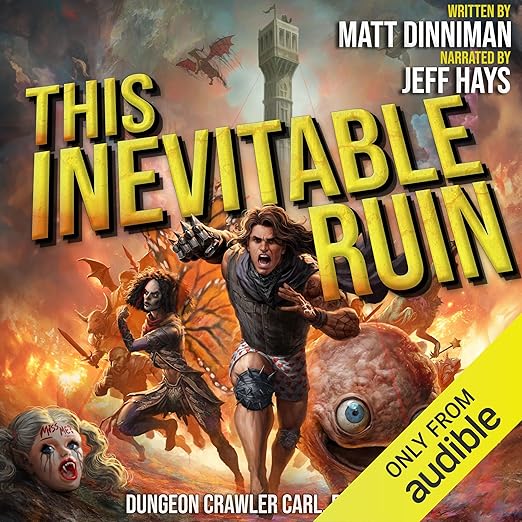
Book seven in any long-running series arrives with a specific set of expectations, and this audiobook of This Inevitable Ruin by Matt Dinniman both honors and complicates those expectations in ways that distinguish it from the kind of installment-filler that series fiction at this length can produce. Jeff Hays narrates, as he has throughout the Dungeon Crawler Carl series, and by this point the pairing of Dinniman's writing and Hays's voice has become as integral to the listening experience as the content itself. I came to this having followed Carl and Donut across the earlier floors, and I found the ninth floor's Faction Wars arc one of the series' most structurally ambitious chapters.
Nine Armies, One NPC Team, and Real Death
The setup is simultaneously escalated and clarified from previous books. Nine armies led by wealthy aliens compete for a central castle, with full real-death stakes for the first time: those who fall stay in the ground. Carl's group has become one of those nine teams, and the NPCs who have been cannon fodder throughout the series have formed a tenth, having achieved full self-awareness. For Donut and Katia, the stakes are even more specific: only one of them will be allowed to leave this level. Dinniman is not subtle about what this floor is intended to represent within the larger arc. 'This is what they have been fighting toward. This is war.' The chapter titles are not marketing copy; they reflect where the series has actually arrived.
Jeff Hays has built something unusual across this series: a voice for Carl that is immediately distinctive, simultaneously deadpan and earnest, which captures exactly the tone Dinniman writes in. The reviewer Dale Neely noted that the books are 'inventive, funny, and strange in a way that feels rare,' and Hays's narration is calibrated to that specific register. The dark humor that runs through the series, the meta-commentary on the AI running the dungeon, the absurdist naming conventions, all of these land in audio in a way that requires a narrator who genuinely understands what the writing is doing. Hays is that narrator.
Twenty-Nine Hours of War Across Multiple Fronts
The case for this installment specifically rests on what Lucas's review calls 'pacing that is strong, stakes that feel real, and humor that still lands without undercutting the darker moments.' That balance is harder to maintain at book seven than at book one, when the series is still building its world and its characters have not yet accumulated the history that makes loss meaningful. Dinniman navigates this by making the emotional weight of previous volumes load-bearing rather than incidental: what happens to Donut and Katia in this book would not carry the same impact without the preceding six volumes of context.
The nearly twenty-nine-hour runtime reflects the scale of what this book attempts. This is not a single narrative thread but a genuine war narrative, with multiple simultaneous fronts, shifting alliances, and the kind of strategic complexity that the Faction Wars concept promises. Dinniman handles that complexity by maintaining Carl's point of view as the organizing principle even when events are happening around him rather than to him. The AI's 'rapid decline' that Carl and company exploit for advantage is a thread that runs through the book and pays off in ways that are satisfying precisely because Dinniman has been patient about establishing it.
Cole's Favorite Book Comes at an Emotional Cost
This is firmly a book for established series listeners. Cole's review calls it 'my favorite book series to date' and immediately mentions depth of characters as the reason, but that depth is entirely cumulative. Coming to this volume without the preceding six would not just limit the emotional impact; it would make the stakes of the Donut-Katia situation largely incomprehensible. This is not a book that can function as a series introduction.
The emotional register of this installment runs darker than some earlier volumes in the series. The reviewer Lucas specifically notes that the book is 'emotionally heavier in a good way,' which is accurate but worth naming for listeners who come to Dungeon Crawler Carl primarily for its comedic absurdism. The comedy is still present and still functional, but this book is clearly processing the weight of its own accumulated history in a way that requires willingness to sit with difficult outcomes. The war narrative format naturally produces casualties, and Dinniman does not exempt his characters from that logic.
Experiencing this installment as an audiobook rather than in print is particularly relevant for a series where Jeff Hays has become so identified with the characters that listeners who started in audio often find print versions feel wrong by comparison. The humor in Dinniman's writing is heavily dependent on Carl's internal delivery, the particular brand of resigned competence that Hays has perfected across seven books, and the absurdist naming conventions for alien races, items, and dungeon mechanics land differently when voiced with the right degree of straight-faced commitment. At nearly twenty-nine hours, this audiobook asks for genuine sustained attention, and what it offers in return is a war narrative that has been earning its emotional weight across half a million pages of preceding story.
Series-Ready Listeners Get This Floor's Full Payoff
Existing Dungeon Crawler Carl listeners who have been following the series and are ready for the ninth floor's Faction Wars will find this installment delivers what the preceding books have been building toward. Jeff Hays's narration is as strong as ever, the structural ambition is genuine, and the emotional weight is earned rather than imposed. At nearly twenty-nine hours, it is a substantial commitment, but for a series at book seven, the willingness to make that commitment is already established.
New listeners to the series should start at book one. The series rewards sequential listening in a way that makes jumping in at this point a poor investment. For readers who want LitRPG fiction with genuine emotional stakes and comedy that does not flinch from darkness, the series as a whole and this volume specifically are worth the considerable time they require.
Common Questions
Can I start the Dungeon Crawler Carl audiobook series with This Inevitable Ruin?
No. The emotional stakes of this installment, particularly the Donut-Katia conflict and the Faction Wars setup, depend entirely on the preceding six volumes. Starting here would make the most significant moments incomprehensible.
Is this audiobook darker in tone than earlier Dungeon Crawler Carl books?
Yes, intentionally. Reviewers consistently note it is 'emotionally heavier' while maintaining the series humor. The Faction Wars setting brings real-death stakes for the first time and Dinniman does not exempt his core cast from the consequences of a war narrative.
What makes this audiobook different from earlier installments in the Dungeon Crawler Carl series?
The ninth floor's Faction Wars arc is the most structurally complex setup in the series so far, involving nine competing armies, fully self-aware NPCs, and stakes explicitly framed as the culmination of everything the characters have been building toward. It functions as the series' central payoff chapter.