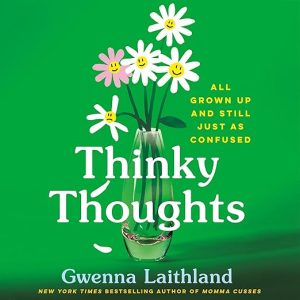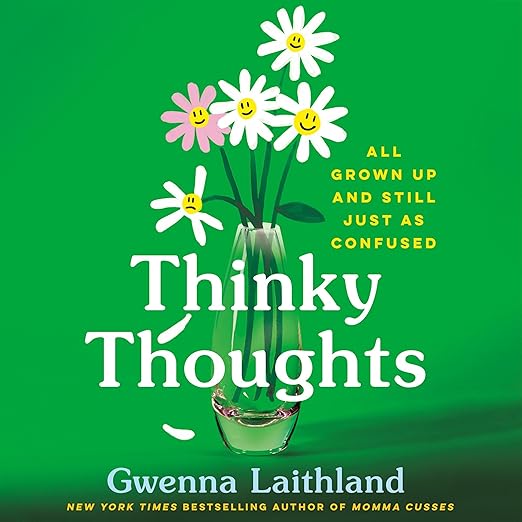
I started Thinky Thoughts on a Tuesday morning while folding laundry, which felt appropriate, and then I was still listening two hours later while sitting on the floor of my office having abandoned the laundry entirely. Gwenna Laithland, who runs the Momma Cusses corner of the internet, has built a following on the kind of self-aware, slightly chaotic honesty that resonates with people who find most parenting content exhausting. This audiobook is the natural extension of that voice, and as an audiobook specifically, it works better than almost anything I can compare it to in the genre.
The publisher positions it alongside Jenny Lawson and Samantha Irby, which is fair in the broadest sense: all three write from a place of genuine weirdness rather than performed relatability. But Laithland's voice has its own register. She's a millennial who came into motherhood carrying a brain that, by her own description, moves too fast. The essays here circle questions that don't resolve neatly: how her childhood shaped her motherhood, whether it matters if she hasn't left the house in three days, why her daughter loves adzuki beans but hates rollercoasters. These are not serious questions, and then they are, and the transition between those states is where Laithland is most interesting.
Essays and Fragments Between Memoir and Meditation
What Macmillan Audio has understood here is that some books don't just benefit from being read by their authors, they require it. Thinky Thoughts is a collection of essays, memories, poems, and fragments. The structure is intentionally loose, walking the line between memoir and guided meditation, which is exactly how it's described in the synopsis. That looseness would read as undisciplined on the page if you were skimming. In audio, with Laithland's particular sense of comedic timing, it reads as controlled chaos, which is the whole point.
The book doesn't try to answer the questions it raises. That's stated explicitly and it's not a weakness. "Thinky Thoughts won't answer life's great questions," the synopsis promises, "but it will make you feel a little better knowing you're not alone in asking them." That's an honest description of what this actually delivers. It's a book about existing inside your own head without it being a guide for improvement, which is rarer than it should be in this corner of the publishing world.
Gwenna Laithland's Timing Makes the Vulnerable Moments Land
The author-read format here is not a footnote. Laithland's performance is the text. Her timing in the comedy essays is sharp without being stagey, and her quieter moments, the ones where she moves from self-deprecating humor into something more vulnerable, land because of the cumulative trust the earlier sections build. You've laughed with her about cranberry bog spiders and grocery store anxiety before she gets to the harder material, and that matters.
At seven hours, this is a comfortable listen across a few sessions. The shorter essay structure means you can set it down and pick it back up without losing thread, which suits the fragmented, associative quality of the content. This is not a book that asks you to follow a sustained argument. It asks you to spend time inside a particular kind of mind, and that's a different kind of listening.
An Instant Bestseller With No Reviews Yet
This book was released in April 2026 and is listed as an instant New York Times bestseller, which suggests Laithland's online audience has followed her into this format with real enthusiasm. There are no aggregated listener reviews available yet, so this review works from the text and the author's established body of work rather than reception data.
One thing to be aware of: the book doesn't have the propulsive narrative pull of a memoir with a clear through-line. If you need a book to be going somewhere definitive, the associative, looping structure of Thinky Thoughts may feel unfocused. This is a feature for some listeners and a genuine friction point for others. Laithland herself frames the book as "a tiny bit of still not knowing what I'm supposed to be doing as an adult," which is accurate. Readers who want that uncertainty validated will find it. Readers who want it resolved won't.
Fans of Laithland's Existing Work Will Recognize This
Thinky Thoughts is suited for anyone who finds mainstream parenting and self-help content too tidy, too confident, or too convinced of its own usefulness. Fans of Laithland's existing work online will find this an expanded and more formally considered version of what they already love. Readers new to her should find the entry point easy, as she doesn't assume familiarity with her platform.
Skip it if you're looking for practical takeaways or a structured self-help framework. This book has no actionable steps. It has something harder to come by: the specific relief of recognizing your own particular brand of mental noise in someone else's words. For the right listener, that's worth considerably more.