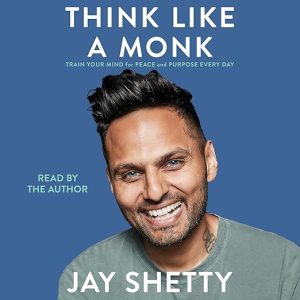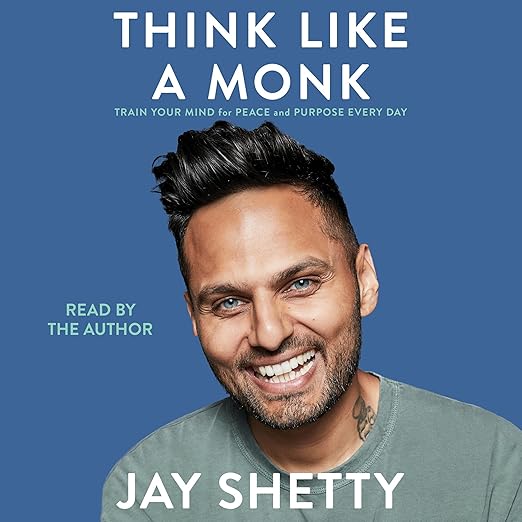
I came to Think Like a Monk later than most people in my circle. It had been recommended more than once during a period when I was skeptical of the self-help genre in general and of social media figures turned authors in particular. What I found, working through it one early morning commute at a time over several weeks, was something more carefully constructed and more honestly grounded than I expected. Jay Shetty's background is unusual enough to give this book a foundation that most entries in the genre simply do not have, and that foundation is not window dressing.
Shetty trained in the Vedic monastic tradition for three years in India, studying under teachers in an ashram and meditating for up to eight hours daily. He then returned to London at his teacher's suggestion, deeply in debt and without recognizable professional credentials, to try to bring what he had learned into contact with the world he had left. His reconnection with old school friends working for major corporations, all experiencing significant stress and unhappiness, became the origin of a coaching practice and eventually of this book. That origin story is not marketing copy. It is the actual architecture of the argument, and understanding it changes how you receive what follows.
Separating Who You Are from Your Roles
Shetty's central insight is not that monastic life is the answer to contemporary stress. It is that the specific practices and frameworks monks use to manage attention, identity, and purpose are transferable to people who will never renounce anything. The chapter on identity, distinguishing between who you are and the roles you perform, the values you have absorbed from family and culture versus the values you have actually chosen, is the book's strongest section and the one that reviewer P.J. Owen identified as doing something genuinely useful rather than repackaging existing ideas in new language.
Owen wrote with considerable experience of the self-help genre, noting that many books in the category take a narrow angle from someone else's original idea and extend it past its natural length, when a shorter format would have sufficed. His assessment of Think Like a Monk was that Shetty draws connections between ancient wisdom and modern application more effectively than most comparable books, and does so in a way that actually helps you put ideas into practice rather than simply understand them intellectually. That distinction between knowing a principle and being given tools to use it is where many books in this genre fail, and Shetty does not fail there. The book is practical in a specific and testable way.
The material moves through a logical progression from internal to external. The early chapters address identity, purpose, and the sources of negative thought patterns. The middle chapters move to fear, intention, and gratitude. The later sections address relationships, service, and the relationship between giving and finding meaning. That sequence is deliberate rather than arbitrary, and the architecture of the book rewards being experienced as a sequence rather than dipped into selectively.
Try This Exercises Turn Theory Into Practice
One of the book's practical strengths is its inclusion of Try This exercises at the end of chapters, specific and concrete practices that apply the preceding material directly rather than leaving the translation to the listener. Reviewer KG noted these exercises and their value as a complement to Shetty's podcast content. Reviewer Dr. Felish specifically recommended treating the book as a journey rather than a listening experience to be gotten through, approaching it slowly with a notebook in hand and treating each chapter as material to sit with before moving forward.
Reviewer Angel described the experience as genuinely life-changing, which is the kind of claim that reviewers of self-help books sometimes make under the influence of a listening session and sometimes mean with full sincerity. The specificity of Angel's account, the description of recognizing how much daily stress comes from clinging to things beyond control and how specific exercises helped address that, suggests genuine application rather than enthusiasm for the genre. That quality of reader response, across multiple independent reviewers, is one signal that the material is doing something beyond comfortable confirmation of existing beliefs.
Shetty Knows This Rhythm Better Than Any Narrator
At eleven hours, this is a substantial audiobook, and the narration carries the entire listening experience. Shetty has been delivering this material in live coaching contexts, in video content watched by hundreds of millions of people, and in podcast conversations with guests for years. His voice carries the warmth and unhurried quality of someone who has genuinely internalized what he is teaching rather than simply prepared it for presentation. There is no performance of wisdom in his delivery. There is the quieter quality of someone sharing what they have found useful, which is harder to fake in audio than in print and impossible to replicate through a hired narrator reading text that belongs to someone else's life.
He also understands the rhythm of the material in ways that no outside narrator could. He knows which concepts need space around them and which can move quickly. He knows where the humor is and how to deliver it without undermining the surrounding gravity. The result is an audiobook that rewards the full eleven hours rather than fatiguing across them.
Monastic Tools Without the Monastic Commitment
Ideal for listeners open to self-help with a spiritual dimension who want something grounded in practical exercises rather than abstract principles or motivational language. Also accessible to listeners curious about Vedic monastic practice who want its tools without its full commitments. Skip it if you are looking for neuroscience-based productivity frameworks or if you find ancient wisdom as a source of contemporary guidance unconvincing at the premise level. Shetty's touchstones are explicitly and unapologetically drawn from Indian philosophical and spiritual tradition, and that grounding is present throughout.
At a Glance
- Read by: Shetty reading his own book is an asset, his warm and unhurried delivery carrying the conviction of someone who has taught this material in live coaching for years.
- At its heart: purpose and identity beneath social expectation, the mechanics of negative thought patterns, the relationship between service and personal meaning
- Vibe: Earnest and grounding, dense with practical exercises but never preachy
- Short version: One of the more thoughtfully constructed self-help audiobooks of recent years, bridging ancient monastic practice and contemporary stress in ways that hold up under scrutiny.
Frequently Asked Questions
Do I need to be religious or spiritually inclined to get value from Think Like a Monk?
No. Shetty is explicit that the practices and frameworks he describes are transferable to people without religious commitments. The book draws on Vedic tradition without requiring belief, treating monastic practice as a source of psychological tools rather than doctrine. Multiple reviewers with secular orientations found the material applicable and useful.
How does Think Like a Monk compare to Shetty's podcast On Purpose as a learning resource?
Reviewer KG described the book as a complement to the podcast rather than a replacement, noting that the written format offers structured exercises and a logical progression that the podcast's episode-by-episode format cannot always provide. The book is a more cohesive single argument; the podcast extends specific topics in greater depth with guest perspectives.
Is Think Like a Monk available as a free audiobook?
Yes. Think Like a Monk is available as a free audiobook for Audible subscribers, which makes it a straightforward way to access what has become one of the more widely read self-help titles of the past several years without committing a credit.