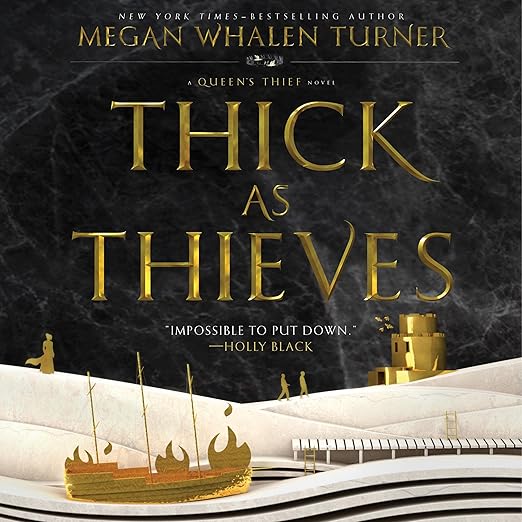
Can the fifth book in a sequence really be a fine place to start? The copy attached to this audiobook says so almost in those words, promising that the epic novels set in the world of the Queen's Thief can be read in any order. Two sentences later the same copy calls Thick as Thieves the fifth of them. Eight hours and forty-seven minutes with Kamet, a secretary and slave whose entire predicament rests on a court disgrace he assumes you already understand, left me thinking that promise needs a footnote rather than an endorsement. It is a fine book. It is not a fine door.
The Verdict, Briefly
Kamet begins at the top of a very small ladder, and a five-star response posted the day after release lays out the position more clearly than the jacket copy manages: he belongs to Nahuseresh, the emperor's nephew and brother to the heir, and he has hoarded favors for years because he expects to become the most powerful slave in the Mede empire. To him that is a career rather than a consolation prize, and the calculation is the most interesting thing about him. A whispered warning takes it away in a sentence. What follows is an overland escape with a stranger from Attolia, and a man who has spent his life administering other people's power discovering he has none of his own to administer.
Against that setup, the read-in-any-order line looks less like guidance and more like a sentence the publisher needed. Kamet's leverage, his master's decline and the reason an Attolian would cross an empire to collect him all rest on a political collapse that happened in an earlier volume, and the book treats it as shared knowledge rather than as something to be explained. You can follow the escape without it. You cannot feel the weight of it, and weight is most of what this series trades in. That gap is the difference between an adventure you enjoy on the surface and one that reorganizes itself in your head afterward, and eight and three quarter hours is a long time to spend on the wrong side of it.
The Best Parts of Thick as Thieves
Turner writes a particular kind of plot: everything you are told is true, most of what you conclude from it is wrong, and the correction lands late enough to rearrange the whole book behind you. A five-star response from July 2017 puts it the way a reader rather than a critic would, describing a plot developed carefully enough that you do not always know what is going on until the very end, and calling the multi-year wait between these books a delicious kind of anticipation. That is the trade the series asks for, and this volume honors it. The escape looks like a straight line for hours. It is not a straight line, and the moment you understand why is worth the fare by itself.
Steve West reads it, and the assignment is more delicate than an escape plot suggests. A four-star response from March 2023, written on a re-read, describes Kamet as starting out speaking to everyone in a haughty manner, which is precisely the difficulty: the arc of the book is that register coming apart in company he did not choose and cannot dismiss. A reader has to make the early superiority bearable enough to stay with and sharp enough that losing it registers as a loss. Add Mede and Attolian names arriving thick and with nothing on a screen to check them against, and the job runs harder than a young-adult adventure label implies.
Points to Consider
Delivery speed is what two of the five visible responses actually grade. A five-star from Australia in 2019 praises the book and the seller in one breath and finishes on how quickly the parcel arrived. Another, from France in January 2018, is about the pleasure of learning a new installment existed and ordering it immediately. Both are warm and neither concerns a recording. That matters more than usual here, because the ratings counter on the listing reads one. A single vote can only be a whole number of stars, so 4.6 cannot have come from it, and the review column by itself shows five graded responses. Whatever the true population is, the number of people you can read who are discussing the actual book is three.
Greenwillow Books sits in the publisher field, a book imprint name rather than an audio studio, and the rest of the description reads print-side as well. Three cover quotations are stacked into it and not one is about this volume: the first calls the Queen's Thief books a secret, discovered history of real but forgotten lands, the second promises you will fall in love with every page of these stories, the third talks about diving into the world and finishing them all. The award list, a Newbery Honor, a Los Angeles Times Book Prize, an Andre Norton shortlisting and the Mythopoeic Fantasy Award, is attributed to the novels as a group. None of that is false. None of it describes the eight hours you are buying.
The Right Listener for Thick as Thieves
Series readers are the obvious audience and hardly need my encouragement: this is the volume that hands the story to a new pair of eyes and returns it changed, and the last hour rewards four books of patience. Anyone who enjoys a two-hander on the road, where the danger is mostly logistics, cover stories and two people slowly taking each other's measure, will find one of the better recent examples. The Rothfuss and Martin comparisons in the copy set an expectation of scale that this book deliberately refuses; what it offers instead is precision, and precision is the rarer commodity.
Skip it, or postpone it, if this would be your entry point. The description invites you in cold and the book will not cooperate: the stakes are inherited, the emotional payoff belongs to people who are barely on stage, and Eugenides, the thief the series is named for and the copy sells hardest, is not whose head you occupy here. Newcomers hunting a standalone fantasy adventure will get a competent one and miss the reason anybody loves these books. That is a real cost for a title the publisher is pitching as a fine place to begin.