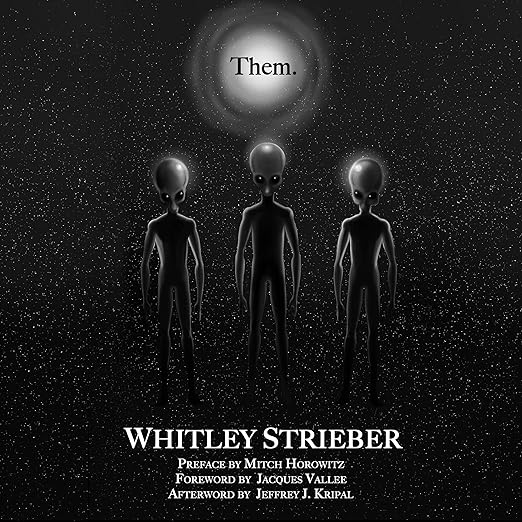
Whitley Strieber narrating his own audiobook, Them, produces an unusual listening experience. The author of Communion - the 1987 memoir that brought close encounter testimony into mainstream publishing - returns here not with his personal experiences at the center but with something more structured: an extended analysis of what multiple civilian and military witnesses have reported, and what those reports might collectively reveal about the intentions of what Strieber calls "the visitors." Important note for listeners: the author field on some editions lists another writer, but the synopsis, narration, and content are entirely Strieber's own work - this is his investigation of visitor phenomena, drawing on more than three decades of research. The self-narrated audiobook runs over ten hours.
The Verdict, Briefly
The structure of Them divides neatly into two movements. The first examines eleven civilian close encounter witnesses in depth, drawing on their reported experiences to construct what Strieber frames as the first serious attempt to derive intent from the data rather than simply cataloging events. The second half turns to military encounters, arguing that the visitors themselves have actively pressured governments to maintain secrecy, and that this pressure has had traceable effects on both public policy and on the lives of individual military personnel. Jacques Vallee, who wrote the foreword, calls the book a case for "in-depth realignment of public policy with public need," which is a description of its political ambition rather than just its analytical one. Mitch Horowitz, in the preface, places it in the lineage of Vallee's own Passport to Magonia - which is high praise within this field of inquiry. Strieber's central argument is that the persistent pattern across both civilian and military encounters points toward something stranger than simple contact: a relationship already in progress, already shaping institutional behavior, already producing casualties and suppression. That argument is made with more systematic evidence than most books in this genre attempt. Reviewer Ayden Raymond Greene notes that what distinguishes Strieber's approach is "honest inquiry into the 'what' we see and how much of it we don't understand" - he doesn't manufacture false certainty to comfort the reader.
Why Listen to Them
The self-narration is the decisive factor in why the audiobook format matters here. Strieber reading his own analysis of encounter witnesses carries a different weight than a professional narrator would produce. When he moves from the testimony of others to the book's final chapter - described as "riveting" - the shift in emotional proximity is audible in his voice. He has spent over thirty years inside this material, and the narration doesn't hide that investment. One reviewer accurately notes that there is "redundant material" from Strieber's earlier books for longtime readers, and that's a fair observation: passages involving letters he has received have appeared in other contexts. But the same reviewer concedes that the final third of the book contains genuinely new insights framed within a more comprehensive analytical structure than Strieber has previously attempted. At just over ten hours, the runtime is long enough to develop its arguments fully without exhausting patience. The two-part structure - civilian experiences followed by military encounters - creates a cumulative case that builds across the full runtime rather than front-loading its strongest material. Listeners who have read Communion or The Key will find this a substantive addition rather than a repetition, precisely because the analytical method here is more systematic than those earlier books.
Points to Consider
The book's most intellectually original section is its treatment of communication barriers between species with differently structured brains. Strieber doesn't frame this as a spiritual mystery but as a cognitive and structural problem - one that might be addressable once named clearly. That section rewards attention, and the audio format doesn't always allow for easy re-engagement. Because Strieber narrates with the momentum of someone who has lived inside these ideas for decades, it can be harder in audio than on the page to stop and sit with a particular argument. The book's insistence on taking its subject entirely seriously is both its greatest strength and its limiting factor for some listeners. Reviewers who came in skeptical found the forensic approach to witness testimony more compelling than they expected, but the framing throughout assumes a certain baseline willingness to take the phenomenon at face value. Listeners who approach this as a sociological or psychological study of reported experiences, rather than as an investigation of literal events, will find the book's premises in persistent tension with their own framing. Strieber does not hedge, and for listeners who need that hedging, the ten-hour runtime will test patience.
Who Should Listen to Them
Listeners already engaged with close encounter literature - those who have read Vallee, John Mack, or Strieber's earlier work - will find this the most analytically rigorous book he has written. It rewards serious attention from people who want to understand the pattern of military encounters specifically, not just the civilian ones. The military testimony sections in the second half are relatively underexplored territory even in this genre. Listeners looking for a horror audiobook in the vein of the original Communion will find this more sober than they expect. And those who have never engaged with this subject at all may find the lack of skeptical scaffolding a barrier to entry. But for anyone with genuine curiosity about what decades of consistent witness testimony might cumulatively reveal, Them offers something methodical and, in its final chapter, genuinely affecting.
A Few Questions About Them
Do I need to have read Communion before listening to this audiobook?
No, but it helps. Strieber's earlier work provides context for his personal investment in the subject, and readers familiar with Communion will recognize the framework he's building on. The audiobook stands on its own analytically, but the emotional weight of certain sections is deeper with that background.
Is this audiobook appropriate for listeners who are skeptical about UFO and close encounter phenomena?
Skeptical listeners who are curious rather than dismissive may find value in the analytical approach to witness patterns. But the book does not include alternative explanations as counterweights - it proceeds from the assumption that the encounters are real. That stance will determine whether the audiobook works for you.