Key Details
- Narrator: Cylin Busby reads a two-author memoir alone, on a label whose name is Full Cast Audio.
- Subjects: Attempted murder and its aftermath, small-town corruption, a child's account of fear, family survival.
- Tone: Tense, intimate, unresolved by design.
- Bottom line: A rare two-generation true story, sitting on a page whose rating badge does not add up.
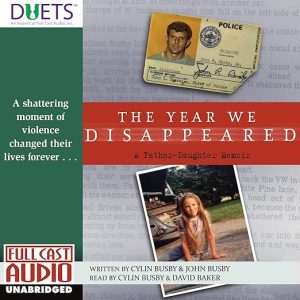
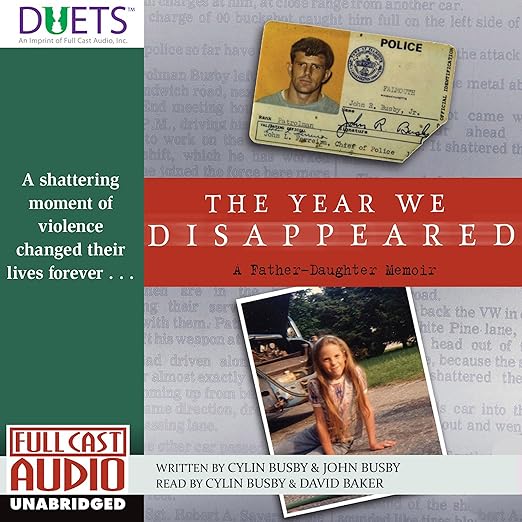
Which of the two voices in this memoir does the audiobook actually give you? The description says the book alternates: in separate chapters, John Busby and his daughter Cylin, who was nine at the time, recount the same year from opposite ends of it. The narrator field carries one name, Cylin Busby, and the author field carries that same single name, even though the description credits two people with the writing. Eight hours and thirty-five minutes of a two-person account, delivered by one of the two.
First, the Big Picture
John Busby is the reason this book exists and he is not on the byline. A peaceful summer night is shattered by gunfire as an unseen assailant tries to murder a police officer, the description begins, and it is his shooting, his survival, his multiple surgeries and his rage that fill half the chapters. He writes graphically and movingly, by the copy's own account. The author field still lists Cylin Busby by herself. Anyone searching for this story under the other name attached to it would never arrive here.
Five written responses sit on this page and the counter above them reads one. That is the first impossibility. The second is the badge: 4.3, from a single vote, when a vote is a whole number of stars. No rounding convention turns one rating into 4.3, so either the count is wrong, the average is wrong, or both are being computed from a pool the page does not display. The five visible grades run five, four, five, three and five, and their own average does not land on 4.3 either. None of this is fatal to the book. It is simply arithmetic that refuses to close.
Cylin Busby reads the whole thing alone, which is defensible and slightly strange on this particular label. The publisher field says Full Cast Audio. A memoir constructed from two alternating voices, issued under a name that advertises multiple performers, went to a single reader who happens to be one of the two writers. What the credit does establish is that half the book will be delivered by the person who lived it at nine. What it cannot establish is how a father's account of his own surgeries sounds in that same voice.
What Makes The Year We Disappeared Worth Hearing
The alternating structure is the reason to take this over a conventional true-crime account. Francesca Zee expected the switching to be confusing, or to cheapen the story, and reports the opposite: every other chapter they trade off, and the effect is an interesting twist rather than a gimmick. WishesUT, at three stars and the most skeptical entry on the page, credits the same device for making the household legible, showing how the adults absorbed the thing alongside how a child understood it. Two responses at opposite ends of the scale agreeing on one structural point is worth more than either would be alone.
Full disclosure of the setting is left to a reviewer rather than to the description. The copy never says where any of it happened. WishesUT supplies the answer, naming Falmouth, MA, and identifying John Busby as a police officer who stood up to the wrong people and paid for it. The description prefers a malignant thug who no one dares to cross. One of those is checkable and the other is jacket language. When a comment column outperforms the listing on hard information, that is worth noticing before you decide what the copy is worth.
One thing the description does state honestly is that the perpetrator remains at large, meaning neither Busby, nor his wife, nor their three children are safe, and that condition governs the entire book. CGI, at four stars, names the consequence precisely: the most frightening element is how powerful and influential criminals can be in a small town. That is the engine, not the shooting. Eight and a half hours leaves room to sit inside that fear rather than summarize it, and the alternating chapters mean you keep re-entering it from two different heights.
The Caveats
Readers who need resolution should read CGI's reservation before buying. That response calls the ending somewhat abrupt and traces the disappointment to caring what became of this family afterward. The description promises redemption and recovery, and ultimately hope and healing, which is a substantial claim for a story whose central threat was never lifted. Anyone who requires a closed case at the end of a true story should know that the copy is doing some smoothing here, and that at least one listener felt the distance between that promise and the final chapter.
A second date problem sits underneath the rating one. This edition is dated November 8, 2012, and the earliest response on the page was written that August, three months before the recording existed. Two further entries describe buying the book on an e-reader, one of them prompted by an offer that appeared on the device itself. The column is therefore assessing the text rather than this edition, and the badge floating above it has inherited every bit of that. Julie's entry, meanwhile, remembers the daughter as about eight when the shooting happened, where the description says nine, a one-year drift that tells you how these responses were composed: from memory, some years afterward.
Should You Listen to The Year We Disappeared?
Families with teenagers are the audience the category names, and the material supports the choice: a nine-year-old's account of losing friends, moving house and rebuilding a life under threat lands squarely in that register. Julie's response frames the book as a testament to a strong family and a strong marriage, which is fair to it. Adults who read true crime will find something less familiar than the genre usually supplies, since the victim and his child are the ones talking and neither treats the investigation as a puzzle to be solved. Classrooms working through nonfiction with older students get an unusually clean case study in point of view, because the same year is told twice and neither telling cancels the other out.
Give it a miss when you want procedure, forensics or an answer, because none arrives and the book says as much from its opening pages. A single reader voicing a father's account of his own rage may strike some listeners as the wrong instrument, and this page supplies nothing whatever to settle that. Cylin reads her own half of this from the inside, and for the listeners it reaches, it will reach very hard indeed.
Frequently Asked Questions
Why does the rating read 4.3 when the counter shows a single vote?
Because no rounding convention produces 4.3 from a single whole-star rating. Five signed responses are also visible above a counter that reads one, and the grades attached to them do not average out to the badge either. Some other pool is feeding these numbers, and the page never shows it.
Who narrates The Year We Disappeared audiobook?
Cylin Busby, alone, across eight hours and thirty-five minutes. She is also one of the book's two authors, so half the chapters are read by the person who lived them at nine years old. The publisher field, somewhat awkwardly for a two-voice memoir, reads Full Cast Audio.
Is John Busby credited as a co-author anywhere?
Not in the byline. The author field lists one name while the description states plainly that father and daughter write alternating chapters, and that his half covers the shooting, the surgeries and the rage. Anyone searching under the other name attached to this story will not reach this page.
Is this audiobook appropriate for younger teenagers?
The category says teen, and a child's-eye account of losing friends and starting over does fit that age. The subject is a shooting to the face, a threat that never lifts, and police corruption in a small town. Judge by the individual reader rather than by the shelf label.