
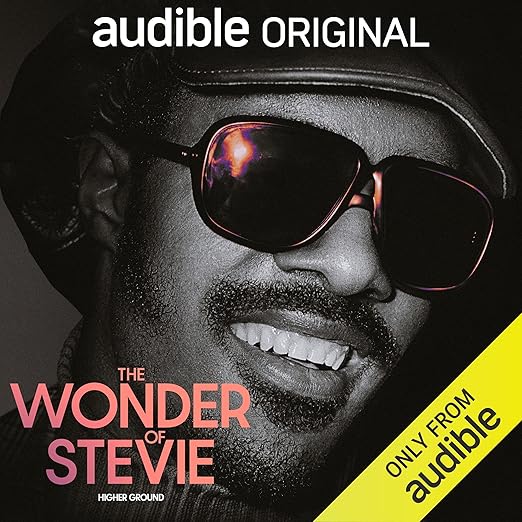
Five albums in five years, more than half a dozen Grammys, over ten million copies sold, and Stevie Wonder was not yet thirty. The Wonder of Stevie takes that run, beginning in 1972, and gives each record an installment of its own. Calling it an audiobook is already a slight misfit, because what arrives is a produced documentary series with a host, a long list of interviewees and more than forty of Wonder's songs running through it, sitting on a page built for books that somebody reads aloud.
The Real Role Here Is Host
Wesley Morris carries both the author credit and the reading credit, which is accurate and slightly misleading at the same time. The role is host. The description introduces Morris as a Pulitzer Prize-winning culture critic at the New York Times, and the format is conversation rather than recitation: contributors including Barack and Michelle Obama, Questlove, Smokey Robinson, Janelle Monae and George Clinton supply the analysis, and the host's work is shaping all of it into a single argument.
Each installment is built around one album, and that structural decision is what makes the whole thing work. The description invites you to follow the classic period chronologically or jump straight to whichever record you already love, which is a genuinely different proposition from a cradle-to-legacy biography. You can treat it as a listening guide instead: play the episode, play the album, return for the next one, and the running time stretches comfortably across weeks.
One October 2024 response calls it a lovely podcast, and that word is the most honest description anywhere on the page. The account comes from someone who was a young girl in the 1970s with music filling the house and the neighborhood, and who says the back stories behind these songs finally explain why the attachment lasted. That is precisely what the format delivers: not a life story, but the conditions under which specific records got made.
The Subject Finally Speaks for Himself
Forty-plus Stevie Wonder recordings run through the series, and that changes the experience in a way no printed biography can match. When the analysis turns to a particular arrangement, the arrangement is right there to be played against it. Music writing on the page has always had to describe sound using words; this is the format where that limitation simply disappears, and it is the strongest single argument for taking this material in audio rather than reading about the same five years.
Barack Obama appears twice over: once among the contributors, and again in a closing conversation with Wonder himself that the description flags as exclusive to the service producing the series. That final episode is doing a specific job. After hours of other people explaining what Wonder meant to them, the subject finally speaks for himself, and the reversal lands harder because everything before it has been testimony about him rather than from him.
Something worth naming directly: the series is explicit that Wonder's classic period draws on both the beauty and the pain of the Black American experience, and it puts his spiritual transformation at the center rather than treating it as background color. That is the through-line the whole project hangs on. It is also why the Grammy count and the sales figures end up feeling like the least interesting facts in the room, useful mainly as evidence that the culture noticed at the time. The series is far more interested in why an artist making music this joyful was also making music this angry, and in what it took to hold both at once.
Calling This an Audiobook Oversells the Format
Calling this an audiobook sets an expectation it does not meet, and that is the first thing to know. Nothing here is a chapter. The unit is the episode, the production is layered with archival audio and music rather than read straight, and if you want one continuous narrated arc from childhood to legacy, this is not built that way at all. The page prints no episode list either, so you cannot see the shape before you start.
Four Five-Star Reviews Force the Other Two
Six hours and ten minutes for an entire classic period is tight. Five albums, a spiritual transformation, a cultural argument and a presidential conversation all fit inside a running time shorter than most single-subject music biographies. That compression is a feature if what you want is the arc and the emotional case, and a real limit if what you want is detail. Anyone hoping for session-by-session studio history will find the series moving past it quickly.
Only six ratings sit under this listing, with four written responses, every one of them at five stars. That arithmetic settles the two silent votes as well, since nothing lower could average to a clean five across six. A perfect score reads like consensus, and on a sample this small it is closer to an absence of dissent, so treat the number as a small enthusiastic room rather than as a verdict from the wider audience.
Five Grammy Awards Here, Half a Dozen There
Music listeners are the obvious audience, though the narrower and better fit is anyone who already knows these five records and wants to understand why they arrived exactly when they did. The series assumes affection and does not spend time arguing that Wonder matters. A January 4, 2025 response frames it as a tribute to one of the greatest creative talents the country has produced, crediting Wonder with five consecutive Grammy awards before the age of thirty, where the description on the same page says more than half a dozen. Neither figure carries a source.
If your interest in Stevie Wonder runs biographical rather than musical, adjust before you buy. The classic period is the whole frame, and the years on either side of it get comparatively little attention. And if you dislike documentary formats where the host repeatedly cedes the floor to famous guests, the density of contributors here will read as crowding rather than as range. A January 17, 2025 response says only best ever, which is enthusiasm with no information attached.
Come for the records, stay for the argument about what making them cost. This is the rare music project where the medium and the subject are properly matched, and the compression is the price of that match rather than a flaw in it. Play it alongside the albums, one installment at a time, and it becomes the best available companion to the run the description calls the greatest creative era in popular music.
Before You Listen
Is The Wonder of Stevie an audiobook or a documentary series?
Structurally it is the second. Each installment covers one album, the production layers interviews, archival material and music, and one written response calls it a podcast outright. The page sells it as a book, so set your expectations for episodes rather than chapters and for a host rather than a reader.
Can the installments be played out of order?
The description says so explicitly: follow the classic period chronologically, or jump to whichever record or stretch of time interests you most. The closing conversation is the sensible exception, since it functions as a conclusion. If you own the albums, the natural rhythm is one installment, then the record it covers.
Which Stevie Wonder albums does the audiobook cover?
The frame is the five-year run beginning in 1972 and the five albums released inside it, each getting its own installment. The page does not print the individual titles anywhere, so if you are buying to hear about one specific record, confirm it falls inside that window first.
How long is it, and is the Obama conversation really included?
Six hours and ten minutes in total, and yes. The description names a final episode built around a conversation between Stevie Wonder and Barack Obama, flagged as exclusive to the service that produced the series. Michelle Obama appears separately, among the contributors supplying analysis across the earlier installments.







