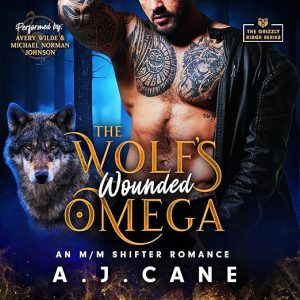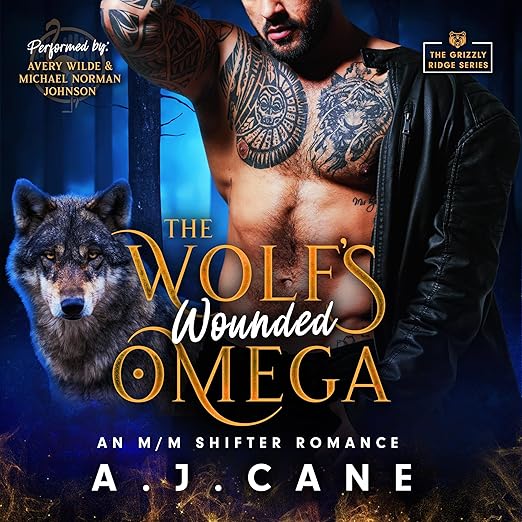
Grizzly Ridge's omegas come under threat from a rogue wolf pack eventually, but the real tension in this audiobook is set from the first scene: a fated-mate bond Danny wants absolutely no part of. Wolf shifter Knox finds his mate and gets rejected on the spot, and A.J. Cane spends the next seven hours and nineteen minutes explaining exactly why Danny's guard is up that high. Narrator Avery Wilde voices both leads, and the choice to hold Knox back rather than let him charge in is where the performance actually earns its keep.
The setup leans hard into familiar omegaverse mechanics, fated mates, a possessive alpha, an omega with a violently ended relationship in his past, but the emotional engine is specific rather than generic: Knox knows he isn't patient by nature and is actively working against his own instincts so he doesn't push Danny further away. That kind of self-aware restraint is a more interesting hook than a straightforward possessive-alpha romance usually offers.
The external plot, a rogue wolf pack threatening the omegas of Grizzly Ridge, functions mainly as pressure rather than as the book's real subject; it forces Danny to trust Knox faster than he otherwise would, which is a fairly conventional hurt/comfort engine, but the book earns it by keeping Danny's wariness psychologically consistent rather than dropping it the moment the plot needs him to trust his fated mate.
The title itself does real work: wounded doesn't just describe Danny's backstory, it names the entire emotional register the book operates in, an omega whose wound is the reason for his defensiveness rather than an incidental detail mentioned once and dropped. Genre titles that name a character's core wound directly, rather than leaning on a more generic trope label, tend to signal a book more interested in psychology than just mechanics, and that holds up here.
Grizzly Ridge as a setting name does double duty too, evoking both the wilderness isolation the wolf-pack threat depends on and a sense of established community worth protecting; a rogue pack threatening 'the omegas of Grizzly Ridge' specifically, rather than some vaguer danger, gives the external plot a defined stake tied to the same vulnerability Danny embodies personally.
The synopsis's own closing pitch, 'One click to start listening to this sweet and steamy M/M shifter romance today', is standard self-published romance marketing language, not a swipe at the book's quality; indie romance in this specific subgenre relies heavily on that kind of direct, low-friction call to action, and it's worth recognizing as a genre convention rather than reading anything into it about the writing itself.
Two Very Different Registers From One Narrator
Avery Wilde's biggest strength here is vocal differentiation between two very different emotional registers: Knox's grumpy, restrained alpha voice reads as genuinely controlled rather than just quiet, and Danny's wounded-omega register carries real defensiveness without tipping into melodrama. That distinction matters in a dual-POV structure where a listener needs to track whose internal walls are up at any given moment.
The patience in Knox's holding-back scenes is where the narration does its best work; a lot of shifter-romance audio leans into aggressive, possessive delivery for the alpha lead by default, and Wilde resists that default here, which matches Knox's own arc of learning restraint rather than working against it. That choice makes the eventual softening land with more weight than it would with a more one-note reading.
Fated-mate romance runs on a specific tension: an instant, biologically undeniable bond on one side, and the very real question of consent and choice on the other, since Danny never chose to be anyone's mate, biology simply decided for him. Cane doesn't shortcut past that tension by having Danny simply accept the bond once Knox proves trustworthy; the rejection at the start stays a real obstacle the book has to work through rather than a formality to clear in the first chapter.
Seven hours and nineteen minutes is a substantial runtime for a single-couple romance in this subgenre, long enough that the external threat plot and the internal trust-building arc both get real room to develop rather than one being rushed to make space for the other, which is a common complaint in shorter genre entries that try to do both in half the time.
The pacing of Danny's backstory reveal also deserves credit: the violent end of his prior relationship gets named early and directly rather than withheld as a late-book twist, which keeps the book from exploiting his trauma for a cheap reveal and instead lets it function as the emotional baseline the whole romance has to work against from page one.
Tagged Sweet and Steamy With Real Heat
This is tagged erotica, and the synopsis is upfront about it: 'sweet and steamy', with real heat alongside the emotional plot, not a fade-to-black romance. Listeners should go in with clear expectations about explicit content rather than assuming the hurt/comfort framing means things stay tame.
Omegaverse-specific vocabulary, omega, alpha, fated mate, rogue pack dynamics, gets used without much on-ramping for a reader totally new to the subgenre; fans of shifter romance broadly but not omegaverse specifically may need a beat to orient before the emotional stakes fully click. Danny's backstory, a past relationship that 'ended violently', also sits closer to real trauma than some hurt/comfort romances go, so listeners sensitive to that theme should know it's handled seriously rather than played for shock.
Hurt/comfort as a pairing with omegaverse specifically works because the power dynamics the subgenre already assumes, alpha strength, omega vulnerability, give the comfort half of the trope somewhere concrete to land; Knox's protectiveness has an actual structural role once the rogue pack threat arrives, not just emotional wallpaper around the romance.
A.J. Cane's catalog leans consistently into this exact register, possessive-but-restrained shifter heroes paired with wary, previously hurt omegas, so readers picking this up cold should know it's part of a broader, consistent authorial voice rather than a one-off experiment in the trope.
Cover art and title conventions in this specific self-published shifter-romance space tend to signal content very precisely to readers already fluent in the genre, wounded, alpha, omega, shifter, each doing specific promotional work, which means a browsing reader who already reads this subgenre regularly can usually tell exactly what they're getting before pressing play.
Hurt/Comfort Devotees Get Exactly What They Came For
Hurt/comfort devotees and fated-mate completists will get exactly what they came for here, and so will M/M shifter romance readers specifically looking for a possessive-alpha dynamic that's actually earned through restraint rather than assumed from the trope alone. Fans already following A.J. Cane's other work have an easy reason to add this one.
Readers who specifically enjoy a slower-building trust arc over an instant-bond romance that skips straight to intimacy will find that Cane paces Danny's guardedness with real patience; this isn't a book where the fated-mate bond erases the rejection by the second chapter.
Newcomers to omegaverse conventions might feel dropped into unfamiliar vocabulary before the emotional stakes click, and anyone avoiding explicit content or stories built around past relationship trauma should choose a different shelf entirely.