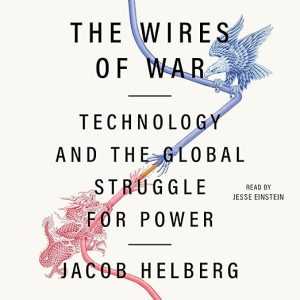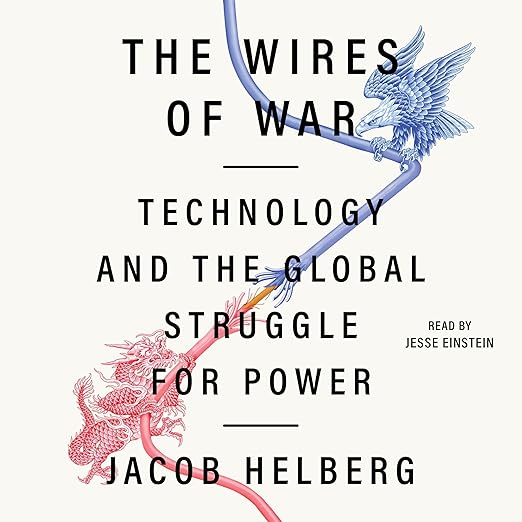
Jacob Helberg spent four years at Google leading the company's global effort to combat disinformation and foreign interference, and The Wires of War, narrated by Jesse Einstein in this audiobook edition, is his account of what that work revealed about a conflict most Americans have only partially understood. The book operates on two fronts, mirroring the two-front structure of the war Helberg describes: the software layer (social media manipulation, disinformation campaigns, algorithmic exploitation) and the hardware layer (5G infrastructure, undersea fiber-optic cables, semiconductor supply chains). Both fronts, Helberg argues, are already active battlegrounds between Western democracies and the authoritarian regimes of China, Russia, and Iran, and the United States is losing ground on both.
Insider Access, With Solutions Left Underdeveloped
What separates this audiobook from the crowded field of technology-and-geopolitics books is the quality of Helberg's insider access. He is not a journalist reconstructing events from interviews and documents; he was a participant in the policy decisions at one of the world's most consequential technology companies during a period of intense foreign interference activity. That position gives his account a specificity that most comparable books cannot match. When he describes the mechanics of how state actors exploit social media platforms, he is not speculating. He is describing the problem his team was actively trying to solve from inside the organization.
Publishers Weekly called the book an informative and often harrowing wake-up call, and that framing holds. The hardware dimension of the argument, the Chinese government's strategic investment in the physical infrastructure of the global internet including 5G networks and undersea cables, is the portion of the book that will likely be most unfamiliar to general listeners. Helberg handles it with enough technical grounding to be convincing without becoming inaccessible. Kirkus Reviews noted his unnervingly convincing evidence that time is running out, and the weight of that evidence, accumulated across eleven-plus hours, is considerable.
One substantive critique appears in the reviews: the book is stronger on diagnosing the problem than on proposing solutions. A reviewer who found the analysis excellent noted the solutions section as comparatively underdeveloped. This is a fair criticism. Helberg's prescriptions, closer partnership between Silicon Valley and the federal government, are argued at a high level of generality that does not match the precision of the threat analysis. Listeners should enter expecting a thorough account of a crisis and a fairly broad framework for response, not a detailed policy blueprint.
Einstein Keeps a Brisk Pace for Eleven Hours
Jesse Einstein's narration is steady and authoritative without being dry. The book requires a narrator who can sustain listener attention through chapters that involve dense technical and institutional detail, and Einstein manages that by keeping the pace brisk and the delivery clear. He does not editorialize or insert drama where Helberg's prose is deliberately measured, but he also does not flatten the passages where Helberg's tone is most urgent. The eleven-and-a-half-hour runtime is appropriate for the scope of what the book covers; this is not a text that can be compressed without losing the cumulative weight of its argument.
Audio is a reasonable format for this book. The argument is linear and does not depend on charts or diagrams, and Einstein's clarity makes the technical sections as accessible as they can reasonably be in audio form. Listeners who prefer to take notes while engaging with policy-heavy nonfiction may want to supplement with the print edition for reference, but the audio works as a complete experience.
Hardware Front Matters More Than Software Front
The book's most important conceptual contribution is the distinction between the software front and the hardware front. Most public discussion of the tech cold war focuses on the software layer, disinformation and platform manipulation, because these incidents generate visible and newsworthy events. Helberg's argument that the hardware battle is more consequential and less understood is the more original claim, and it is worth paying close attention to the chapters where he builds the case for why control of physical infrastructure is the deeper vulnerability. The 5G argument in particular has become more urgent since the book's publication, and Helberg's framing gives listeners a useful analytical lens for evaluating subsequent developments.
The account of Helberg's own experience navigating internal Google politics while simultaneously trying to address state-actor interference is also valuable. It illustrates the institutional friction between tech company culture, its instinct toward openness and speed, and the slower more classified world of national security policy. That tension is one of Helberg's most consistent and persuasive themes throughout the audiobook and gives it a narrative quality that pure policy analysis often lacks.
Helberg's background at Google also gives him a window into how the technology industry has historically understood, or misunderstood, its role in geopolitics. The industry's default assumption that open information exchange is inherently democratizing is one of the book's recurring targets. Helberg argues that autocracies have learned to exploit openness precisely because democracies built their systems on that assumption, and he uses specific examples from both the disinformation front and the infrastructure competition to show how that exploitation works in practice.
Readers Who Like Insider Policy Nonfiction
This audiobook is essential listening for anyone seriously engaged with technology policy, international relations, or the geopolitics of the US-China relationship. It is accessible to general listeners with intellectual curiosity about how the internet actually works as infrastructure and why that matters, but it rewards listeners who already have some background in tech policy or geopolitics. The argument is not simplified for the completely uninitiated.
Those who find policy nonfiction rewarding when it comes with genuine insider authority, in the tradition of books like The Fifth Risk or James Clapper's Facts and Fears, will find Helberg's account a worthy addition to that category. Listeners seeking equal weight on diagnosis and prescription should know going in that the analysis is significantly stronger than the solutions, and adjusting expectations accordingly will make this a more satisfying listen.
At a Glance
- Narration: Jesse Einstein keeps the technical material accessible without dumbing it down. His delivery gives Helberg's insider account the pacing of a careful argument rather than a policy white paper.
- Themes: Technology as geopolitical battleground, democratic resilience, corporate-government tension
- Mood: Urgent and analytically dense
- Verdict: Helberg's access and firsthand experience at Google make this a genuinely informed account of the tech cold war, more convincing than most geopolitical nonfiction because it comes from someone who was inside it.
Questions Listeners Ask
How technical is The Wires of War audiobook and do I need a background in technology to follow it?
No specialized technical background is required. Helberg writes for a general policy audience and Jesse Einstein's narration keeps the exposition clear. The hardware chapters on 5G and fiber infrastructure are the most technically dense, but Helberg explains the concepts in terms of strategic significance rather than engineering detail. Listeners with some background in tech or geopolitics will absorb the argument faster, but it is accessible without that context.
Does the audiobook cover recent developments in US-China technology competition beyond the book's original publication?
The book covers events through approximately 2020, when Helberg's direct involvement at Google ended. Developments since then, including export controls on semiconductors and TikTok regulation debates, are not addressed. The analytical framework Helberg provides remains highly relevant for interpreting those subsequent events, but listeners should be aware this is a snapshot of the situation as it stood around 2021.