Quick Take
- Narration: Genevieve Jones delivers the material in a clear, unhurried pace well suited to technical agricultural content, functional and easy to follow without being dry.
- Themes: Year-round food production, small farm economics, cold-climate resilience
- Mood: Practical and quietly inspiring, the kind of listen that makes you want to sketch tunnel layouts
- Verdict: An indispensable listen for small-scale market growers in northern climates who want to stop losing revenue every winter.
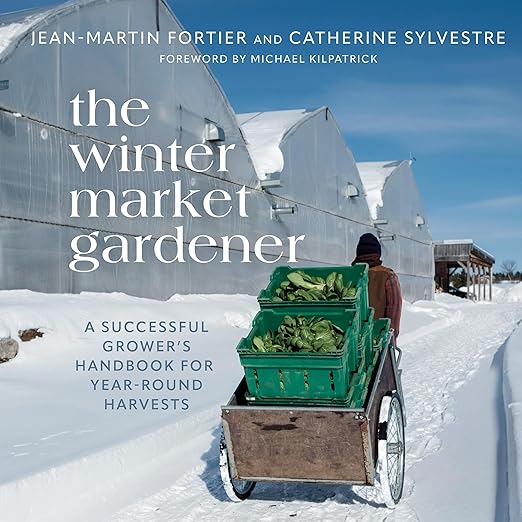
I spent a long January weekend reorganizing my bookmarks on season-extension growing, which is not as exciting as it sounds, but it led me straight to Jean-Martin Fortier. I had followed his earlier work, The Market Gardener, for years, so when this companion audiobook landed in my queue I put everything else aside. Genevieve Jones narrates, and I pressed play somewhere around Sunday morning coffee. Four hours later I had a full page of notes and a genuine urge to call someone who owns a caterpillar tunnel.
Fortier’s reputation in the small farm world is substantial. He and Catherine, his collaborator, run Les Jardins de la Grelinette in Quebec, and the results they have achieved in northern winters are widely cited as proof that cold-climate growing does not have to mean a revenue gap from November to April. This audiobook is the distillation of what they have learned, and it does not waste a sentence.
Our Take on The Winter Market Gardener
What separates this from general gardening content is the specificity. Fortier does not speak in vague encouragements. He gives you cultivar names, optimal seeding dates, crop spacing figures, and a genuine reckoning of the cost difference between a heated greenhouse and an unheated one. One reviewer noted that the charts and graphs, available via the companion PDF included with the Audible edition, are particularly informative, and that is accurate. The audiobook rewards you most if you have those materials open alongside the narration. This is one of those rare cases where the PDF companion actually earns its existence.
The book does not position itself as a replacement for Eliot Coleman’s Winter Harvest Handbook, and Fortier is gracious in acknowledging that lineage. Where Coleman laid the philosophical and structural groundwork for four-season growing, Fortier narrows the focus to what works for a small farm trying to make money at winter farmers markets. That is a more commercially grounded lens, and listeners who want the business case alongside the horticulture will find it here.
Why Listen to The Winter Market Gardener
Fortier covers tunnel infrastructure in a way that actually helps you decide: row covers, low tunnels, caterpillar tunnels, high tunnels, each with their trade-offs laid out plainly. He addresses pest management and weed control in winter conditions, subjects most other books treat as an afterthought. The section on winter storage crops and autumn growing is particularly useful for growers who want a complete picture of their cold-season production calendar rather than isolated techniques.
Genevieve Jones’s narration is composed and methodical, appropriate for a book that is fundamentally a technical manual. She does not editorialize or add theatrical texture, and that restraint is the right call. The material speaks for itself. At four hours and five minutes, the audiobook is also one of the more efficient listens in this category: dense with information but not padded.
What to Watch For in The Winter Market Gardener
This is not a beginner’s guide. Fortier assumes you already understand the basics of market vegetable growing. He references crop-planning concepts without extended explanation, which means listeners who are entirely new to market gardening will need to supplement this with more foundational reading. The focus is also firmly on northern and temperate climates, listeners gardening in warmer zones will find portions of the infrastructure advice less relevant to their context.
One reviewer noted the book is now several years old and some pricing and equipment data may have shifted. That is worth keeping in mind when evaluating the economics sections, though the core horticultural advice ages well.
Who Should Listen to The Winter Market Gardener
This audiobook is built for working small farmers and serious market growers in northern climates who want to extend their revenue season through winter. It is also an excellent listen for committed home growers who produce at scale and want to move beyond improvised cold frames. Listeners who prefer inspiration over instruction, or who are just beginning to understand vegetable growing, will likely find the pace and specificity demanding. If you know who Jean-Martin Fortier is and have been waiting for his winter-focused work in audio form, this delivers exactly what you would expect.
Frequently Asked Questions
Does the audiobook include the charts and crop planning tables from the print edition?
Yes, a companion PDF is available in your Audible Library alongside the audio file. The charts, graphs, and vegetable profiles are in that document, and several reviewers specifically highlight their value.
Is this suitable for listeners who are new to market gardening?
Not ideally. Fortier assumes familiarity with small-farm growing fundamentals. Beginners would benefit from his earlier book, The Market Gardener, first.
Does the book address both heated and unheated growing structures?
Yes. Fortier gives a detailed comparison of the costs and benefits of heated versus unheated greenhouses, along with guidance on row covers, low tunnels, caterpillar tunnels, and high tunnels.
Is this audiobook relevant for gardeners outside North America?
Largely yes. Reviewers from the UK and France have found it useful, particularly for permaculture and small-scale market production in similar northern climates. Some equipment pricing will vary by region.