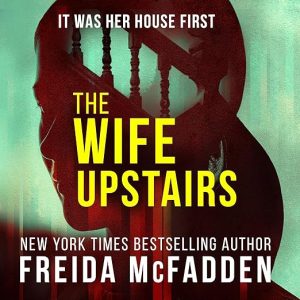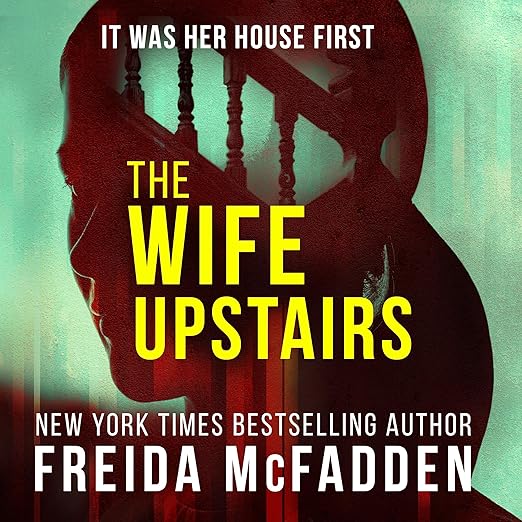
Victoria Barnett cannot speak, cannot walk and cannot feed herself, and the audiobook keeps her at the center anyway. A nurse practitioner with a good career, a loving husband, a house in the suburbs and a plan to fill it with children, she is left after an accident confined to the top floor of that house with round-the-clock care. Sylvia Robinson is hired by Victoria's husband to look after her, works out that Victoria is a good deal less impaired than she was told, and then finds a diary tucked away in a drawer. Nine hours and forty-six minutes, voiced by Angie Kane, is what Freida McFadden builds from that.
Two timelines do the heavy lifting, and a February 2026 five-star identifies them as the reason the book works, praising the alternation between what happened then and what is happening now, and crediting it with building the mystery around an earlier wife. The observation is right. A diary is a slow instrument, and cutting between the writing of it and the reading of it is what keeps the pace up while a nurse in an upstairs room turns pages. It is also the reason the middle of the book does not sag the way a single-timeline version of this premise would.
McFadden is doing something harder than the premise suggests. A protagonist who cannot speak, cannot move and cannot correct anybody's assumptions removes every tool a suspense novel normally uses, and what remains is a woman thinking at a caregiver who cannot hear her. The diary exists to break that silence, which makes it both the plot engine and a slightly convenient one. The book is aware of the convenience and mostly outruns it, though a reader who prizes plausibility over momentum will notice the seams before the halfway mark.
What Freida McFadden Gets Right
Momentum is the product, and the responses agree on it without agreeing on much else. A September 2025 four-star enjoys the twists and turns, calls McFadden reliable, and still flags some holes as annoying, which is a fair summary of the trade this kind of thriller offers. You are buying velocity. Nothing here rewards slow, close attention to how the pieces fit, and quite a lot of it punishes that attention. If the last quarter of a book matters more to you than the first three, this is built the way you like.
Angie Kane's task is stranger than a standard domestic thriller. Victoria narrates from inside a body that produces no speech, so her chapters are interior by necessity while Sylvia's are conventional first-person present. On top of that sits the diary, a third layer where one character reads another character's written voice aloud inside the story, and the recording has to keep all three distinguishable without signposting. Sample a diary passage rather than the opening chapter, because that is the one place where the format could genuinely muddle a plot that depends on knowing whose sentence you are in.
Where Freida McFadden Loses Some Ground
Pacing is the recurring complaint, and it is specific rather than vague. An October 2022 three-star, which liked the book while ranking it below the author's better-known title, objects to how slowly Sylvia gets through Victoria's diary, allowing that the reluctance makes sense at first and losing patience once the character starts asking questions of her own and still does not read faster. That is a real structural problem. The diary is the delivery mechanism for the entire backstory, and metering it out for suspense means a character behaving unlike a person to preserve a reveal.
Arithmetic on this listing is clean, at least. An average of 4.4 across 79 votes sits comfortably inside what whole stars can produce, and nothing about the pair needs explaining. Its usefulness is another matter. What a buyer wants to know about a twist thriller is whether the twist earns its setup, and that is the one judgment no rating column can make without destroying the thing it is grading. The number tells you this book found an audience. It cannot tell you whether the last chapter will feel like a payoff or a cheat.
Shelving is muddled too. The record files this first under literature and fiction and only second under mystery, thriller and suspense, with genre fiction and thriller as tags. The order matters more than it sounds. A domestic thriller with a locked-in narrator and a hidden diary is not competing for the attention of literary fiction browsers, and a listener searching the thriller shelf is the one who will actually want it. The mislabeling costs nothing to a reader who already knows what they are buying and quite a lot to everybody else.
Who Should Pick Up The Wife Upstairs
Readers who want to be dragged along will be well served. A March 2026 five-star captures it, calling the book a roller coaster that kept the pages turning to the end and praising how cleanly it was put together, then adding the only compliment that matters in this genre, which is that the author does not disappoint. It moves at a pitch that makes the hours disappear, and the chapters are short enough that stopping mid-session costs nothing.
Listeners drawn to a caregiver-and-patient setup will get what they came for, along with anyone who likes stories where the reader knows more than one character and less than another, and people who read this author already and want the same machine running on a different track. The medical texture is light rather than clinical, so no particular tolerance is required. Suburban comfort as a setting for menace is the register throughout.
Airtight plotting is not on offer, so anyone who needs it should stop here; this book consistently prioritizes the next turn over the previous one's bookkeeping. A story built on withheld information is the other likely irritant, because withholding is the whole design, from the accident onward. Diary-driven suspense is a taste, and this book leans on the device harder than most, which is precisely why the people who love it love it.
How long is the audiobook, and can it be finished in one sitting?
Just under ten hours, and it is plainly consumed fast. A five-star from somebody new to the author reports finishing in around ten hours, which is roughly the runtime and tells you the column here is measuring reading rather than listening. Chapter length makes it easy to stop anywhere.
Does the diary device give the ending away early?
It does the opposite, and that is the complaint. The diary is metered out slowly across the book so the backstory arrives in pieces, which preserves the reveal but slows the middle. If you are the kind of listener who wants information as soon as a character could plausibly have it, expect some frustration.
Is this audiobook worth it if you can already guess the twist?
Probably yes, though for different reasons. The pleasure here is the escalation rather than the surprise, and the two-timeline structure keeps working even when you are ahead of it. Listeners who read a lot in this genre tend to see one of the turns coming and get caught by a second.