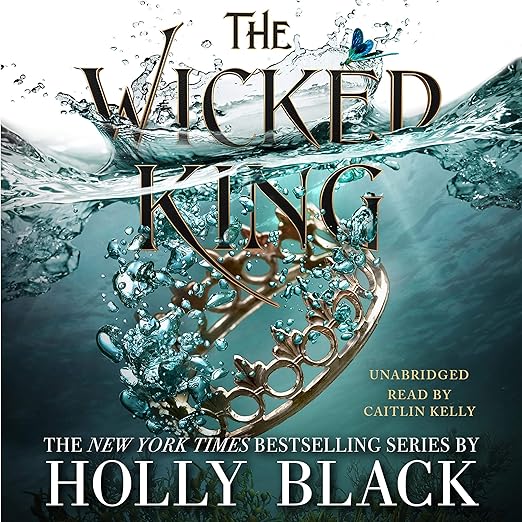
Jude Duarte spent the first volume of Holly Black's Folk of the Air series learning that Faerie kills the naive. By the time The Wicked King begins, she has already done something audacious: she has bound the king himself, Cardan, to her will, and positioned herself as the real power behind a throne she can never openly occupy. The question the novel keeps pressing is whether control built on coercion can hold, and whether someone who has fought this hard to belong might be the very person undoing everything she has built. Caitlin Kelly narrates this audiobook with a precision that serves Black's layered dialogue exceptionally well, and listeners who came to the series through The Cruel Prince will find Kelly's performance has settled even further into the ensemble's rhythms.
The Folk of the Air is a series that rewards readers who pay close attention to what characters do not say. Black's Faerie cannot lie, but it deceives with extraordinary fluency, and The Wicked King leans hard into that tension. Holly Black is one of the most technically assured writers working in YA fantasy, and this second installment demonstrates why: she does not allow her sequel to coast on the premise she established. She builds.
Power in Faerie Is the Most Unstable Thing
What Black does here that many YA sequels fail to accomplish is refuse to simply replicate the first book's structure at larger scale. The Cruel Prince was a story about survival and ambition in a hostile world. The Wicked King is a story about what happens after you win. Jude has power now, but power in Faerie is the most unstable substance in existence, and Black makes sure every scene carries the threat of dissolution. The political maneuvering is genuinely intricate; the shifting alliances, the surveillance, the paranoia about who close to Jude might be her betrayer, all of it unfolds with a tightness that keeps the 10-hour runtime from developing any slack.
The Cardan dynamic, which is what most readers come for, is handled with a restraint that makes the moments of tension land harder. Black understands that the push-pull between Jude and Cardan works precisely because it is not resolved quickly. His humiliations of her have political utility from his perspective; her control of him has moral costs she increasingly cannot ignore. Kelly's narration navigates this without turning it into melodrama, which is the right call. The emotional weight accumulates rather than spilling over, and the ending arrives with the force of something that has been building since page one of the series.
Caitlin Kelly Gives Jude's Exhaustion a Voice
Caitlin Kelly is one of the better narrators working in YA fantasy audio, and her performance here demonstrates exactly why. She handles Black's prose with intelligence rather than mere expressiveness: the rhythm of the sentences is preserved, the irony is audible without being telegraphed, and her voice for Jude carries the exhaustion of someone who has been vigilant for too long. The audiobook format suits the material particularly well because Black's dialogue scenes are dense with subtext. Having a narrator who understands where to place weight and where to pull back makes those exchanges considerably more rewarding than silent reading might be for some listeners.
One reviewer described the book as a middle book that does not feel like a middle book, and that assessment holds. Black constructs this installment with enough narrative momentum of its own that it avoids the common second-volume trap of existing primarily to set up the finale. The emotional stakes are genuinely in play throughout, and the resolution, while deliberately incomplete in ways that serve the trilogy structure, earns its cliffhanger rather than manufacturing one. Kelly sustains the tension through those final sequences with the kind of measured urgency that makes the format's linear delivery a genuine asset rather than a limitation compared to print.
Betrayal in Plain Sight for Attentive Listeners
Black plants her plot reversal with considerable craft. The betrayal, when it comes, has been visible in retrospect all along, which is the mark of a mystery construction done well. Listeners who are attentive to the supporting cast will catch the tells before the reveal; those who are primarily focused on the Jude-Cardan dynamic may be genuinely surprised. Either experience is valid, but it is worth noting that Black's plotting is tight enough to reward a second listen with fresh attention to the secondary characters who move through Jude's orbit.
The political worldbuilding also deepens in this volume in ways that matter for the finale. The structure of Faerie's courts, the nature of Cardan's bind, and the implications of Oak's status as heir all receive development that is necessary context for the third book. Listeners should be aware that The Wicked King ends at a point of deliberate destabilization, and those who prefer resolved narratives will want to have the third installment, The Queen of Nothing, ready to continue immediately.
Jude Becomes an Active Architect of Her Fate
Anyone who finished The Cruel Prince and found its ending irresistible will find this audiobook an entirely worthy continuation. Holly Black fans who have not yet started the Folk of the Air series should begin there rather than here; the context is essential. Listeners who enjoy YA fantasy with genuinely complex political plotting, morally compromised protagonists, and a romantic tension that earns rather than manufactures its emotional charge will find The Wicked King among the stronger entries in the genre. Caitlin Kelly's narration makes the audio format the recommended version for anyone who has not yet engaged with this series. Those who found The Cruel Prince's world-building intriguing but its heroine too reactive will find that Jude in this volume has developed into a far more active architect of her own situation, which changes the experience of the narrative substantially and for the better.
- Read by: Caitlin Kelly brings layered intelligence to Black's dense dialogue, capturing Jude's exhausted vigilance and the Cardan dynamic's irony without overplaying either.
- At its heart: Power and its moral cost, political betrayal, identity between worlds
- Vibe: Taut and intricate, with accumulating dread
- Short version: A second installment that builds rather than coasts, making it one of the sharper YA fantasy sequels in recent years.