
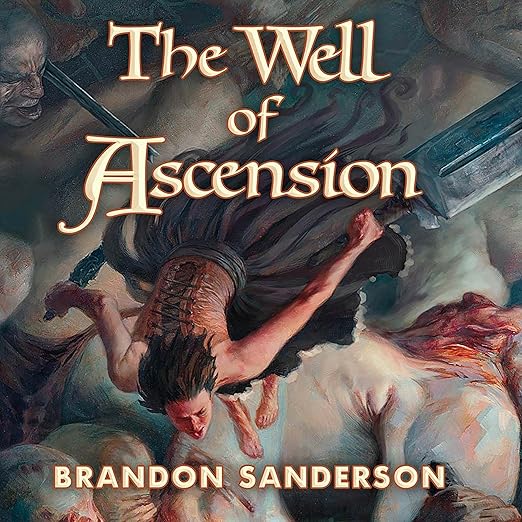
Sequels that start after the villain is dead are rare, because they require authors to generate conflict from something other than an obvious external threat. Brandon Sanderson's The Well of Ascension, the second book in the original Mistborn trilogy, accepts that challenge and turns it into the entire structural premise. The Lord Ruler is gone. Vin killed him. Now what? Michael Kramer narrates, as he has throughout the Mistborn series, and his performance is one of the dependable constants across nearly 29 hours of audiobook that tests the reader in ways the first volume deliberately did not. Sanderson earned this difficulty. The question is whether listeners will stay with it.
Elend Must Govern the Empire Vin Broke
Sanderson opens this novel inside a political crisis rather than a heist. Elend Venture, the idealistic nobleman who dreamed of a better world while the Lord Ruler still lived, now has to actually build that world from the rubble of an empire. Three armies are besieging Luthadel. The crew that overthrew the Final Empire now has to learn governance, logistics, and coalition politics. Vin, elevated to near-mythic status as the Mistborn who slew a god, is simultaneously more powerful and more isolated than she has ever been. And the mists that blanket the world at night are changing in ways that imply something worse than the Lord Ruler was lurking underneath.
A Slow Siege Redeemed by Vin's Mist Scenes
The shift in register from book one is real and deliberate. The Final Empire was a heist; this is a siege. The pacing slows considerably through the middle sections, which is where some listeners lose patience. One reviewer noted that they 'found themselves somewhat bored' during stretches of political maneuvering and inner debate. That is a legitimate response. Sanderson is doing something structurally demanding here: he is making the reader feel the weight of stasis, the grinding exhaustion of a siege, the circular logic of democratic councils that cannot reach decisions while armies wait outside. Whether that feels meaningful or tedious depends significantly on what you want from fantasy fiction.
The book's best sequences are those in which Vin moves through the mists in ways that become increasingly uncanny. Sanderson is building toward a revelation about the nature of the magic system and the cosmology of the world, and these mist scenes carry that weight in ways that the political plotting cannot. The atmospheric, almost gothic quality of Vin's solo excursions into the ash-covered darkness is some of the most vivid prose Sanderson had written to that point in the series.
Kramer Finds a Lower Register for the Mists
Michael Kramer has narrated so many Brandon Sanderson books that the two of them have become identified with each other in the Cosmere fandom, and for good reason. Kramer handles Sanderson's extended internal monologue passages, which are the primary mode of characterization here, without letting them collapse into a drone. He gives Vin a voice that is recognizably different from Elend, whose political earnestness requires a slightly open quality in delivery. The wider cast, including the returning crew members and new political figures, is consistently differentiated. At 29 hours, that consistency requires genuine craft rather than habit.
The mist sequences are where Kramer's performance is most effective. He finds a lower, more atmospheric register for those passages that contrasts usefully with the political council scenes, giving the book a sonic texture that maps onto its structural contrasts. Listeners who have come from The Final Empire will notice the tonal shift in Kramer's reading as quickly as they notice it in Sanderson's writing.
Read The Final Empire Before This Middle Book
This is book two of a trilogy, and listeners who have not read Mistborn: The Final Empire will be lost from the opening chapter. The magic system, character relationships, and entire emotional premise require The Final Empire as foundation. Sanderson's worldbuilding is cumulative, his magic system has rules that compound, and the payoff of this book's final section depends entirely on investment built over two volumes. The series must be listened to in order.
The book ends on a note that will feel devastating without the context the third book, The Hero of Ages, provides. If you are the type of listener who needs clean emotional resolution at the end of each volume, you will be uncomfortable here. The Well of Ascension functions as a middle book in every structural sense, including the role of breaking something down before the final volume can rebuild it.
Sanderson also uses this volume to significantly expand the lore surrounding the ash, the mists, and the history of the Final Empire in ways that recontextualize events from the first book. Listeners who paid careful attention to background details in The Final Empire will find those details paying off here in ways that reward investment. The magic system, allomancy, has additional dimensions here that the first book withheld, and their introduction changes the nature of the threat Vin faces in the mist. These revelations are handled with structural care rather than dropped as information dumps, which is one of the places where Sanderson's plotting craft is most visible.
Essential Only for Committed Trilogy Readers
This audiobook is essential for anyone committed to the original Mistborn trilogy, and Michael Kramer's narration makes the long middle passages more bearable than they read on the page. It is not a good entry point for Sanderson newcomers; that role belongs to Mistborn: The Final Empire, or for a shorter introduction, The Emperor's Soul. For listeners who loved the first book and want the full story, The Well of Ascension delivers exactly where the trilogy needs to go next, even when it is difficult. The payoff in The Hero of Ages makes the patience here worth every hour of the investment.
The Short Version
- Read by: Michael Kramer is the definitive Mistborn voice; his atmospheric handling of the mist sequences and differentiated cast are essential to the experience.
- At its heart: Political power and its costs, identity after trauma, the weight of prophecy
- Vibe: Dense and atmospheric, slower than the first Mistborn book, building toward catastrophe
- Short version: A demanding but essential second volume that earns its difficulty if you commit to the trilogy.
Can I listen to The Well of Ascension audiobook without reading Mistborn: The Final Empire first?
No. This audiobook picks up directly after the events of book one. The magic system, character relationships, and entire premise require The Final Empire as foundation.
Is The Well of Ascension slower than the first Mistborn audiobook?
Yes, noticeably. The heist structure of the first book gives way to a political siege narrative with extended introspective passages. The pacing is a deliberate choice, but listeners expecting the same kinetic energy will need to adjust.
Does The Well of Ascension have a satisfying ending as a standalone audiobook?
Not really. The ending is dramatic but deliberately open, setting up The Hero of Ages. Sanderson is writing a trilogy arc, and this book functions as a structural middle rather than a resolved story.
How does Michael Kramer's narration hold up across 29 hours in this audiobook?
Very well. Kramer is among the most consistent long-form narrators working in fantasy, and his Mistborn performances benefit from years of working with Sanderson's material. The extended siege sequences and internal monologues are where his steadiness is most valuable.







