
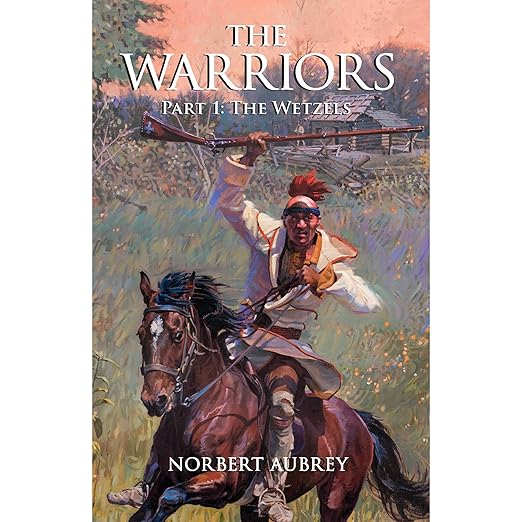
Fourteen-year-old Lewis Wetzel takes a musket ball to the breastbone in the first pages of this audiobook, and Norbert Aubrey wastes no time establishing the terms of his American Frontier saga. The Warriors, the first book in Aubrey's YA historical fiction series, opens in 1777 and does something genuinely unusual for the genre: it refuses to assign heroism along neat cultural lines. Lewis is a real historical figure, and so is the world into which Aubrey drops him, the contested borderlands of what would become Ohio and Pennsylvania, where settler encroachment and Indigenous resistance produced cycles of reprisal that neither side could fully control.
I was drawn to this audiobook partly because of how rarely the pre-Revolutionary frontier gets dramatized for young adult audiences with this kind of moral attention. Aubrey constructs dual perspectives from the outset. Lewis, wounded and captured after a raid, is taken prisoner by Knotche, the raiding party leader who lost his father to settler violence and has sworn vengeance. The two characters are mirror images of each other in their grievances and their stubbornness, and Aubrey tracks their collision with enough structural care that neither reads as a simple villain.
Our Take on The Warriors
The Virtual Voice narration handles the factual and expository passages adequately, but it struggles in the scenes that demand the most emotional range, particularly the capture sequences and the moments of interior conflict that Aubrey gives both Lewis and Knotche. Historical fiction at this pitch needs a narrator who can modulate between the vernacular of period speech and the interior life of characters processing traumatic events in real time. The AI-generated voice delivers the words; it does not quite live inside them.
That caveat aside, the text itself carries considerable weight. One reviewer who grew up near the historical sites described being able to imagine the region vividly through Aubrey's prose, and that rootedness in specific geography is one of the novel's genuine strengths. The Fort Lauren area, the Ohio borderlands, the particular textures of frontier settlement are rendered with the kind of detail that only comes from sustained research. Another reviewer noted that the novel painted a more truthful portrait than the official history, capturing both the violence of settler seizure and the defensive brutality of Indigenous response without heavy-handed moralizing.
Why Listen to The Warriors
For young adult listeners with an interest in American history beyond the traditional patriot-and-redcoat frame, this audiobook offers something rarer: the perspective of people on the western edge of the revolutionary period, where the war looked entirely different and the stakes were territorial survival on both sides. Aubrey does not simplify Knotche into a noble victim or Lewis into a straightforward hero. Lewis's post-escape campaign of retaliation is presented as understandable and as morally compromised, simultaneously, which is an unusual and valuable structural choice for fiction aimed at this age range.
The pacing is propulsive. Aubrey constructs the book as a series of escalations, each action prompting a counter-action, building toward a confrontation that the narrative frames as both inevitable and preventable, a collision shaped by forces larger than either individual. At seven hours and seven minutes, the audiobook moves at the pace its genre requires without lingering unnecessarily.
The opening premise, a fourteen-year-old wounded and captured on the frontier and forced to reckon with a captor who has his own entirely legitimate reasons for violence, is the kind of morally complex setup that tends to generate the best YA fiction. Aubrey sustains that complexity across the narrative rather than resolving it into comfortable clarity.
What Aubrey achieves in terms of historical texture is also worth naming specifically. The American Frontier of 1777 is not a period that gets dramatized often for young adult audiences with any seriousness. Most frontier YA fiction either romanticizes the settler perspective or flattens the Indigenous perspective into victimhood. Aubrey does neither. Knotche's world, the tribal territory, the raiding party's logic, the particular kind of leadership Knotche exerts, is rendered with enough specificity that it does not feel like a gesture toward balance but like the result of actual historical engagement. That specificity is what makes reviewers who grew up near the historical sites respond as strongly as they do. The geography is real; the human dynamics are real; the violence is historically grounded rather than generic.
What to Watch For in The Warriors
The parallel structure between Lewis and Knotche is the architectural key to the novel. Aubrey cuts between their perspectives at deliberate intervals, and listeners who track those cuts carefully will notice how Aubrey weights each character's interiority differently as the narrative progresses. Lewis gets more external action; Knotche gets more reflection. That distribution is thematically intentional, not accidental.
Pay attention also to the moments when the two characters' worldviews almost overlap. Aubrey places them close to mutual understanding several times without allowing that understanding to fully materialize, which is historically accurate and narratively honest. The frontier was not a place where cultural translation happened cleanly, and the novel does not pretend otherwise.
This is the first book in a series. The ending sets up further confrontations without fully resolving the Lewis-Knotche dynamic, which will suit listeners eager to continue and may frustrate those who prefer self-contained stories.
Who Should Listen to The Warriors
Teen and YA listeners with a taste for historical fiction and action-forward plotting will find this audiobook engaging. Adults interested in revisionist frontier history, particularly the pre-Revolutionary Ohio territory, will also find Aubrey's research worth the listening time. Those sensitive to descriptions of frontier violence should be aware that the content is frank about the period's brutality on all sides. Listeners who prioritize high-quality vocal performance in their audiobooks will find the Virtual Voice narration limiting; the text genuinely merits a full human production.
At a Glance
- Read by: Virtual Voice narration gives this audiobook a functional if flat delivery; the action-heavy content benefits from a human narrator's range, which this format cannot quite provide.
- At its heart: Identity and survival on the frontier, competing claims to land and justice, the violence of history from multiple perspectives.
- Vibe: Gritty and relentless, with moral complexity woven through the conflict.
- Short version: A historically grounded YA opener that takes the unusual step of humanizing both sides of the frontier conflict without excusing either.
Before You Listen
Is The Warriors audiobook suitable for younger teens?
The content is appropriate for older teens, roughly fourteen and up. The frontier violence is frank and involves both settler and Indigenous characters in morally complex situations. Younger readers would benefit from adult discussion around the historical context.
Does the audiobook present both Lewis Wetzel and Knotche sympathetically?
Yes, Aubrey constructs the dual perspective carefully. Knotche's motivation, avenging his father's murder and defending his people's territory, is given the same narrative weight as Lewis's survival drive. Neither character functions simply as hero or villain.
Is this audiobook a standalone or do I need to continue the series?
It reads as the first installment of an ongoing series and the ending sets up future confrontations without fully resolving the central conflict. It functions as a satisfying opening rather than a complete story.
How does the Virtual Voice narration affect the listening experience for this audiobook?
It is functional for dialogue and expository passages but lacks the emotional range the material requires for its most intense scenes. The dual-perspective structure in particular would benefit from a human narrator who can shade each character's interiority differently.







