Before You Press Play
- Narration: Steven Pressfield narrates his own work, and the result is a performance that feels like a directive from someone who earned the right to give it; the voice is measured, direct, and quietly severe.
- Themes: Resistance as the universal creative enemy, turning professional as a mindset shift, the relationship between the self and creative calling
- Mood: Austere and confrontational, like a coach who refuses to accept your excuses
- Verdict: A short, forceful book that holds up across every creative discipline, and Pressfield narrating himself is the only version worth listening to.
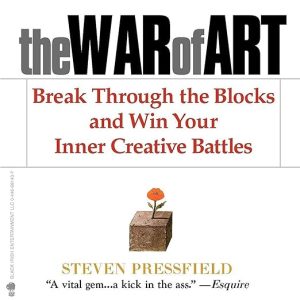
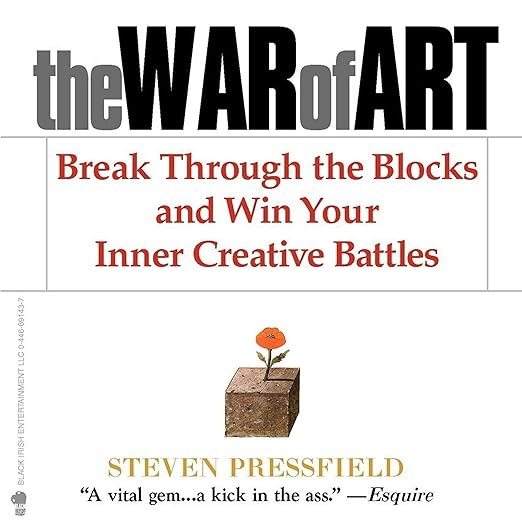
I first came across The War of Art during a stretch when I was writing less than I wanted to be, which is the most precisely wrong and most precisely right time to encounter a book about creative resistance. I remember sitting in my car in a parking garage, not getting out, listening to Pressfield describe Resistance with a capital R as the force that makes you check your email instead of working, that tells you the idea needs more preparation before you start, that whispers that tomorrow would be a better day than today. By the end of that parking garage session, I had stayed twenty minutes longer than I needed to, which felt like both the point and the irony.
The War of Art was published in 2002 and has remained in print and in conversation ever since, which says something about how directly Pressfield identified a problem that creative people across every discipline recognize immediately. He is not writing for writers only; the book has been adopted by entrepreneurs, musicians, athletes, and military service members, a breadth of application that reflects how universal the underlying argument is. Resistance, he argues, is the force that rises between any human being and any meaningful act, and it is not a personal failing. It is a predictable condition of being alive and trying to create something worthwhile.
Resistance, Turning Pro and the Distant Muse
The book is organized into three parts that move in a deliberate sequence, beginning with identifying the enemy, moving to the means of combat, and ending with a more metaphysical argument about creative calling. The first section, on Resistance itself, is the strongest. Pressfield catalogs Resistance's tactics with a precision that is almost clinical: procrastination, rationalization, the endless preparation that postpones execution, the self-sabotage that arrives precisely when a project is closest to completion. For creative people who have recognized these patterns in themselves without knowing what to call them, reading this section is an experience somewhere between relief and discomfort.
The second section, on Turning Pro, is where the book shifts from diagnosis to prescription. The professional, in Pressfield's framework, is not someone who gets paid for their work; it is someone who shows up regardless of inspiration, who treats the creative act as a commitment rather than an option, who does not allow Resistance to negotiate. One reviewer compared the book's structure to Sun Tzu's Art of War, noting that knowing your enemy and knowing yourself is the prerequisite to any campaign. The framing is deliberate; Pressfield is writing a field manual, not a memoir, and the audio format suits that design well. The third section moves into more explicitly spiritual territory, invoking the Muse and the concept of the higher self, which some readers embrace and others find difficult to square with the martial pragmatism of the earlier sections.
Pressfield Narrates with Quiet, Certain Severity
At two hours and twenty-nine minutes, The War of Art is a brief audiobook by any measure, and Pressfield narrates it himself with a quality that is harder to describe than to experience. His voice is not warm in the way that personal development narration often aims for. It is quiet, certain, and a little severe, which is exactly right for the material. When he describes what it means to sit down and do the work despite resistance, there is no inspirational uplift in his delivery. He sounds like someone who has spent decades doing exactly that, which he has. The autobiography embedded in the book, his years of failure before publishing his first novel, gives the prescription its credibility, and the narration extends that credibility into the listening experience.
One reviewer, translating from French, described it as a book that should be required at school, and classified it among the most transformative texts in their collection. Another, reviewing from Germany, connected the book's third section to Carl Jung's shadow archetype and found in Pressfield a guide to the depths of creative existence that was not only for the blocked artist but for anyone who has been pushing their life's dreams ahead of them. That breadth of international response reflects something real: this book addresses a human problem rather than a cultural or professional one.
Brevity Covers a Lot of Ground Quickly
The book's brevity is also its primary limitation. At under two and a half hours, it covers a lot of conceptual ground quickly, and some listeners will want more. Pressfield's subsequent books, including Turning Pro and Do the Work, expand on specific aspects of the framework, and many readers who find The War of Art essential will eventually want those extensions. But as a single, concentrated argument, this book accomplishes what it sets out to do with unusual efficiency. There is very little in it that does not earn its place, which is itself a lesson Pressfield's own framework would endorse. Listen if you are a working creative of any kind who has ever noticed the pattern of resistance and self-sabotage that shows up specifically when meaningful work is at stake. Skip if you need a warm, encouraging tone from your personal development listening; Pressfield is a coach who does not soften the diagnosis.
The Muse Section Won't Land for Everyone
The book's brevity is also its primary limitation. At under two and a half hours, it covers a lot of conceptual ground quickly, and some listeners will want more. Pressfield's subsequent books, including Turning Pro and Do the Work, expand on specific aspects of the framework, and many readers who find The War of Art essential will eventually want those extensions. But as a single, concentrated argument, this book accomplishes what it sets out to do with unusual efficiency.
There is very little in it that does not earn its place, which is itself a lesson Pressfield's own framework would endorse. One reviewer, translating from French, described it as a book that should be required at school, and classified it among the most transformative texts in their collection. Listen if you are a working creative of any kind who has ever noticed the pattern of resistance and self-sabotage that shows up specifically when meaningful work is at stake. Skip if you need a warm, encouraging tone from your personal development listening; Pressfield is a coach who does not soften the diagnosis, and the third section's metaphysical turn, involving the Muse and the concept of higher calling, may not land for every listener.