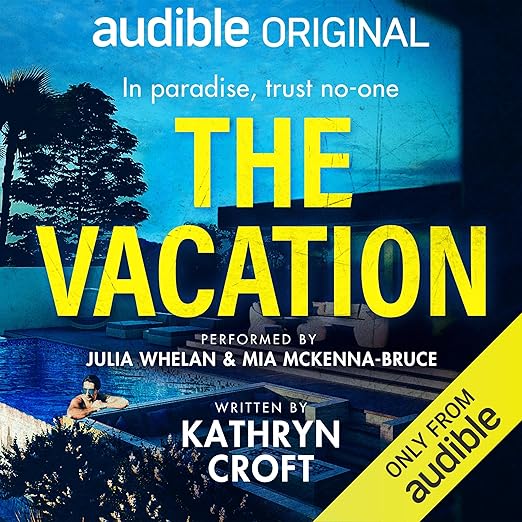
Kathryn Croft's The Vacation opens on an Italian coastal idyll that reads as false from the first pages. Erin has booked a last-minute villa on the Amalfi Coast in the hope that the setting will repair something broken in her family, which is exactly the kind of hope the thriller genre exists to dismantle. The audiobook, performed by multi-Audie Award winner Julia Whelan, covers the compressed days between arrival and catastrophe with the layered, misdirecting plotting that has made Croft a reliable name in British psychological suspense. At four hours and forty-four minutes, it is a model of compressed construction.
The Verdict, Briefly
The craft of The Vacation is in what Croft withholds. The synopsis confirms that Erin's son Jesse goes missing after a party and that a body turns up on the beach - those are the mechanical facts. What the synopsis does not convey is how precisely Croft has constructed the relationship between Erin's family and the sibling pair Tristan and Bea in the neighboring villa, or how much of what the reader is told in the story's first third is strategically incomplete. The marketing comparison to The White Lotus is apt in the sense that Croft is interested in what beauty and privilege do to people's ethical guardrails - the Amalfi Coast setting functions as both aspiration and distraction.
Whelan's performance is the production's consistent asset. She is one of the few narrators working in this format who can manage the first-person unreliable perspective without telegraphing the unreliability to the alert listener. Her reading of Erin as a woman convincing herself she has things under control - and slowly losing that conviction as events outpace her - is calibrated across the full runtime. Reviewers consistently note that the story kept them "hooked from start to finish" and that they "could not believe anything," which is a specific compliment about Croft's misdirection technique rather than general enthusiasm.
The Amalfi Coast setting is used with precision rather than as backdrop. Croft is not simply deploying Italy's beauty as contrast to the threat - the isolation of the villas, the difficulty of local navigation for foreigners, and the social dynamics of the tourist enclave all function as plot elements. The way Jesse's disappearance is investigated in a foreign environment where Erin has no institutional leverage or local contacts is one of the more effectively rendered aspects of the narrative, and it gives the thriller's premise genuine specificity.
What Makes The Vacation Worth Hearing
The short runtime is a genuine asset for this particular story rather than a compromise. One reviewer noted that the only complaint was wanting more of it, which is the best problem a thriller can generate. At under five hours, The Vacation does not have space for filler, for prolonged false-trail sequences, or for the pacing slumps that bloat longer suspense novels. Every chapter introduces or complicates information. The reviewer who described the pacing as "sometimes a little rushed" attributed this to length rather than weak storytelling, which is a meaningful distinction - the compression serves the material rather than undermining it.
The "dark truths lurking beneath the surface of their seemingly ordinary lives" framing in the synopsis is accurate but underplays how directly those truths connect to events before the story begins. The backstory reveals are among the more effective elements of the structure, and they arrive with enough force to genuinely reframe earlier scenes. Whelan's double reading of those recontextualized moments - moments the listener experienced once as straightforward and now must reconsider - would reward a second listen through a different interpretive lens.
Points to Consider
The short runtime means the character development, while solid, is working within constraints. Tristan and Bea in particular are given enough complexity to make them effective as plot elements, but their full motivations are not deeply excavated. This is a trade-off of the compressed thriller form rather than a failure of craft, but listeners who want deep character interiority alongside the suspense architecture will find The Vacation weighted toward plot. The "good character development" noted by one reviewer reflects what is possible in this format rather than the depth of a longer novel.
The Amalfi setting also means there is a logistical specificity to how the story's crisis unfolds - the ways a foreign location shapes and limits what Erin can do when Jesse disappears - that is worth attending to as a reader. Croft is not using Italy as a picturesque backdrop; the location actively determines the shape of the crisis, and the story would be a different thriller in a different setting.
The cast of this production includes two narrators alongside Whelan: Mia McKenna-Bruce, winner of the BAFTA Rising Star award, also performs in this audiobook. That dual-narrator structure - Whelan handling Erin's perspective and McKenna-Bruce bringing a different voice to the story - adds a layer of sonic differentiation that serves the plot's alternating perspectives. Listeners who have followed Whelan's other work will notice she is operating in familiar thriller territory here, and her professionalism in managing the genre's demands is the performance's chief virtue.
Who Should Listen to The Vacation
Fans of British psychological thrillers in the Liane Moriarty or Lucy Foley register will find The Vacation a well-executed entry in that tradition. The comps to Big Little Lies in the marketing are legitimate - Croft shares Moriarty's interest in the secrets families maintain from each other and the violence those secrets can enable when external pressure arrives. Julia Whelan's narration is the right reason to choose audio over print here; her interpretive command adds a layer of texture that the written page alone does not replicate. Listeners who want their thrillers long and slow-burning should look elsewhere, but for listeners who appreciate compressed, precise suspense, this audiobook delivers a complete and satisfying experience within its narrow window.
Does Julia Whelan's narration add something to The Vacation that reading the text would not?
Yes, specifically in the unreliable-narrator sequences. Whelan's controlled performance of Erin's self-deception - her ability to make convinced reasoning sound subtly off without flagging it overtly - adds an interpretive layer that is difficult to reproduce on the page.
Is The Vacation audiobook a standalone or part of a series by Kathryn Croft?
The Vacation is a standalone thriller. Croft's catalog includes The Christmas Party and a number of other psychological suspense novels, all of which stand independently. No prior knowledge of Croft's work is needed.
At under five hours, does the audiobook feel rushed or incomplete?
Reviewers are consistent that the pacing is fast but intentional rather than underdeveloped. The most common note is that readers wished it were longer - a sign that the compression serves the material rather than undermining it.
How twisty is The Vacation audiobook compared to other domestic thrillers in its genre?
Multiple reviewers describe the twist structure as genuinely surprising rather than telegraphed. Croft uses the dual-couple setup and the foreign-location constraint to generate misdirection that holds up across the runtime, and the finale reframes earlier scenes in ways that make a second listen worthwhile.