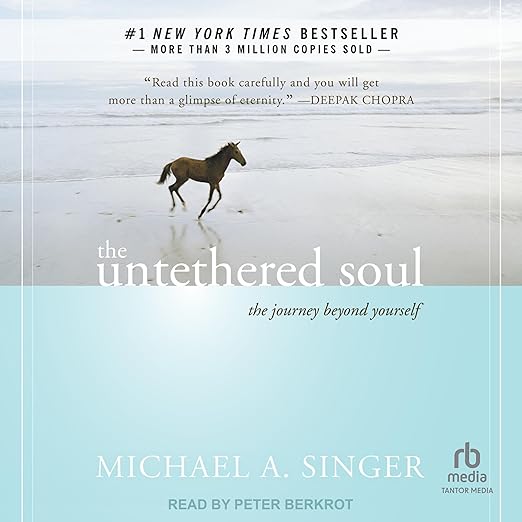
In Brief
- Narration: Peter Berkrot reads Tantor's 2011 production alone, on material where tone decides whether instruction sounds calm or preachy.
- Themes: The inner voice, non-attachment, consciousness as something you can step behind.
- Mood: Calm, insistent, quietly demanding.
- Verdict: The better format for this book, provided repetition settles you rather than irritating you.
Michael A. Singer wrote a short book about a very old idea, and the audiobook turns out to suit it better than the printed page does. Tantor's production runs six hours and eleven minutes with Peter Berkrot reading, and the material is built almost entirely on one instruction restated in fresh circumstances. My verdict first, since it decides everything else here: this is a book to hear more than once, and the recording makes that practical in a way rereading never quite manages.
One Narrator Carries Both Inner Voices
Two voices live inside the listener, in Singer's account, and separating them is the whole practice. One of them talks constantly, comments on everything, and mistakes its own noise for the self. The other simply notices. Once you have felt the difference even briefly, the rest of the book follows without effort, and the remaining chapters work through what changes when the noticing one is allowed to take charge.
Where this becomes concrete is in the responses, and one from June 2021 is unusually precise. It describes recognizing two distinct entities inside itself while reading: a talker it identifies as the ego, unabashedly bold, and a listener it came to understand as its true self, which is bad at pushing back when the ego goes too far. That is the book's central move, reported from the inside by somebody it worked on.
Peter Berkrot has the harder job on a title like this. Instructional spirituality slips easily into a soothing register that flattens the argument, or into a lecturing one that makes it sound like homework, and Singer's prose is plain enough to tip either way. Tantor published this in December 2011, well before the book became the fixture it now is, and the listing names one narrator with no cast and no companion material.
Twenty Minutes to Read, Twenty Hours to Practice
Practical value arrives faster than the mystical framing suggests. The instructions are behavioral: notice the voice, decline to follow it, let a disturbance pass through instead of storing it for later. None of that requires belief in anything, which is why the book traveled so far beyond its original readership and why this listing files it under health and wellness and religion and spirituality at the same time.
Twenty minutes to read a chapter and twenty hours to figure it out is how a February 24, 2026 response puts it, and I have not seen the problem stated better. The prose is easy. The implementation is not. That same response admits to disagreeing with some chapters while calling the bulk of the book very good, and reports being able to work on only one chapter at a time, which is an honest account of how this material actually gets used.
Chapters run short and self-contained, which is the structural reason the audio works so well. You can take one in on the way somewhere and turn it over for a week without losing your place, because the book is not constructing an argument so much as circling a single one. That makes it unusually forgiving of interrupted listening, a rare quality on a shelf where most titles depend on sequence.
Reviewers Compare This to The Power of Now
Repetition is the risk. Singer returns to the same instruction from many angles, and by the second half a listener who has already absorbed the idea will start hearing restatement rather than development. On the page you can skim. In audio you cannot, which means the six-hour running time can feel longer than it is once the central insight has landed and the examples keep arriving anyway.
Brevity in the pool is worth counting. Two of the five visible responses run to a single phrase apiece, and a third is not a customer response at all: it is a magazine review from December 2013, reprinted here by its own author, who says so in the title and who compares the book's word-of-mouth rise to that of Eckhart Tolle's The Power of Now. Behind them sit 44 ratings averaging 4.7, which allows between twelve and fifteen stars of deduction in total.
Faith is not required, but a tolerance for assertion is. Singer states things about consciousness without arguing for them, and listeners who want evidence rather than instruction will find the book frustrating inside the first hour. The description on this listing runs to exactly one sentence, which does nothing to prepare a buyer for how much of the writing is directive rather than explanatory.
Audio Edition Beats the Page for Once
Newcomers to mindfulness are the ideal audience, particularly anyone who has bounced off meditation books that open with technique. Singer opens with a recognition instead, and that recognition is available to anybody who has ever caught themselves arguing internally at three in the morning. The lone four-star here, filed on February 22, 2026, sums the entire experience up in one word: "Interesting."
Avoid it if you need citations and mechanisms. Avoid it too if repetition irritates you rather than settling you, because repetition is the method here and no quality of reading disguises that. Anyone who has already worked through comparable present-moment writing should expect real overlap in territory, even where the voice and the framing differ.
Taken as a whole, this is the rare wellness title where the audio edition is the better product. The chapters are short enough to absorb in one pass, the instruction is simple enough to carry around all day, and hearing it read aloud removes the temptation to skim past the paragraphs that apply directly to you. I would run it twice: once to follow, and once to argue with.
Does The Untethered Soul audiobook come with exercises or a companion PDF?
The listing advertises neither. No worksheets, no guided practices, no downloadable document. The book operates by noticing rather than by recording, so nothing asks you to write anything down. That is part of why the audio format serves it well: the instruction is meant to be carried around, not filed away.
How long is The Untethered Soul audiobook, and what pace suits it?
Six hours and eleven minutes, which a determined listener could clear in a single day. Doing that would waste it. The chapters are short and self-contained and the material is designed to be applied between sessions, so one chapter a day across two weeks serves the book far better.