Quick Take
- Narration: Sundeen reads his own work with the unhurried confidence of a journalist who knows exactly where he’s going, warm, conversational, occasionally wry.
- Themes: voluntary simplicity, American idealism, ethical contradiction
- Mood: Contemplative and quietly provocative
- Verdict: A rare work of immersive journalism that earns its politics through human storytelling rather than lectures.
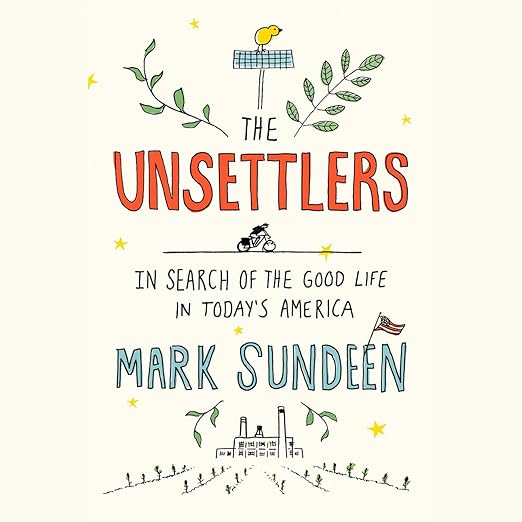
I came to this one on a gray Saturday morning when I had no plans and no obligations, which felt, in retrospect, like exactly the right conditions. There’s something about listening to Mark Sundeen narrate his own book while sitting in a centrally heated apartment surrounded by things you didn’t need to buy that sharpens the experience considerably. I kept pausing to look around at my own life. The question the book keeps asking is not whether these people are right, but whether you’ve ever seriously considered the possibility that they might be.
The Unsettlers follows three families across three geographies: a former opera singer and a marine biologist who buy a Missouri homestead sight unseen and arrive by bicycle in the middle of the night; a couple in Detroit who’ve turned to urban farming as a form of civic resurrection; and a veteran Montana couple who’ve been practicing organic farming for decades, quietly navigating what it means to raise a family with a genuine ethical code. Sundeen is their chronicler, not their cheerleader, and that distinction matters enormously.
Our Take on The Unsettlers
What sets this book apart from the small library of back-to-the-land narratives is Sundeen’s refusal to turn his subjects into saints or his readers into guilty spectators. He is honest about his own complicity in the system these families are fleeing, and that openness runs through every interview and every scene. One reviewer described his approach as having a raw, warts-and-all transparency, and I felt that throughout. There is no glossy sustainability manifesto here, just people working very hard at something they believe in and struggling with the contradictions that entails.
The book’s great insight, which several reviewers flagged, is that we are all hypocrites at some level. The person buying organic produce while idling a SUV. The activist who rails against petrochemicals while living with synthetic carpet. Sundeen doesn’t belabor this point because he doesn’t need to. The portraits do the work. And the three geographies give him enough variety to avoid any sense that he’s profiling a single subculture. The Detroit urban farming story in particular carries weight that the other two narratives can’t quite match, sitting as it does at the intersection of race, urban decline, and civic repair in ways the genre rarely touches.
Why Listen to The Unsettlers
Sundeen narrates his own book, and it’s the right call. He has a journalist’s measured delivery, no flourishes, no performance, which keeps the material grounded. This is not a book that wants to dazzle you; it wants to sit with you. His voice has an almost conversational ease that makes ten and a half hours feel far shorter. The production from Penguin Audio is clean and unfussy, which suits the subject perfectly.
The three-family structure gives the book a natural architecture. Each case study illuminates a different dimension of voluntary simplicity: the Missouri homesteaders grapple with isolation and purpose; the Detroit urban farmers engage with questions of race and civic repair in ways that feel genuinely original; the Montana couple wrestle with what it means to age inside a set of values that the wider world keeps ignoring. Sundeen moves between stories with enough editorial discipline that no thread outstays its welcome. He is especially strong on physical labor, on what it actually feels like to spend a day tending fields or repairing fences in bad weather, and that granularity prevents the book from becoming abstract, which is a real risk in writing about idealism.
What to Watch For in The Unsettlers
The book is positioned as journalism, but it carries real literary ambitions. Sundeen’s prose has a clarity that doesn’t announce itself. You simply find yourself noticing that the sentences are doing quiet, precise work. His writing about the relationship between belief and behavior is particularly thoughtful, and several passages about what it actually costs to live consistently with your convictions are among the most interesting nonfiction writing I’ve encountered in this space.
One honest caveat: if you come looking for answers or a blueprint for how to live, you won’t find one here. Sundeen is genuinely agnostic about whether any of his subjects have solved anything, and some readers may find that frustrating. The book asks better questions than it resolves. That’s a feature rather than a failure, but worth knowing before you begin. The Los Angeles Times called it an in-depth and compelling account, and that description captures both what it delivers and what it withholds. This is a work of documentation, not prescription.
Who Should Listen to The Unsettlers
This book will resonate strongly with readers who are already curious about sustainable living, localism, or the contradictions of modern consumption, but who are tired of the genre’s tendency toward self-congratulation. It will also reward listeners interested in American social history and the way idealism has persistently, if unevenly, found expression across this country. If you’ve ever looked at your own life and wondered what you’d have to give up to make it align with your values, this one will follow you around for days.
What strikes me most on reflection is that Sundeen wrote this book in a particular historical moment, before the pandemic-era wave of interest in self-sufficiency and off-grid living that followed. Reading it now, the families he profiles feel less like outliers and more like people who arrived at a conclusion that a much wider audience is currently, hesitantly, beginning to consider. That timeliness is not something the book manufactures. It earns it through the quality of its observation and the patience of its attention.
If you’re looking for a practical guide to homesteading or an inspirational story of triumphant simplicity, this isn’t the right fit. But if you want smart, clear-eyed company for a long walk through some genuinely hard questions, Sundeen is very good company indeed.
Frequently Asked Questions
Does Mark Sundeen narrating his own book affect the listening experience?
Positively. His journalist’s cadence gives the material an authority and intimacy that a professional narrator would struggle to replicate. He reads without ego, which matches the book’s tone exactly.
Do the three family stories feel connected, or does the book jump around too much?
The structure is well managed. Each family occupies its own thematic lane, covering purpose, community, and legacy, so the transitions feel purposeful rather than arbitrary. Most listeners find the interweaving keeps the narrative alive rather than fragmenting it.
Is this book politically slanted in a way that might alienate some listeners?
Sundeen deliberately avoids the ideological signaling common in sustainability writing. Multiple reviewers specifically noted how the book sidesteps coastal elitism and dogmatic environmentalism, making it genuinely accessible across political perspectives.
How does this compare to other back-to-the-land memoirs or homesteading narratives?
The Unsettlers is journalism, not memoir, and it’s more interested in documenting complexity than celebrating choices. It sits closer to Jon Krakauer’s immersive style than to the inspirational homesteading genre, making it a more rigorous but less comforting read.