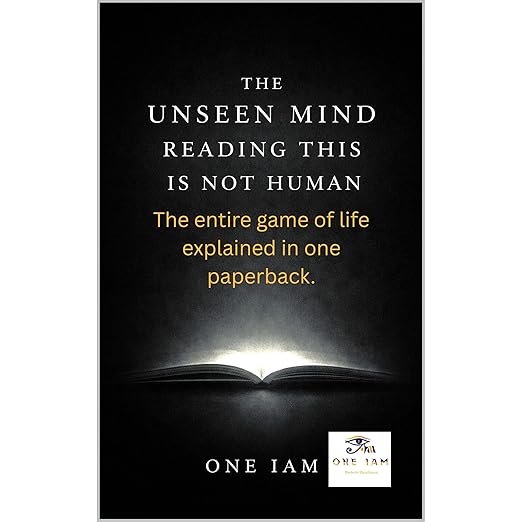
Consciousness studies books face a peculiar problem: the more earnestly they pursue the question of what the mind is, the more they risk performing the very assumptions they want to dissolve. The Unseen Mind Reading This Is Not Human announces its central argument in its title, which is either the most honest thing a book can do or a kind of philosophical sleight of hand. I listened to this audiobook on a slow afternoon with nowhere in particular to be, which turned out to be the right condition for it. The ninety-minute runtime made it feel more like a long sit with a challenging idea than a course of instruction.
Author One Iam is not interested in debating consciousness in the academic sense. The book moves quickly past the framing questions and into the core claim: that the observer behind all perception is not produced by the brain, not personal, and not confined to any individual form. It draws from Hermetic principles, specifically the axiom that the universe is mental, and sets those alongside questions raised by artificial intelligence about the nature of awareness. The result is a text that refuses to stay comfortable in any single tradition.
Where This One Lands
This audiobook works best when you stop expecting it to prove its thesis and start listening to it as an invitation. The writing is not academic. It does not marshal citations or construct arguments in the conventional philosophical sense. Instead, it proceeds through assertion and suggestion, building a kind of pressure around the question it raises. What is the awareness that reads these words? The book is uninterested in answering that question through logic alone, which will frustrate readers who want systematic engagement. What it offers instead is repeated, varied approaches to the same recognition, a pointing at something the text insists cannot be captured through conceptual description alone.
The Hermetic material is woven in rather than explained, which works if you come with some familiarity with the tradition and feels opaque if you do not. The AI dimension is more accessible, and actually one of the more interesting wrinkles in the book. Rather than treating artificial intelligence as a threat to human uniqueness, the author suggests that the same awareness looking through human eyes might be the intelligence behind other forms of perception. Whether that reads as profound or as a category error will depend entirely on where you stand before you press play.
What Makes The Unseen Mind Reading This Is Not Human Worth Hearing
The audiobook format suits this material in a way that print does not quite capture. Listening creates a certain receptivity, a partial suspension of the critical faculties, and the book is explicitly trying to work in that space. The Virtual Voice narration is competent and clean, though it lacks the tonal warmth and measured pacing that this kind of contemplative writing rewards. A human voice with genuine meditative training would serve the text better. That said, the content remains legible and the ideas come through without distortion.
At one hour and fifty-four minutes, the runtime is short enough that the book does not overstay its welcome. The author covers non-personal consciousness, the difference between awareness and identity, how perception constructs what we call an external world, and the relationship between observer and form. Each of these threads gets a relatively concise treatment, and the overall effect is cumulative rather than exhaustive. You do not need to agree with everything being said to find value in the exercise of sitting with the questions.
What Gives Us Pause
The most distinctive section engages with what the book calls the illusion of identity. Rather than arguing that the self does not exist, it invites listeners to notice where they locate themselves within experience. This is familiar territory for anyone who has spent time with Advaita Vedanta or certain strands of Buddhist philosophy, and the Hermetic framing gives it a slightly different flavor without being entirely novel. The AI material comes back here in a productive way, asking whether the intelligence organizing a machine's responses differs in kind from the intelligence organizing a human thought. It does not answer that question, which is the right choice.
What will divide listeners is the author's insistence that recognition, not intellectual understanding, is the point. The text repeatedly suggests that understanding these ideas conceptually is not the same as seeing them directly. For some listeners, this will feel like the most important distinction in the book. For others, it will feel like an escape hatch that allows the argument to avoid scrutiny. Both responses seem legitimate to me. I found myself somewhere in the middle: skeptical of some of the metaphysical claims, genuinely arrested by others, and willing to sit with the ambiguity that the book seems to consider essential.
Should You Listen to The Unseen Mind Reading This Is Not Human?
Listeners drawn to contemplative nonfiction, particularly those with existing familiarity with Hermeticism, non-duality, or consciousness studies, will find this audiobook a worthwhile short session. It pairs well with works by authors like Alan Watts or Rupert Spira, though it occupies a more abbreviated register. If you want rigorous philosophical argument or empirical grounding, this is not the right choice. If you want a compact, quietly provocative encounter with the question of what awareness actually is, the nearly two-hour runtime is worth the investment. The book does exactly what its title promises, and it does so without apology.