Key Details
- Narration: W. Jeff Williams self-narrates, which gives the stories about Arlington, the National Medal of Honor Museum, and COVID recovery a first-person authority that a third-party narrator could not replicate.
- Themes: Character-based leadership, collective purpose, community transformation
- Mood: Grounded and genuinely persuasive, with the confidence of someone who has done the work
- Verdict: A leadership audiobook that earns its arguments through specific, verifiable results rather than through abstraction or motivational posture.
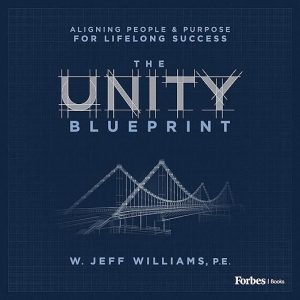
Picture a room where the discussion is not about authority or hierarchy but about whether the people around the table genuinely believe in the same outcome. That scenario, which most leadership writing treats as an aspirational abstraction, is where The Unity Blueprint by W. Jeff Williams begins. Williams draws from decades of leadership experience in Arlington, Texas, not as generic credential but as the source of specific stories, specific decisions, and specific outcomes that he uses to demonstrate what intentional unity actually looks like when it produces results in the real world. This audiobook, narrated by Williams himself, is grounded in a way that distinguishes it from most leadership writing aimed at organizational audiences, and the 7 hours and 23 minutes runtime reflects the genuine depth of the argument he is making.
The case studies are not hypothetical. Williams was directly involved in attracting the National Medal of Honor Museum to Arlington, in the transformation of the city's entertainment district, and in the process by which Arlington became one of the first American cities to recover from the economic impact of the COVID-19 pandemic. These are not anecdotes designed to illustrate pre-existing principles. They are the primary evidence from which the framework of The Unity Blueprint was built. That reversal of the typical leadership-book sequence, principles first and examples second, produces a different and more grounded reading experience than the genre usually offers. The principles feel earned rather than asserted because the reader encounters the evidence before the abstraction.
Williams's central argument is that the greatest organizational achievements do not depend on individual brilliance. They depend on the ability to unite people around shared purpose. That premise is not novel in leadership literature, but the treatment Williams gives it is more specific and more honest than most. He describes character-based leadership as distinct from authority-based leadership, and he uses the Arlington material to show what that distinction looks like in practice. When a city is trying to attract a major museum or anchor an entertainment district, the decisions that matter are not the ones made from the top of a hierarchy. They are the ones made through genuine relationships with diverse stakeholders who have different interests and different definitions of success, and who will not align behind a shared goal simply because someone in authority has declared it.
Reviewers consistently note two qualities in this book: that it feels real rather than theoretical, and that Williams's focus on authenticity and connection is not decorative but structural. One describes the stories as showing that great leadership often starts with listening. Another flags the emphasis on character, shared purpose, and truly valuing people as standing out from the management-strategy framing that dominates the genre. The 4.8 rating across 47 reviews is a smaller sample than the genre leaders, but the consistency of the response, with no significant outliers in the negative direction, points to a book that has connected strongly and honestly with the readers who have found it.
First-Person Testimony Outweighs a Hired Narrator
Williams narrating his own book is the most direct argument for the audiobook format here. The stories about Arlington, about the Medal of Honor Museum, about what it took to navigate COVID recovery ahead of peer cities, carry a different weight when delivered in the voice of the person who was in those rooms making those decisions. The emotional authority of first-person testimony is genuinely different from the authority of a professional narrator reading someone else's experiences, and leadership books that deal in civic and organizational transformation particularly benefit from that proximity to the source.
The seven-hour runtime is appropriate for the content depth. Williams is not padding; the book moves through the leadership framework systematically while returning consistently to the Arlington material as its grounding thread. The structure is coherent and the connection between the abstract principles and the concrete examples is always explicit rather than implied. Listeners who have found other leadership audiobooks frustrating because they could not see how the principles connected to real conditions will find Williams's approach genuinely different in this regard. The framework is always demonstrated before it is generalized, which is the right order for building the kind of practical understanding that actually changes behavior.
Civic Evidence Needs Translation for Corporate Readers
The book is grounded primarily in municipal and civic leadership contexts. Williams's examples are drawn from city government, large-scale community development, and institutional partnership building. Readers from corporate environments, nonprofit organizations, or team-level management roles will find the principles transferable, and Williams makes explicit efforts to generalize them, but the primary texture of the evidence is civic rather than corporate or entrepreneurial. Listeners who want case studies from technology companies, financial institutions, or small-business contexts will find the Arlington material useful but may need to do more translation work than readers already operating in civic or community leadership roles.
The opening question framing, what if your greatest achievements depended not on individual brilliance but on your ability to unite people, positions the book against a certain kind of individualist leadership mythology that remains dominant in much of the business literature. Williams is not subtle about this argument. Readers who are strongly invested in the individual-leader-as-hero narrative will find The Unity Blueprint a corrective read that challenges their assumptions with specific evidence. Those who come to it already skeptical of the hero-leader model will find Williams's argument well-supported and his evidence specific enough to be convincing across the full runtime.
The Author's Own Voice Delivers Lived Principles
Leaders in municipal government, civic organizations, and community development roles will find the Arlington case studies directly applicable to their work. Organizational leaders in any sector who are working with diverse stakeholders and trying to build genuine alignment rather than top-down compliance will find the character-based leadership framework useful and transferable. Readers who want leadership theory without concrete evidence will be underfed here. And anyone who wants a business audiobook where the author's own voice delivers the material with the authority of someone who has genuinely lived the principles they are describing, rather than assembled them from research and consulting experience, will find Williams's self-narration the right choice for this particular book and argument.