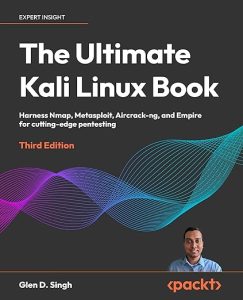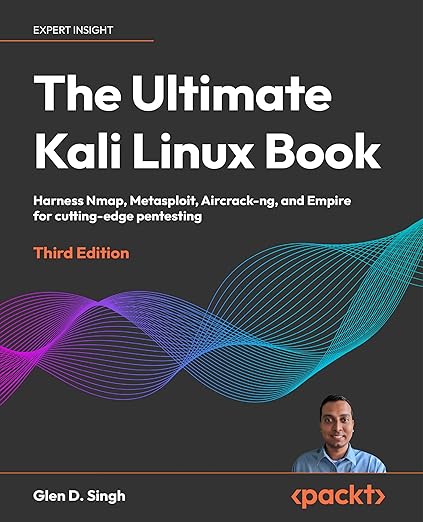
Cybersecurity training materials tend to do one of two things badly: they either stay so close to the conceptual surface that practitioners learn nothing actionable, or they dive so deep into command syntax that beginners lose the thread entirely. Glen D. Singh’s audiobook The Ultimate Kali Linux Book, now in its third edition, threads that needle with more success than most resources in the field. At nearly fourteen hours of audio, it is a serious commitment, but listeners who arrive with a genuine interest in penetration testing and ethical hacking will find that Singh has structured the material to work progressively, building from initial lab configuration through increasingly sophisticated attack and defense scenarios that reflect how real enterprise environments are actually compromised.
Singh’s approach is unapologetically practical. The book’s architecture mirrors an actual penetration test: passive reconnaissance, vulnerability assessment, network exploitation, post-exploitation, and finally Active Directory attacks and social engineering. Each chapter builds on the methods introduced in earlier ones, which means the audiobook rewards sequential listening rather than selective chapter access. The addition of a dedicated OSINT chapter in this third edition is timely; open-source intelligence gathering has become an increasingly important early-stage pentesting skill, and Singh’s treatment of it fits naturally into the book’s logical progression from passive to active reconnaissance.
New labs on web applications and social engineering round out an edition that feels substantially updated rather than cosmetically revised. One reviewer who worked through the book described the command explanation approach as particularly effective: Singh breaks down not just what each command does but what each individual flag within the command means, which reinforces genuine understanding rather than encouraging rote memorization of recipes. That instinct is exactly right for an educational text of this kind. The goal is to produce practitioners who can adapt their approach to novel situations, not technicians who can only execute steps they have already seen scripted out for them elsewhere.
Freeman's Measured Pacing Through Dense Command Syntax
Alex Freeman narrates with the measured competence the material demands. Technical narration of this kind is genuinely difficult to execute well: the reader must convey command syntax clearly enough that a listener following along in a lab environment can reconstruct what is being described, while maintaining enough pacing flow that the conceptual explanation around the command does not get buried. Freeman handles this balance adequately. He does not bring interpretive color to the material, but that is appropriate here; the book is a training resource first and a listening experience second, and the narration reflects that priority correctly.
The chapters on wireless penetration testing and advanced Active Directory attacks are among the most practically dense sections of the recording, and Freeman’s pacing in those sequences is careful enough to follow even when the material is technically intricate. The audiobook is accompanied by a DRM-free PDF version that includes the visual lab diagrams and network topology illustrations that the audio cannot reproduce on its own. Listeners should treat the PDF as a necessary companion rather than an optional supplement, particularly for the lab procedure chapters where spatial and visual relationships between systems matter to understanding what is actually happening during an attack sequence.
The PDF You Need Beside the Lab Chapters
The audiobook format creates real constraints for technical training content of this kind, and listeners should calibrate their expectations accordingly. The hands-on lab procedures are described verbally, which means you cannot simply follow the audio and execute commands in sequence without also having the PDF open for reference. The sections that work best in pure audio form are the conceptual framing chapters, such as the introduction to ethical hacking methodologies and the overview of what distinguishes authorized penetration testing from unauthorized intrusion, where Singh explains the attacker’s mindset and the professional and legal frameworks that surround this work.
These conceptual sections provide genuinely valuable context regardless of the listener’s experience level. The command-heavy chapters covering Nmap scanning, post-exploitation techniques, and Command and Control tactics require the visual companion to be fully productive as learning materials. Listeners who approach the audiobook as lecture content alongside an open lab environment, rather than as passive listening, will extract substantially more value from the fourteen hours than those who attempt to absorb it without active engagement. Singh’s stated target audience, students, trainers, cybersecurity professionals, and penetration testers, should each find material calibrated to their specific needs across the book’s breadth of coverage.
Course Material for Labs, Never a Commute
Singh explicitly targets this book at students, trainers, cybersecurity professionals, and penetration testers who want to develop or sharpen their Kali Linux skills. The book begins with no assumed knowledge of the platform and progresses to advanced techniques, which means it can serve both a first-time Kali Linux user and an experienced practitioner looking for a structured refresher on current enterprise network attack surfaces. Listeners preparing for certifications in ethical hacking will find the book’s progression well aligned with how those certifications structure their own assessment domains. This audiobook is not suited to passive listening during a commute or while doing something else. It is course material, and it functions best when the listener has a lab environment available and the PDF companion open. Those who want a high-level narrative introduction to cybersecurity rather than a hands-on training resource should look elsewhere, but anyone willing to engage with it as the technical training it is designed to be will find real value across its full fourteen hours.
The Short Version
- Read by: Alex Freeman handles the heavily technical material with competent clarity, though the command-line syntax sections work best with the PDF companion open alongside.
- At its heart: Ethical hacking methodology, penetration testing workflows, Active Directory and wireless vulnerabilities
- Vibe: Methodical and hands-on, structured like a lab course rather than a narrative
- Short version: Glen D. Singh’s audiobook is a serious training resource for cybersecurity students and professionals who want a structured pathway from Kali Linux basics to enterprise-grade pentesting.
Good to Know
Is this audiobook suitable for someone who has never used Kali Linux before?
Yes. Singh explicitly states that no prior knowledge of Kali Linux is required, and the book begins with installation and environment configuration before progressing to reconnaissance and exploitation techniques. The progression is deliberate and designed to build confidence and competence incrementally.
How does the third edition of this audiobook differ from earlier versions?
The third edition adds a full OSINT chapter on open-source intelligence gathering, new labs on web application security and social engineering, and revised lab-building procedures that are easier to follow. The underlying structure remains the same, but the new content reflects current enterprise attack surfaces more accurately than previous editions.
Can someone use this audiobook to prepare for ethical hacking certifications?
The content aligns well with major ethical hacking certification syllabi, covering reconnaissance, vulnerability assessment, network exploitation, Active Directory attacks, and social engineering in a structured sequence. Listeners should supplement the audio with hands-on lab practice rather than relying on the recording alone.