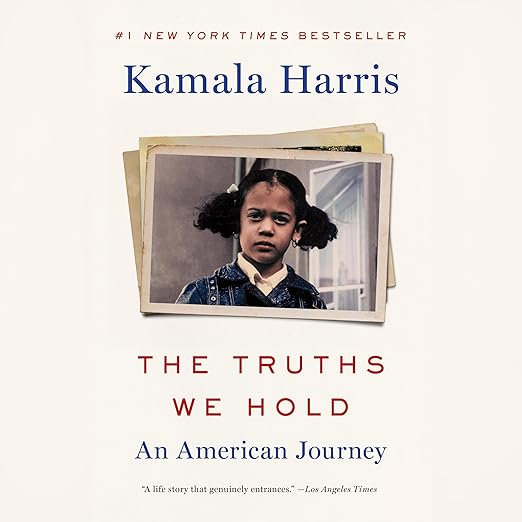
When Kamala Harris was 12 years old, her mother Shyamala moved the family to Montreal, where Kamala attended a French-language school and learned to navigate a new city in a second language. This detail, which surfaces in the audiobook's early chapters, captures something essential about Harris as a subject: her biography is consistently more surprising, more specific, and more complicated than the standard political memoir tends to allow. Narrator Robin Miles handles the material with clarity and warmth, a voice that suits the memoir's register of personal reckoning without veering into hagiography.
What We Made of It
Harris wrote this book in 2019, at the beginning of her presidential campaign, and it carries the particular ambitions of that moment: a statement of values, a biographical foundation for political argument, a vision of what shared purpose might look like in a fractured national moment. What distinguishes it from many political memoirs is the specificity of its personal narrative. Harris writes about being raised in Oakland in a community organized around social justice with genuine precision, not as a backdrop for political argument but as the actual substance of her formation.
Her mother Shyamala, a breast cancer researcher and civil rights activist who emigrated from India, is the book's moral center. Harris writes about her with a clarity that suggests she has spent considerable time thinking about how her mother's values became her own. The intersection of Tamil Indian immigrant identity with the African American civil rights tradition in which Harris was raised is handled with more nuance than the campaign context might suggest.
Robin Miles's narration is an asset here. She reads with a steadiness that matches Harris's own public register: direct, measured, not particularly oratorical. This is a memoir that makes its argument by accumulation rather than rhetoric, and Miles's pacing supports that structural approach. She does not perform emotion she does not earn through the text.
The Best Parts of The Truths We Hold
The book is organized around a series of values and policy areas that Harris believes define the challenges facing American society: economic justice, healthcare, immigration, public safety. Each section roots the policy argument in personal experience or specific cases from Harris's prosecutorial career. This structure is more effective than it sounds: the move from personal narrative to policy argument feels earned rather than grafted.
One reviewer noted it was 'full of surprises,' specifically citing the Canada chapter and French schooling as examples of biographical material that did not match their assumptions. That observation reflects the book's general quality: Harris's biography genuinely does not follow the expected arc of an American political memoir, and the surprise of specific details is part of what makes the book worth the listening time.
The audiobook format serves this material well. At nine-plus hours, it is appropriately concise for a political memoir, and Miles's narration keeps the material moving through the policy sections that might otherwise drag in print. The personal chapters, particularly those dealing with Harris's early career as a prosecutor and her evolving understanding of the criminal justice system, are the strongest in the book.
What Might Not Land
This is a campaign memoir, written at a specific political moment with specific political purposes, and readers should engage with it as such. Harris's account of her prosecutorial record is self-presenting in the way such memoirs always are; critics of her record as District Attorney and Attorney General of California will find that the book does not substantially address those critiques. This is not surprising, but it is worth noting.
The book's vision of shared struggle and shared values is explicitly aspirational, and some listeners will find the optimism of its framing unsupported by the political climate in which they are reading it. Harris writes as if collective good faith is possible and proximate, which was a debatable proposition when the book was published and has become a more contested one since.
The Canada and French-language school material deserves mention as genuine biographical texture. Harris's account of navigating that transition at 12, of speaking French in a new country while maintaining the identities her Oakland upbringing had given her, is one of the book's more unexpected and humanizing passages.
Who Should Listen to The Truths We Hold
Readers seeking a primary-source account of Kamala Harris's formation, values, and political philosophy will find more genuine biographical material here than in most secondary accounts of her career. The book is well-suited to listeners who want to understand how she thinks, in her own words, about justice, family, and public service.
Listeners who are already formed in their opinions about Harris's political record will find confirmation or frustration in proportion to those existing views. But as a listening experience, Robin Miles's narration makes this audiobook genuinely engaging even for listeners without a prior investment in Harris as a subject. The personal narrative sections are strong enough to stand independently of the political argument.
Young readers and students interested in American political biography will find Harris a useful subject precisely because her background does not follow familiar patterns. The combination of immigrant family identity, civil rights community formation, and prosecutorial career gives her a more complicated origin story than most political figures offer, and Miles narrates the complexity with patient clarity. The audiobook is also a reasonable entry point for non-American listeners who want a first-person account of how American progressive politics is formed at the community and family level, rather than through the abstract policy frameworks that dominate most political coverage. Harris writes about values as things that are transmitted through specific people and specific communities, and that makes the book more accessible across contexts than a standard political memoir tends to be.
Is this audiobook suitable for listeners who are already skeptical of Kamala Harris's record?
The book is self-presenting, as all political memoirs are, and it does not substantially address critiques of her prosecutorial record as District Attorney or Attorney General. Listeners with strong prior opinions will find confirmation or frustration in proportion to those views. The personal narrative sections, however, offer biographical texture not available in most secondary accounts.
What biographical details in the audiobook were most surprising to listeners?
The Canada chapter generated the most surprised responses. At 12, Harris moved to Montreal with her mother and attended a French-language school. Reviewers specifically cited this as biographical material that did not match their assumptions about her background. Her account of navigating that transition while maintaining her Oakland-formed identity is one of the book's more humanizing passages.