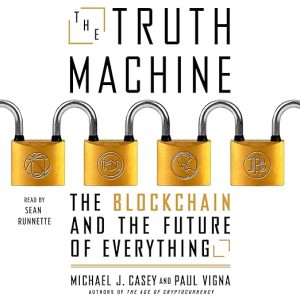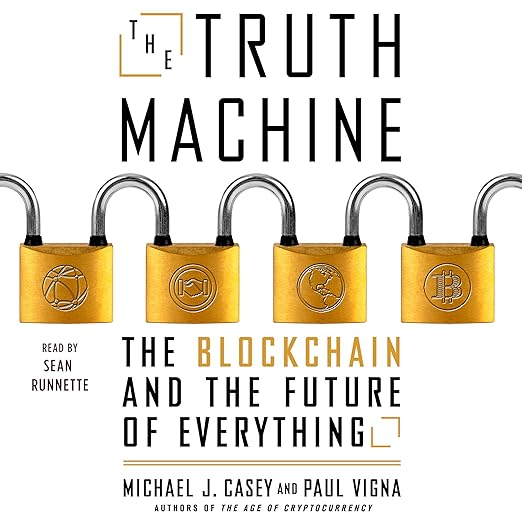
Lawrence H. Summers rarely lends his name to a book blurb, and his line calling this 'the best book so far' on blockchain technology opens the case for why The Truth Machine still matters as an audiobook years after its early crypto-hype moment passed. Michael J. Casey and Paul Vigna, the same duo behind The Age of Cryptocurrency, wrote this as their follow-up examination of blockchain's broader promise beyond Bitcoin specifically: restoring personal control over data and identity, extending economic access to billions of currently excluded people, and disrupting entrenched middlemen across finance, law, and shipping. The title itself names the book's central claim directly: blockchain as a truth machine, a system that establishes verified fact and consensus without requiring a trusted central authority to vouch for it. That framing positions the technology in almost philosophical terms, less about currency speculation and more about the basic problem of how any society agrees on a shared, trustworthy record of what actually happened.
Preserved Like a Snapshot of 2018
Casey and Vigna's core argument treats blockchain as a new kind of operating system for trust itself, one designed to replace institutions society has relied on for centuries, banks, legal intermediaries, credit systems, with a model that doesn't require trusting any single central party. They're careful, per the book's own framing, to maintain a balanced perspective throughout, weighing genuine disruption potential against real costs: job losses, the assertion of new special interests, and threats to existing social cohesion that this kind of structural shift would create. Reviewer Gary Moreau, himself an author, frames the book as a serious primer 'written by two experienced financial journalists with a ringside seat,' distinct from purely technical or purely promotional crypto writing. Casey and Vigna both built their careers as mainstream financial journalists before turning to blockchain-focused writing together, and that background shows in how the book handles skepticism: it treats blockchain's more utopian promises with the same scrutiny a beat reporter would apply to any industry insider's claims, rather than writing as embedded advocates for the technology.
Reviewer John Morton adds a useful framing for anyone approaching this book now: it offers 'a snapshot of the world as it was in 2018,' preserved with real specificity. That dating matters less as a flaw than as context; Morton calls it 'good to preserve history as it was written in the moment,' which is exactly how this book now functions for listeners revisiting blockchain's earlier promise years later.
Runnette Balances Technical Detail and Political Stakes
Sean Runnette narrates with the journalistic pacing this material needs, moving comfortably between dense technical explanation and the political-economy argument running underneath it. That dual register is a real skill: Casey and Vigna aren't just explaining how blockchains work technically, they're making a case about power, trust, and institutional legitimacy, and Runnette handles both registers without letting either one flatten the other. Across ten hours and twenty-four minutes, that consistency keeps genuinely dense material, distributed ledgers, smart contracts, decentralization, from ever becoming a monotone technical lecture, which is exactly the risk a book this conceptually dense runs with a less versatile narrator. The book's structure moves deliberately from technical explanation toward broader economic and political implication, a sequencing choice that front-loads the material listeners need to follow the higher-stakes argument coming later, rather than assuming prior blockchain literacy from the very first chapter. Casey and Vigna's willingness to name specific real-world pilot projects and early institutional experiments, rather than speaking only in hypotheticals, gives the more speculative later chapters a grounding that purely theoretical blockchain writing from the same period often lacked. That grounding is part of why the book aged into a useful historical document rather than pure hype-cycle ephemera: even a reader skeptical of blockchain's more utopian claims can extract real value from how carefully the authors document what was actually being built, tested, and funded at the time of writing. The disruption case studies Casey and Vigna build out for shipping and legal industries specifically are worth highlighting, since most popular blockchain writing fixates almost entirely on finance; walking through how a distributed ledger could replace the mountain of paper documentation currently required to move a shipping container across international borders makes the technology's non-financial potential considerably more concrete than abstract talk of decentralization usually manages.
Reviewer Real Happy captures the book's more provocative claims directly, quoting its warning about 'the biggest employment shakeup the world has ever seen' as blockchain-driven disruption spreads. That kind of high-stakes framing, balanced against the authors' own stated attempt at evenhandedness, gives the audiobook real narrative tension: it's simultaneously optimistic about blockchain's potential and honest about what widespread adoption would actually cost specific workers and industries. Reviewer Gary Moreau notes this functions as a direct sequel in argument to The Age of Cryptocurrency, Casey and Vigna's earlier book focused more narrowly on Bitcoin itself; listeners who enjoyed that earlier work will recognize the same careful, journalist's instinct for separating genuine signal from speculative noise, applied here to blockchain's wider applications beyond currency alone.
Ten Hours That Assume You Know the Jargon
Written in the thick of the 2017 to 2018 blockchain and cryptocurrency boom, some of this book's specific predictions and named examples will feel dated to a listener arriving with current knowledge of how the technology actually developed since. The structural critique of legacy financial systems, and the underlying case for why trust-minimizing technology matters, ages considerably better than any specific forecast about timelines or particular companies. Reviewer John Morton also flags that the book carries real 'societal and political commentary' beyond pure technical explanation, so listeners expecting a narrowly technical engineering guide should know this is closer to argument-driven journalism than a how-blockchains-work manual.
At just over ten hours, this covers a lot of conceptual ground efficiently without becoming exhausting, though listeners entirely new to blockchain basics may want a lighter introductory resource first. The book assumes some baseline familiarity with terms like distributed ledger and smart contract before building its larger argument on top of them.
Historical Context, Not Current Market Analysis
Listeners curious about blockchain's actual structural promise beyond Bitcoin price speculation, fans of The Age of Cryptocurrency, and readers who enjoy accessible tech-economics journalism will get real value from this audiobook. It's also useful for anyone wanting historical context on how seriously credentialed economists and journalists were thinking about this technology during its first major hype cycle.
Skip it if you want cutting-edge, current analysis of blockchain and cryptocurrency markets, since this is now a historical snapshot rather than an up-to-date guide. Listeners wanting a narrowly technical engineering manual for building on blockchain infrastructure should also look elsewhere, since this book is written for a general audience interested in economic and political implications.
Common Questions
Is The Truth Machine audiobook still relevant given how much blockchain has changed since 2018?
Partly. Specific predictions and named examples feel dated, but the structural critique of legacy financial systems ages better and still holds real value.
How does Sean Runnette's narration handle the technical material in this audiobook?
He moves comfortably between dense technical explanation and political-economy argument, keeping both registers clear across the ten-hour runtime.