At a Glance
- Subjects: Workplace gaslighting, office politics and hidden power dynamics, career sabotage, protecting a professional reputation.
- Tone: Clinical, brisk, and deliberately unsentimental.
- Bottom line: A ninety-seven-minute vocabulary lesson for somebody who suspects what is happening to them, with no listener feedback of any kind to check it against.
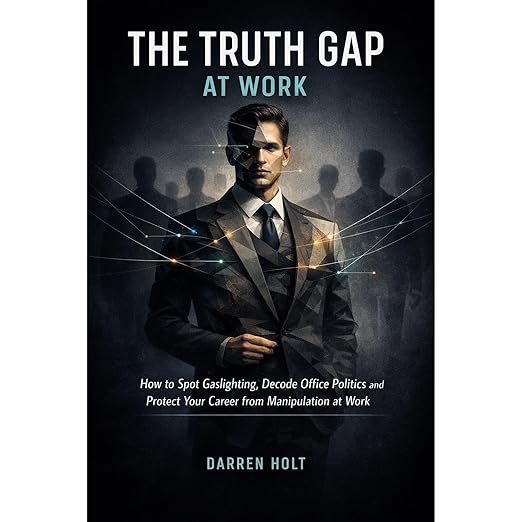
Corporate gaslighting has become a shelf category of its own, and this audiobook is a compact entry in it: one hour and thirty-seven minutes on recognizing manipulation at work, published independently in March 2026. Darren Holt starts from a reasonable premise. Something at work feels off, feedback keeps changing direction, a manager rewrites what happened in a meeting, and none of it is provable. The book proposes to hand that experience a vocabulary, which is a modest goal and a genuinely useful one.
The Pause Before an Answer Has No Machine Equivalent
Where a performer would normally be named, this record carries Virtual Voice. A machine supplies the reading rather than a person, and that belongs at the top of any honest assessment because it changes what the product can do. Nothing follows from it about the writing; plenty of worthwhile text reaches audio this way, particularly from independent authors working without a production budget. What does follow is a limit on the one material this particular subject is made of.
Consider what the book is about. Feedback that quietly reverses, a colleague undermining you in a meeting, a manager narrating events differently afterward: none of that lives in the words. It lives in the pause before an answer, the stress on one syllable, the pleasant tone doing unpleasant work. A guide teaching people to hear the gap between what is said and what is meant, delivered by a system with no intentions to encode, has to ask listeners to take the diagnosis on trust rather than demonstrating a single example of it.
Knowing the Pattern Has a Name Is the Point
Arithmetic is the honest way to judge this one. Ninety-seven minutes has to cover ten stated outcomes, running from spotting gaslighting to decoding power dynamics to building a network of allies and mentors. Under ten minutes each. Nobody masters assertive communication in high-conflict situations in ten minutes and the description does not quite claim they will, since its verbs throughout are recognize, understand and decode. Judged as an orientation rather than a course, the runtime stops being a weakness. Ninety-seven minutes also fits into one sitting, which is very likely how the material was designed to be taken.
What a short book of this kind does well is name things. Somebody two years into a job where the performance reviews keep contradicting each other does not need a framework; they need to know the pattern has a name, that other people have documented it, and that the appropriate response is strategic rather than emotional. The description makes exactly that its central promise, which is the most defensible promise available at this length. Naming the behavior stops a person concluding the problem is them.
The stated boundary deserves credit too. The copy says outright that this is not about becoming manipulative yourself, that the aim is awareness and professional protection, and that a reader should be able to read office politics without turning cynical or aggressive. Books in this niche slide with depressing regularity into a how-to for the darker version. Declining that in the description is a small ethical decision, and for a buyer choosing between a dozen near-identical titles it signals the register inside.
Never Mentions the Audio Edition At All
Five months after publication this record is completely empty. Star field, rating counter and response column all sit blank, with nothing filed since March 14, 2026. That is not a verdict, since independent business titles routinely go a year without a comment, but it leaves a buyer with no external check of any kind: no confirmation that the ninety-seven minutes are structured, that the examples are concrete, or that a machine reading stays listenable across a full sitting.
The description never once acknowledges what it is selling. Inside this book you will learn, it says. It addresses readers, promises clear explanations and practical workplace strategies, and mentions the audio edition nowhere at all. On a synthetic reading of a title advertising ten distinct skills, a buyer would reasonably want to know whether the file is chaptered, whether those ten outcomes map onto sections, and whether anything can be bookmarked. The page answers none of it, and the column holds nobody to ask.
Filing is the third thing to weigh. Business and careers is right. Health and wellness is the second category on this record, and it shifts the promise: a book about gaslighting sitting in wellness implies emotional recovery, while this copy is about detection and career protection, reputations, opportunities and decisions made about you when you are not in the room. Anybody arriving from wellness hoping to feel better will find the register colder than expected, and the colder framing is the accurate one. Career Success, the single tag on the record, at least points the right way.
Anybody Needing a Human Voice Should Sample First
Employees currently inside a bad situation are the intended buyers, particularly at the early stage where the evidence is all atmosphere: feedback that changed direction, a meeting that felt wrong afterward, a colleague whose helpfulness carries an edge. Ninety-seven minutes is a small enough outlay for somebody who mainly wants confirmation they are not imagining it. New managers get real value as well, since half the behaviors described are things a person can do without intending any of it.
Readers wanting case studies, scripts or a documented method should buy something longer and edited, because this length cannot deliver depth across ten separate outcomes. Anybody who needs a human voice for material about human behavior should sample the opening minutes, since a synthetic reading is all this record offers and no listener has yet reported on how it holds up. Approached as a first vocabulary rather than as a plan, the ninety-seven minutes are honestly priced.
Frequently Asked Questions
Who reads The Truth Gap at Work audiobook?
Nobody is credited as a performer. The narrator field carries Virtual Voice, which indicates a synthetic reading rather than a human one, and no other name appears on the record. The runtime is one hour and thirty-seven minutes. Anyone whose concentration suffers with machine narration should try the opening minutes before buying.
Is ninety-seven minutes enough to cover ten different skills?
Not to master them. The description lists ten outcomes, from recognizing gaslighting to building a network of allies, which works out to under ten minutes apiece. What that length can realistically deliver is recognition and vocabulary: names for the behaviors, and a sense of which ones are happening to you right now.
Does the audiobook teach you to manipulate people back?
No, and the copy is unusually direct about it. The book positions itself as awareness, professionalism and career protection rather than counter-manipulation, and specifically warns against becoming cynical or aggressive in response. The emphasis falls on interpreting situations accurately and responding strategically instead of reacting in the moment.
What workplace situations does it actually describe?
Feedback that suddenly changes direction, a colleague undermining your work in meetings, a manager rewriting the narrative of what happened, career sabotage aimed at your reputation, and toxic leadership generally. The framing is about hidden dynamics rather than open conflict, which is why the description keeps stressing patterns in communication over single incidents.