The Short Version
- Voice: Nolan Chase delivers a composed, measured read that keeps the conspiratorial claims sounding credible to sympathetic listeners, though the tone lacks critical distance.
- Big ideas: pandemic skepticism, pharmaceutical industry critique, civil liberties and government overreach
- Atmosphere: Urgent and combative, with a preacher-at-the-pulpit energy throughout
- Worth it?: A document of a specific moment in pandemic-era distrust rather than a work of rigorous public health journalism, approach with eyes open.
I remember when this book landed on my radar back in spring 2021. A colleague forwarded me the link with no comment, just a raised-eyebrow emoji. I spent about an hour with Nolan Chase's narration while doing something mindless around the house, and by the time I came out the other side, I had a lot of thoughts, none of them quite what the authors intended.
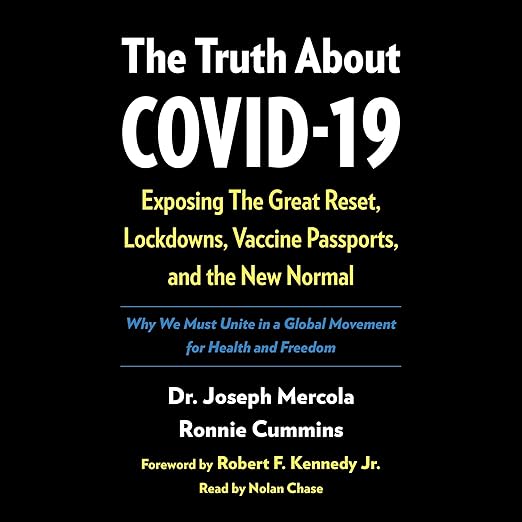
The Truth About COVID-19 is a USA Today bestseller co-authored by Dr. Joseph Mercola, a longtime figure in the alternative health world, and Ronnie Cummins, founder of the Organic Consumers Association. Their argument is sweeping: the SARS-CoV-2 virus was engineered in a bioweapons lab in Wuhan; global elites used the pandemic to engineer the largest upward wealth transfer in history; PCR testing, case counts, and vaccine safety data were systematically manipulated; and safe, inexpensive treatments were suppressed to clear the path for vaccine rollout. That is the scope they are attempting. It is worth knowing what you are getting into.
A Closer Look at The Truth About Covid-19
What Mercola and Cummins have assembled here is less an exercise in investigative reporting than a confident recitation of a worldview. The writing is accessible, even punchy at times, and Nolan Chase reads it with calm authority, which does contribute to the sensation of listening to something factual. The book moves quickly through its claims: lab leak hypothesis, lockdown economic damage, media capture via philanthropic funding, junk food industry complicity in worsening outcomes. Each of these topics has been debated seriously by researchers and journalists. The problem is that the book treats the most contested interpretations as settled conclusions, presenting hypothesis as established fact with little acknowledgment of counterevidence.
The sections on obesity, diabetes, and metabolic health are arguably the most grounded portion of the book. The argument that chronic illness worsened COVID-19 outcomes, and that this connection was underemphasized in public health messaging, is a fair critique that has been echoed by mainstream epidemiologists. But even here, the authors pivot quickly into sweeping claims about industry capture that outrun the evidence they provide.
What Makes The Truth About Covid-19 Worth Hearing
If your goal is to understand what a significant segment of the American public believed during the pandemic, and why those beliefs felt compelling to so many people, this audiobook is genuinely useful. Reviewers describe it as containing more information than they expected, covering not just COVID-19 but the broader healthcare system and nutritional politics. One listener from Spain found it valuable for its examination of the interdependence between pharmaceutical companies, media outlets, and government agencies. That structural critique, stripped of its most extreme claims, touches on real tensions in how public health information is communicated and funded.
The format also works reasonably well as audio. At under eight hours, it does not overstay its welcome, and Chase maintains a clear, unhurried pace. Listeners who already operate within this worldview will find it validating and comprehensively documented with citations that are included in the companion PDF.
Things to Know Before Starting The Truth About Covid-19
The review ecosystem around this title is instructive. Multiple five-star reviews comment on deleted or suppressed reviews, framing that absence as evidence of censorship. One reviewer explicitly notes he does not address the book's actual claims but instead argues that attempted suppression proves the book's thesis. This is a pattern worth recognizing: when a book's reception becomes evidence for the book's argument, independent evaluation becomes very difficult.
Listeners coming from outside the alternative health ecosystem should know that Mercola has been the subject of regulatory action from the FDA and FTC regarding health product claims over many years. That context does not automatically invalidate everything in this book, but it is relevant background for evaluating the credibility of a source who positions himself as a truth-teller suppressed by medical authorities.
Who Dr. Joseph Mercola Is Writing For
This is a document of pandemic-era dissent, and it works best as such. If you study media ecosystems, misinformation dynamics, or the sociology of health skepticism, it offers primary source material. If you are already within the alternative health information world and found Mercola's work credible before, the audiobook will feel thorough and well-organized. If you are looking for rigorous, peer-reviewed analysis of pandemic policy failures, and there is genuinely good critical journalism in that space, this is not the place to start. The combative framing will confirm readers already persuaded, and will likely frustrate those who are not.